

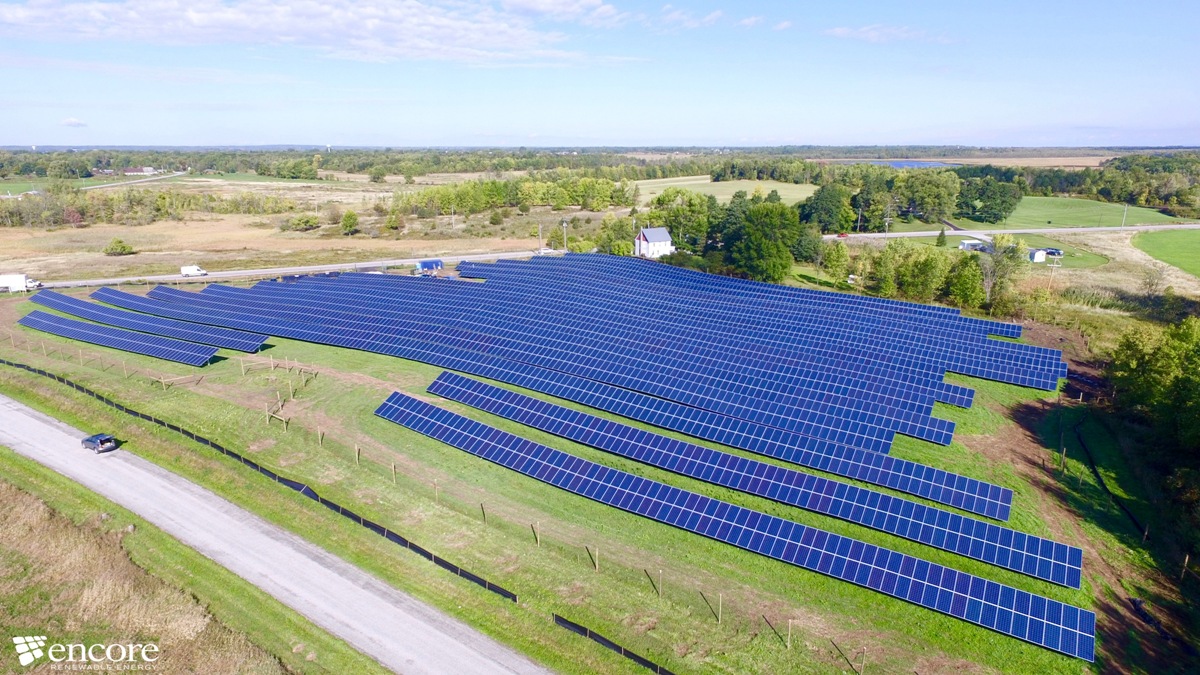
VEC's Alburgh solar field. New England has about 2,000 MW (nameplate capacity) of behind-the-meter solar facilities installed. VEC photo.
Vermont Business Magazine New England is expected to have enough energy to meet consumer demand for electricity this summer, according to ISO New England Inc, but margins will be tighter as about 2,200 megawatts of power will not be available due to either delays or plant retirements. Tight supply margins could develop if forecasted peak system conditions occur. If this happens, ISONE said it will take steps to manage New England’s electricity supply and demand in real time and maintain power system reliability. However, ISONE estimates that current supply will still be well ahead of the historic peak load hit during the summer of 2006.
ISONE is the operator of the region’s bulk power system and wholesale electricity markets.
ISO New England prepares short-term forecasts for summer and winter seasons, taking into account estimated amounts for all resources, including those with and without an obligation through the capacity market to supply electricity; unplanned resource outages; imports from neighboring regions; resource retirements; and any delays in the commissioning of new resources. These estimates help inform ISO New England’s planning on how to operate the grid during the upcoming peak season. Because up to 700 megawatts (MW) of expected new resources are delayed and may not be available this summer, forecast estimates indicate the possibility of a tighter-than-expected margin of supply and reserves.
“ISO New England system operators strive to manage the region’s power system reliably despite multiple uncertainties and unexpected challenges,” said Vamsi Chadalavada, executive vice president and chief operating officer of ISO New England. “The ISO is prepared for the possibility of tight supply conditions this summer. Our system operators will take the appropriate steps to maintain reliability if consumer demand outpaces supply.” If these peak summer conditions happen and there is a supply deficit, ISO New England could obtain additional electricity supplies from neighboring regions and implement operating procedures that help keep the grid in balance during such deficiencies.
2017 summer peak demand forecast
This summer, under normal weather of about 90 degrees Fahrenheit (°F), electricity demand is forecasted to peak at 26,482MW. Extreme summer weather, such as an extended heat wave of about 94°F, could push demand up to 28,865 MW. These forecasts incorporate the demand-reducing effects of energy-efficiency (EE) measures acquired through the Forward Capacity Market and behind-the-meter photovoltaic (BTM PV) installations. Approximately 2,000 MW (nameplate capacity) of behind-the-meter solar facilities are currently installed throughout New England.
New England employs a variety of resources to meet consumer demand for power: generators that produce electricity, such as natural gas, nuclear, oil, coal, hydro, biomass, and wind; demand-response resources that can be activated to reduce their energy use; and power imported into New England from New York and Canada. On May 31, Brayton Point station, a 1,500 MW coal and oil power station located in Massachusetts, will retire; this amount was factored into the forecast estimates. This summer, New England has approximately 29,400 MW of total capacity available.
Last summer, demand for power peaked on August 12, 2016, at 25,466 MW. The all-time record for peak demand was set on August 2, 2006, when demand reached 28,130 MW after a prolonged heat wave. Consumer demand for electricity is highest in New England during the summer because of air conditioning use.
Operating procedures to maintain reliability
ISO New England has well-established operating procedures to maintain grid reliability in the event of an unexpected power plant or transmission line outage, an extended heat wave that results in increased consumer demand, fuel supply issues that affect the amount of electric generation available, or a combination of these factors. These procedures include calling on demand-response resources to curtail their energy use, importing emergency power from neighboring regions, utilizing the reserve margin, and asking businesses and residents to voluntarily conserve energy.
Holyoke, MA—April 26, 2017—ISO New England