

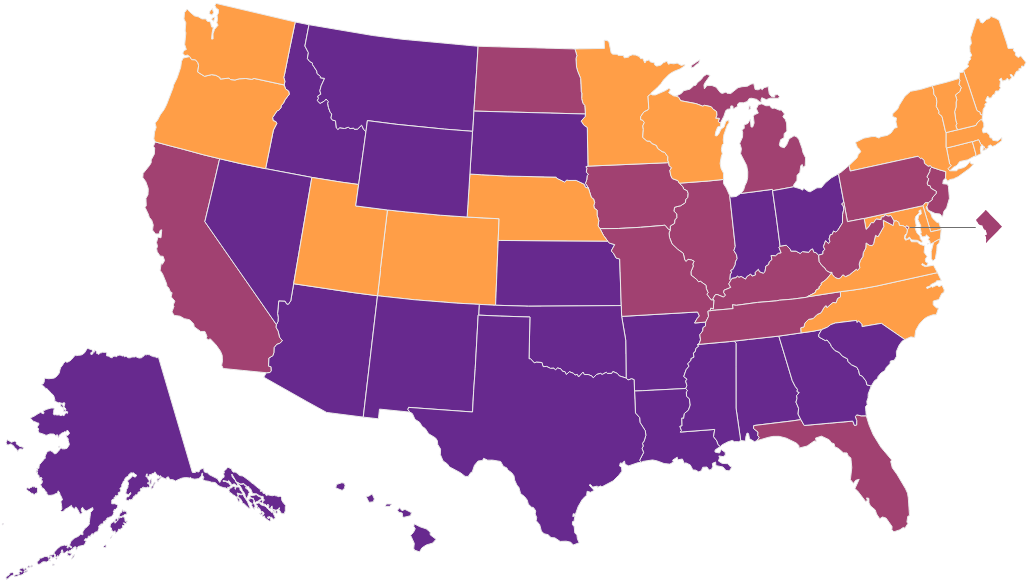

Health preparedness by state map April 2017. Source: Robert Wood JohnsonFoundation
Vermont Business Magazine For the second year running, Vermont scored highest among the 50 states and District of Columbia in public health protection readiness, according to the new National Health Security Preparedness Index. The Index measures the nation's ability to keep people safe and healthy in the event of epidemics, foodborne disease outbreaks, terrorism and other large-scale public health emergencies. Overall, Vermont scored 7.8 out of 10 points, compared to the national average of 6.8.
States were rated on 139 measures from multiple data sources. Vermont was rated higher than the national average in five of six index domains and matched the national average in the other. The index results are not intended for ranking states, according to the report, because states face varying threats and should apply common preparedness principles in locally relevant ways.
The Index tracks the nation’s progress in preparing for, responding to, and recovering from disasters, disease outbreaks and other emergencies that pose risks to health and well-being. Because health security is a responsibility shared by many different stakeholders in government and society, the Index combines measures from more than 50 sources and multiple perspectives to offer a broad view of preparedness.
The Index is issued by the Robert Woods Johnson Foundation in cooperation with the Association of State and Territorial Health Officials (ASTHO). The report shows strengths and challenges over time in health surveillance, incident and information management, countermeasure management, community planning and engagement, surge management, and Emergency Medical Services.
"The Health Department is working every day to protect and promote the health of Vermonters. Our strength as a state has been our ongoing planning and readiness to respond to public health threats in coordination with communities and key partners," said Health Commissioner Mark Levine, MD.
Vermont's strengths include health surveillance and epidemiological investigations, incident management and multi-agency coordination, and its focus on health promotion for children and other at-risk populations. Vermont also scored well in medical management, distribution and dispensing of medications, which was a key element of last year's statewide emergency response exercise, Operation Vigilant Guard.
Vermont has been actively working on making gains in the area of volunteer management, where the state scored 3.3 compared to a national average of 3.9, the state's OnCall for Vermont is reaching more Vermonters than ever in an effort to recruit people with medical and non-medical backgrounds to join a Medical Reserve Corps unit (MRC) or to become an EMS provider. One such MRC volunteer has just received national recognition for her service. Deborah Carlson of St. Albans, a volunteer with the Northwest Vermont MRC, is one of two individuals out of 200,000 to be selected as National Outstanding MRC Public Health Volunteer.
VERMONT STATE DOMAIN SCORESnhspi.org/states/vermont
Health Security Surveillance
010
NATIONAL CONFIDENCE INTERVAL: 7.7 - 8.1
Community Planning & Engagement
010
NATIONAL CONFIDENCE INTERVAL: 5.4 - 6.1
Incident & Information Management
010
NATIONAL CONFIDENCE INTERVAL: 7.9 - 8.4
Healthcare Delivery
010
NATIONAL CONFIDENCE INTERVAL: 4.9 - 5.6
Countermeasure Management
010
NATIONAL CONFIDENCE INTERVAL: 6.8 - 7.2
Environmental & Occupational Health
010
NATIONAL CONFIDENCE INTERVAL: 6.4 - 7.5
An annual assessment of the nation’s day-to-day preparedness for managing community health emergencies improved slightly over the last year—though deep regional inequities remain. The Robert Wood Johnson Foundation (RWJF) released the results of the 2017 National Health Security Preparedness Index, which found the United States scored a 6.8 on a 10-point scale for preparedness—a 1.5 percent improvement over the last year, and a 6.3 percent improvement since the Index began four years ago.
The Preparedness Index analyzes measures such as hazard planning in public schools, monitoring food and water safety, wireless 9-1-1 capabilities, flu vaccination rates, and numbers of paramedics and hospitals—to calculate a composite score that provides the most comprehensive picture of health security and preparedness available.
“Improving health security and preparedness is important for all communities across the country. In our highly mobile country, national emergency preparedness depends on having high levels of protection in every state, city, and region,” said Alonzo Plough, PhD, MPH, chief science officer and a vice president at RWJF. “These data highlight where strengths and gaps in preparedness lie, and can inform approaches to improve health security throughout America.”
Despite improvements in nearly two-thirds of states, significant inequities in preparedness exist across the nation: a gap of 32 percent separates the highest state (Vermont, 7.8) and the lowest state (Alaska, 5.9). Generally, states in the Deep South and Mountain West regions—many of which face elevated risks of disasters and contain disproportionate numbers of low-income residents—lag behind Northeast and Pacific Coast states.
“Equal protection remains an elusive goal in health security, as rural and low-resource regions have fewer and weaker protections in place,” said Glen Mays, PhD, MPH, who leads a team of researchers at the University of Kentucky in developing the Index. “Closing the gaps in preparedness among states and regions remains a national priority.”
Eighteen states achieved preparedness levels that significantly exceed the national average in 2016, and 20 states are significantly below the national average. A total of 33 states increased their overall preparedness levels between 2015 and 2016, while 14 remained level and four states declined.
“Health security and preparedness have wide-ranging impact in our communities,” said Stephen C. Redd, MD, RADM, director of the U.S. Centers for Disease Control and Prevention (CDC’s) Office of Public Health Preparedness and Response. “The Index can help us see where investments are producing returns, and where more work is needed to build public health emergency response capacity.”
Originally developed by the CDC as a tool to drive dialogue to improve health security and preparedness, the Index remains a collaborative effort involving more than 30 organizations. State health officials, emergency management experts, business leaders, nonprofits, researchers, and others help shape the Index each year through its National Advisory Committee and expert workgroups.
The National Health Security Preparedness Index has launched aPreparedness Innovator Challengeto collect and spread best practices for using the Index to improve preparedness. Through July 31, users will submit their stories about how they used Index findings as a tool to focus efforts and, ultimately, improve health security in their communities.

Based on a model informed by experts in public health, emergency management, government, academia, health care, and other sectors, researchers collect, aggregate, and measure preparedness data from more than 50 sources. The final measures fall into six categories, each of which is assessed independently, and cover topics such as:

To view the report, visit nhspi.org.
About the Robert Wood Johnson Foundation
For more than 40 years the Robert Wood Johnson Foundation has worked to improve health and health care. The Foundation is working with others to build a national Culture of Health enabling everyone in America to live longer, healthier lives. For more information, visitwww.rwjf.org. Follow the Foundation on Twitter atwww.rwjf.org/twitteror on Facebook atwww.rwjf.org/facebook.
Source: Department of Health 4.21.2017