

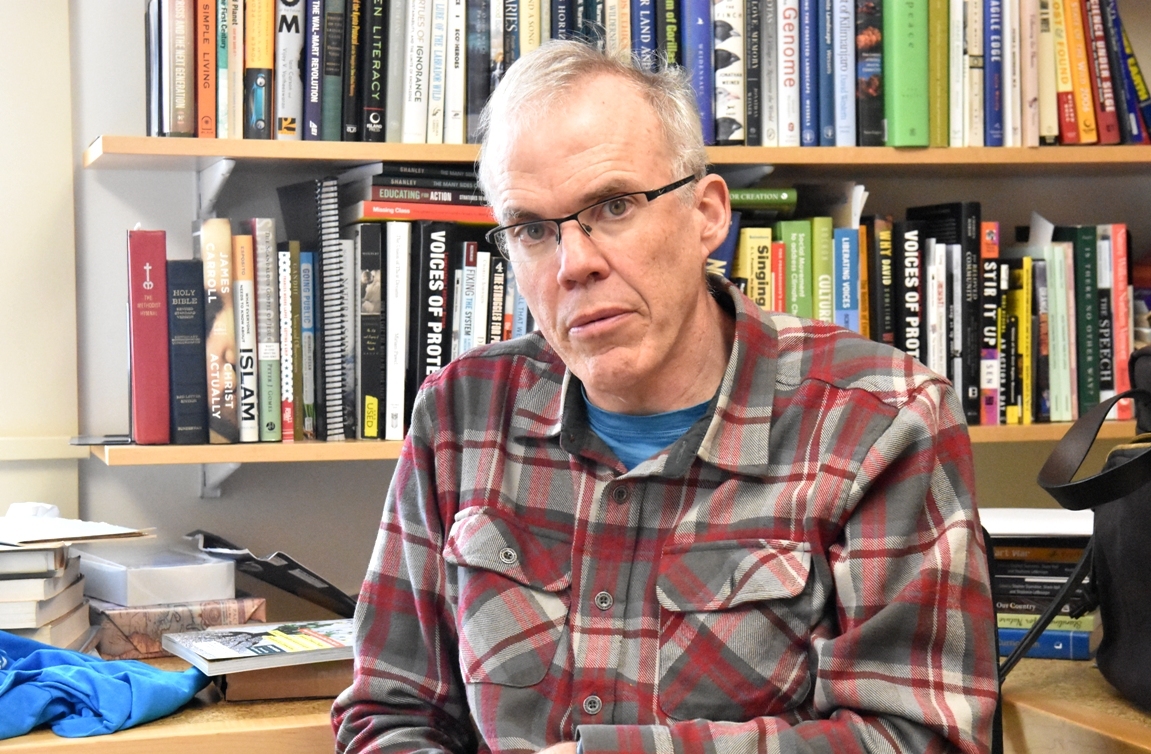
Vermont's Bill McKibben is planning a march in Washington on April 29 called the People’s Climate Mobilization. He's says environmental activists shouldn't lose hope. Joyce Marcel interviewed him for Vermont Business Magazine in March. Photos by Randolph T Holhut.
by Joyce Marcel, Vermont Business Magazine William Ernest McKibben, 56, sits in the eye of the hurricane of climate change, trying to save the world from the danger in which it finds itself. You’d think that after the recent presidential election, where climate change deniers took over the levers of power, this renowned environmentalist, lecturer, author, journalist, the Schumann Distinguished Scholar in Environmental Studies at Middlebury College, Ripton resident, cross-country skier and co-founder of the climate change organization 350.org, would be hiding in bed with his head covered by quilts. Or at the very least, he would have lost his sense of humor.
But no, he remains a whirlwind (forgive the weather analogies) of warning, writing op-ed pieces in such estimable journals as The New York Times, The Guardian, The New York Review of Books and Rolling Stone, cracking sardonic jokes and telling stone-hard truths on the Bill Maher show — Maher described him as a “rock star,” and organizing resistance to the real damage he sees the new administration doing to the environment. His next move? A big march in Washington on April 29th called the People’s Climate Mobilization.
I met McKibben in his office at Middlebury College, an office so filled with books that besides bookcases on four out of four walls, there are large plastic containers of them stacked on the floor, one on top of the other.
“There’s a huge library two hundred yards away,” he said, laughing. “I don’t know why I have as many books as I do.”
Sadly, the day before we met, President Donald Trump had, with the metaphorical stroke of a pen, destroyed two of McKibben’s biggest successes: Trump revived the environmentally unsound, fossil fuel-dependent Keystone XL and Dakota Access pipelines.
“Trump is moving with extraordinary speed, it must be said,” McKibben said. “There’s a sort of ‘shock and awe’ component to the whole thing.”
McKibben had already been a noted environmentalist for many years when, in 2008, he and a group of Middlebury students founded the world-wide environmental organization 350.org. This effort to protect the environment from the dangers of burning fossil fuels has put him into direct conflict with the largest fossil fuel producer in the world, ExxonMobil.
By building a global grassroots climate movement “that can hold our leaders accountable to the realities of science and the principles of justice,” 350.org has gone on to become a global nonprofit with offices and organizers in North America, Europe, Asia, Africa and South America. It has produced rallies in every country except North Korea. It employs about 100 people world-wide, has “hundreds and hundreds of thousands of volunteers,” McKibben said, and a budget of $10 million.
Much of that funding comes from the Rockefeller Family Foundation, which is a leader in the fight against climate change. When people write about this, of course, the word they use most is “irony.” That’s because the Rockefeller family wealth comes from Standard Oil, which is now ExxonMobil.
And in the irony of ironies — even more than having Scott Pruitt, the mouthpiece of Big Oil, in charge of the Environmental Protection Agency — is that ExxonMobil’s most recent CEO, Rex Tillerson, is now the US Secretary of State.
For McKibben, the answer to Trump is organizing and more organizing.
“There are days when I think Donald Trump will be a good spur to organizing and getting people active and engaged and involved,” McKibben said. “And there are days when I think this may be the final roadblock. The difference between climate change and the other terrible problems we face in a Trump era is that the climate one comes with a running clock. He can screw up health care for everybody and it will be terrible for people who won’t have health care for the next four or five years, but it won’t make the health care problem impossible to solve five years from now. Someone will be able to go back and we’ll be able to have national health insurance like every other place on the planet. Climate change is not like that. If we let it get more out of hand, there’s no fixing it. The adversary here, in the end, is not other people and politics. The adversary here in the end is physics, and physics is an implacable adversary.”
McKibben comes from a journalism family, and his first job as a journalist, straight out of Harvard, was one of the most coveted ones in the United States: Writing for The New Yorker.
His first book, “The End of Nature,” was published in 1989 after being serialized in that magazine; it has now been translated into 24 languages. He’s since written more than a dozen. The last, “Oil and Honey: The Education of an Unlikely Activist” was published in 2013. Don’t get me started on how many articles he’s written, because right now it looks like there might be one a day. And he tweets endlessly (@billmckibben).
He’s been awarded, among other honors, the Ghandi Peace Award, the Right Livelihood Prize (sometimes called the “alternative Nobel”) and the Thomas Merton Prize. He’s been awarded honorary degrees from 18 colleges and universities. He has a woodland gnat named after him.
He’s married to the writer Sue Halpern, who is almost as prolific as her husband. They have a daughter, Sophie, who recently began producing podcasts for WGBH’s Frontline program.
His accomplishments may sound daunting, but in person the tall, gangly McKibben is engaging, humble, accessible, gentlemanly and the possessor of a wit as dry as a good white wine. He is a master of irony — a necessary trait in his position.
To get a better handle on McKibben I talked to two of his Middlebury colleagues. Nan Jenks-Jay, the dean of environmental affairs and senior lecturer in environmental studies, is the one who brought McKibben to Middlebury. She doesn’t think “rock star” is a fair description.
“Most rock stars are about themselves,” Jenks-Jay said. “Everything about Bill is about humanity. He’s incredibly humble and conscious, deliberate and discerning. He has this really amazing balance. He functions in a league of influential people who can be full of themselves, and yet he’s so real. He went from being a quiet writer to becoming a public speaker and activist and that’s an unusual transformation. He’s not just a beacon of warning in this dancing storm of the climate crisis, but he’s also a beacon of hope — and this with unrelenting vigilance and humility. That’s a pretty impressive combination.”
McKibben’s accessibility on campus is a special gift to the students, Jenks-Jay said, “enabling students to have access to his brilliance and insightfulness. It’s every-day rewarding.”
Jenks-Jay also praised McKibben’s talent for friendship.
“When you think about what he carries, and what his hopes and dreams for the world are, when you run into him he wraps his arms around you and gives you a big hug and asks about you — and he listens,” she said. “He’s a learner, and being around students is also very jazzing and exciting. The students started 350.org and he was ready to run with it. He was the medium through which it could occur. He’s a vessel. I’m very proud to have him as a friend and a colleague.”
Middlebury Professor Emeritus John Elder first met McKibben over 26 years ago, when they were roommates at a conference on nature and culture in Thailand.
“We enjoyed each other’s company,” Elder said. “At Middlebury he’s been an absolutely wonderful member of the community. The main thing about Bill is that he’s the leading writer and activist in the world. He’s tireless. He keeps up with everything. Whatever is happening in the world of climate, he knows about it. He’s written the most important pieces on climate. As a writer he combines being extremely knowledgeable with being very incisive. He has a very authentic voice, a conversational voice that is grounded in experience. It makes his writing, in addition to being highly knowledgeable, very engaging.”
When McKibben began speaking publicly, he at first was “a little self-depreciating,” Elder said.
“Over the years he has become a commanding speaker,” Elder said. “He knows so much that he just stands up and speaks at people. He’s not looking at notes. He’s looking at you and you’re looking at him. In addition to his speaking and his activism, there’s another thing that really impresses me. He’s a world figure at this point. He’s literally a celebrity. Yet he is truly a modest person. He doesn’t seem to feel any particular admiration for his own role as an activist. I think it’s remarkable that he can be such a prominent figure and also such a modest, serious person. He thinks about these issues all the time. He manages to have a sense of humor even though the issues are grave indeed. He’s a loyal friend. He’s neighborly. He’s inspiringly effective and productive. He’s an unusual person and an admirable one.”
Early Life
McKibben was born in Palo Alto, California, and grew up in Lexington, Massachusetts, with five years somewhere in between in Canada. The peripatetic early life was occasioned by his father’s profession. Gordon McKibben was a well-respected business journalist who was the Canadian bureau chief for Business Week before moving to Boston to cover New England. He started Inc. Magazine and was its first editor. Then he became business editor of The Boston Globe — “back then when newspapers were a good thing to be in,” McKibben said dryly.
McKibben’s mother was also a business journalist — for a time.
“They met at a press conference when she was working for Business Week and my father was working for The Wall Street Journal,” McKibben said. “And when they got married, he more or less took her job and she retired to have my brother and me. I’m the oldest. My brother is two years younger and teaches school in Shreveport, Maine.”
McKibben’s father didn’t teach him much about business or money, but he certainly imbued young Bill with a love of journalism.
“My first job — when I was in junior high — was for the local newspaper, the Lexington Minuteman,” McKibben said. “I covered basketball for 25 cents the column inch. I was really doing it before I know how to type, and dad would come along often and type as I dictated the stories after basketball games.”
His other notable “kid job” was being a tour guide on historic Lexington Green.
“Tourists would come and I would give tours wearing my tri-cornered hat,” McKibben said. “I’d be telling that great story — over and over and over again — about the beginning of the world fight against colonialism and imperialism. Then I’d pass the hat. It was useful to me; it taught me early on that the ideas of dissent and patriotism were closely linked. These were the original patriots and they were also the original dissenters against the abusive government.”
In an uncharacteristic step away from journalism, Gordon McKibben was arrested while protesting the Vietnam war. It made a profound impression on his son.
“It was very unlike him,” McKibben said. “He was usually not engaged politically because he was a journalist, but this was at the height of the things in Vietnam. A very young John Kerry came to Lexington as the head of the Vietnam Veterans Against the War and they announced they were going to camp on Lexington Green. The town fathers said they couldn’t. They said they were going to arrest them. And so 500 townspeople from Lexington went to join with them and at four in the morning they all got hauled off and fined $10 or something and sent home. That was the one time in his life my father ever did anything like that and it made a deep impression on me. I was very proud of him. I was nine or ten and didn’t deeply understand the war in Vietnam, but I knew it was wrong and I was proud of him for standing up.”
This arrest foreshadowed his son’s later career, but at the time McKibben was too young to put himself in the picture.
“I didn’t have any sense of history when I was nine,” McKibben said. “But I did know I wanted to be a writer and follow him into journalism. That was my work right through college.”
At Harvard he got a job on the Crimson and spent the next four years covering Boston politics.
“Harvard had a good newspaper in those days, a six days a week newspaper that was the only daily newspaper in the city of Cambridge — a city of 100,000,” McKibben said. “I covered City Hall, which was good for me. I got out of the bubble of Harvard College and spent an awful lot of my four years knowing the politicians and spending my nights down in the shop pasting up newspapers. I was pretty good with an x-acto knife.”
He graduated with a BA in 1982 and almost immediately afterward received a call from the legendary editor of The New Yorker, William Shawn.
The Writer
“It was a fluke,” McKibben said. “Mr Shawn called me up. I guess they decided they needed to hire someone, and I’m afraid Harvard was their frame of reference. They’d read stuff I’d written in the Crimson. Of course I didn’t believe it was him when he called. I thought it was a prank and swore at him and hung up.”
Six months later Shawn called back.
“I knew it was the same voice, so I didn’t swear,” McKibben said. “The mark of Mr Shawn was that he was the greatest gentleman of all times. We became very good friends and spent a lot of time together. And somehow during the course of that time neither of us ever thought it was necessary to bring up the question of why I had hung up on him the first time he called.”
McKibben, who was by far the youngest person working at the magazine, wrote the then-anonymous Talk of the Town section, which reported short pieces on events in the city.
“The one rule then was you couldn’t write about anybody famous,” McKibben said. “So I had to spend four or five years learning the city inside out. Not its poshest precincts. And I really loved that job and New York. I got off at almost every subway stop in the city at one time or another. And I wasn’t working on the environment hardly at all.”
One of his last pieces for the magazine was a story about where everything he owned in his apartment came from — in unimaginable detail.
“I traced it back,” McKibben said. “Where was (New York electric company) Con Ed getting its oil to run its turbines? I went to Brazil to look at that. The New Yorker in those days had unlimited resources. I went up into the Arctic because Con Ed was getting power from the James Bay hydro dams — the way Vermont does now. I was upstate looking at the water system, which is one of the great wonders of New York.”
The piece he eventually wrote wasn’t strictly about the environment, “but for the first time in my life it showed me how important the physical world actually was,” McKibben said. “I grew up in the suburbs, which are a machine for hiding the physical world. You have no idea where the water comes from or goes, or if there’s a river that’s been covered up. Same as New York City until you start investigating. But once you do, it’s very clear that even a city as mighty as New York is utterly dependent on the physical world. If it wasn’t for a huge aqueduct carrying water from the Catskills and the Delaware, New York would stop in a day. So I think that set me up, by the late 1980s, to start thinking more about the environment.”
In 1985, when the Newhouse organization, Advance Publications, bought The New Yorker, it promised to make no changes in personnel. But by 1987 the company had forced Shawn out. McKibben quit in sympathy.
“When they fired Mr Shawn I didn’t like that, so I quit and moved up to the Adirondacks,” McKibben said. “I didn’t really know the Adirondacks very well. I spent part of a winter there at a writer’s colony where I finished that story about where everything came from. But I fell in love with the Adirondacks. I thought they were just fantastic. I was living in an old ramshackle farmhouse grown into the woods. It’s over in the middle of the park, near North Creek and it’s extremely beautiful. And for me, falling in love with the great wilderness was an extraordinary privilege.”
Life In The Mountains
Along the way, McKibben met his wife, the author Sue Halpern, who is also a scholar-in-residence at Middlebury. Halpern writes regularly for The New York Review of Books.
The couple “met cute,” if you can say that about homelessness.
 “We both working on homelessness issues,” McKibben said. “I was running a homeless shelter in the basement of my church and writing about homelessness. I spent a fair amount of time living on the street as a homeless person. It was as grim as you would imagine. And Sue wrote a piece she sent to The New Yorker about homelessness. They sent it to me to look at and we had lunch and that was that. It’s not that she found me living in a cardboard box. It was one of those occasions where doing good also rebounds to your advantage; I got an excellent wife out of it.”
Once McKibben and Halpern were settled in the Adirondacks, McKibben began doing freelance journalism.
“But really, within eight months or so I was at work on ‘The End of Nature’,” McKibben said. “That was the first book about climate change for a general audience.”
The influences on the wildly successful “The End of Nature” are, in part, his New Yorker story about where things came from, part the beauty of the Adirondacks, part his deep reading of the early scientific literature on climate change.
“I had a sense of how vulnerable all our arrangements were to changes in the physical world,” McKibben said. “And all of a sudden, the biggest changes in the physical world ever were coming at us.
McKibben has never again lived in a city.
“The privilege of writing a book that does well is getting to write more books,” he said. “And I published a bunch more books over the next decade or so while we lived in the Adirondacks.”
Coming to Vermont
The Adirondacks may be wonderful but they are also poor. McKibben and Halpern needed better schools for their daughter and began a long search for a new place to live.
When Jenks-Jay heard they were looking, she gently steered them to Middlebury.
“Bill was at Harvard for a year,” Jenks-Jay said. “I had heard from a mutual friend that they were looking around, so I contacted him at Harvard. I got permission to invite him to be at residency in Middlebury. I introduced him to friends who had property in Ripton. I had known of Bill’s writing, of course, but, more than that, I knew he was a big friend of Middlebury’s environmental program. He was very generous and thought we were doing good things. He was a kindred spirit.”
McKibben and Halpern built a house in Ripton and settled in.
“Ripton is as close to the Adirondacks as you can get in Vermont,” McKibben said. “Most of the land is college land or national forest land. I was so used by this point to wandering forever through the woods that I didn’t want to have to ask people’s permission to trespass. In Ripton I could wander around for hours on end or ski out the back door or whatever. Sophie’s school turned out to be great. She enjoyed herself tremendously and went off to Brown. She’s just taken her first job, and in the family tradition, sort of, she’s gone to work at WGBH where she’s a producer. I’m not sure that one should be happy that one’s child has gone into journalism in 2017, but who knows. Let’s hope.”
The Adirondacks may have fostered McKibben’s spiritual life, but Vermont gave him community, something he now believes might be the world’s only saving grace when climate change becomes a disastrous reality.
“We came because of the schools and things, but over time it became very clear to me that there was something very special in Vermont,” McKibben said. “I wrote a book once about walking from our home in Ripton to where we lived in the Adirondacks, and much of the book was a meditation on the differences between the two places. I loved them both. The huge wilderness and the wild of the Adirondacks is magnificent to me. But what I liked about Vermont is the strong sense of community. I’ve travelled all over the world, and been in many many places, and I think the distinctive thing about Vermont is the depth of that community. My guess is that it’s somehow related to Town Meeting and that tradition. although I don't know for sure. But I do know that in a country where people know their neighbors less and less, that’s affected Vermont not as badly as other places.”
McKibben was an early Locavore.
“I got a little bit to participate in the beginning of the moment when the local food movement was kicking off,” McKibben said. “I taught a course in 2001 on local food production, which I think was the first thing like it in the country. Now, post Michael Pollan, it’s commonplace. But, at the time, it was unusual and we had no books to read, so we — the class — just went around Vermont interviewing farmers and things like that. That’s one of the reasons I love Vermont. That local-ness is very important to me.”
McKibben’s book “Deep Economy” was largely about local economies.
“And of all the local economies in Vermont, the one I appreciate the most is the beer economy,” he said. “I like to drink beer, and this is now literally the greatest place in the world for drinking beer. I don’t know what percentage of the Vermont economy beer makes up, but between the beer itself and the tourists who come to drink it, it’s a not insignificant part of what we do here.”
Yes, McKibben has traveled the Beer Trail.
“Trust me, I’ve traveled it,” he said. “Hermit Thrush down in Brattleboro? One hundred percent renewable energy. In Middlebury we’ve got Otter Creek, maybe the biggest in terms of volume, and a little brewery called the Drop In Brewery. And we’ve got two distilleries making whiskey. I think there’s a big kombucha plant out there, too.”
Climate Change
All this time, McKibben was slowly burrowing deeper into his life’s work. True, he was writing books, teaching, drinking beer and exploring Vermont, but the biggest battle by far lay ahead.
“At a certain point, and it probably took me longer than it should, I thought that if we were going to solve the climate problem, another book was not the thing that would move the needle,” he said. “Like most writers and academics, I think I was confused. I thought what we were having was an argument about climate change, and if there were enough books and data and studies and articles and stuff piled up on one side, our leaders would eventually say, ‘OK, you win. We must do something about this.’ That was a misconception.”
A vast body of research now shows that companies like ExxonMobil, which had a phalanx of their own climate scientists, knew about climate change decades ago.
While they adjusted their own internal business practices to take into account the changing climate — especially the effect that rising water levels would have on their offshore drilling platforms — they mounted a well-funded campaign to deny that it was happening.
What Exxon knew and when it knew it was revealed by two independent journalistic investigations, one done by student reporters at Columbia University’s Graduate School of Journalism, which was published in the Los Angeles Times in 2015, and one done by a team of reporters from the website InsideClimate News.
In different ways, Rockefeller Family Foundation money was behind both of these investigations.
Because of these reports, we know that instead of working to stop climate change — or diverting their manufacturing to renewables — the fossil fuel industry took a page from the campaign run by cigarette companies, who knew for decades that smoking caused cancer and funded campaigns denying the connection. ExxonMobil started doing the same thing.
“For over a quarter-century (ExxonMobil) tried to deceive policymakers and the public about the realities of climate change, protecting its profits at the cost of immense damage to life on this planet,” wrote David Kaiser and Lee Wasserman in The New York Review of Books in the December 8, 2016 issue. (Wasserman is the head of the Rockefeller Family Foundation.) They called Exxon’s actions “morally reprehensible.”
The Rockefeller Family Foundation is divesting its holdings in fossil fuel companies — again, the word “irony” comes to mind.
“I think, in retrospect, it wasn’t an argument,” McKibben said. “We won the argument a very long time ago. The science has been clear for a very long time. It wasn’t an argument. It was a fight. And fights are always about money and power. In this case, the other side was the fossil fuel industry, and though they lost the argument, they were winning the fight. We weren’t making the switch off fossil fuels. So we decided to organize.”
A group of Middlebury students were already organizing around the concept of climate change, and McKibben joined them. Their first action was Step It Up, a march across the western part of Vermont.
“We started at Robert Frost’s old writing cabin and walked up to Burlington,” McKibben said. “It took five days, and by the time we got to Burlington there were about a thousand people marching. And as you know, in Vermont that’s a sizable crowd. The Burlington Free Press said the next day that this might have been the largest demonstration that had yet taken place in the US about climate change.”
If Vermonters were so engaged, then why wasn’t the US government?
“That’s when it dawned on me why we were losing so badly,” McKibben said. “We had all the things you would need for a movement. We had Al Gore. We had scientists. We had engineers. We had policy people. The only part of the movement we didn’t have was the movement part. So we decided to see if we could build, somehow, some of that movement.”
Step It Up was born of McKibben’s idea that Instead of going to Washington for one event, why not have actions happen all around the country?
“So one day the next spring, about eight of us managed to organize about 1,500 demonstrations, many of them small, in every state in the Union,” McKibben said.
He pointed to a sign on his office door that says “Step it up Congress! Cut carbon 80% by 2050.”
“It was effective,” he said. “The day after the demonstrations, both Hillary Clinton and Barack Obama, who were engaged in a presidential primary campaign, endorsed this goal. So this kind of organizing was effective.”
McKibben and the students then decided to organize on a global level, and 350.org was born. (The name comes from the research of scientist James E Hansen, who wrote in 2007 that the safest upper limit of CO2 in the atmosphere was 350 parts-per-million.)
It was a project that faced huge ambitions as well as difficulties.
“But Middlebury came in with some built-in advantages,” he said. “Mostly, it has this great tradition of languages. We had easy access to people who would be able to translate what we were doing. So when we launched the website 350.org in 2008, I think we were translating everything into 14 languages. No one had quite tried anything like this. And again we took as our first organizing focus a big global day of action. In 2009 we had something like 5,200 demonstrations in 181 countries simultaneously. CNN said it was the most widespread day of action in the planet’s history. Not the biggest, because some of the actions were small, but the most widespread. They were everywhere. It helped launch a climate movement.”
Raising Awareness
Over the next few years 350.org produced many more global actions, but McKibben decided that more confrontation was needed “to pick up the pace.”
By 2011, 350.org had started a stock divestment campaign and a fight over the Keystone XL pipeline, which was planned to run from Alberta, Canada, to Nebraska.
“Both of those involved money and business in very profound ways,” McKibben said. “The Keystone fight, which we may well lose with Donald Trump in office, we won for five years. Even if we lost, it has served to launch widespread opposition around the world to pretty much every new fossil fuel piece of infrastructure. The Keystone Pipeline was the first battle like that that Big Oil had ever lost, even temporarily. And demonstrating they were beatable proved to be important in helping spur lots of other people to work. We’ve seen many great victories since then.”
One large-scale victory was a widespread focus on renewable energy. In the US, spurred by President Obama’s subsidies, wind and solar grew exponentially. In Vermont, solar panels on houses and huge fields covered with sun flower-like panels are commonplace.
“Even a decade ago, renewables were still an expensive alternative instead of what they are now, the increasingly obvious and rational choice,” McKibben said. “Increasingly, we stick with fossil fuel not out of reason but out of the power of the fossil fuel industry to keep its business alive.”
Why didn’t the fossil fuel industry switch to renewables?
“They should have,” McKibben said. “They knew all about climate change 40 years ago. I think they didn’t because (A., their expertise is in fossil fuel, and that’s what they’re set up to do. And (B., if you think about it, although there’s plenty of money to be made in renewable energy, it’s probably not as much money to be made as there is in fossil fuel. The business model, if you’re Exxon, is unattractive. Once you’ve got your solar panel up on your roof, what do you do know? Your power arrives for free! If you’re Exxon, that’s a crappy business model compared to having a new tank-full of something arriving every month and writing them another check. At the root, I think that’s what it is.”
The divestment campaign was an effort to convince investors to dump their fossil fuel investments.
“It’s all of a piece,” McKibben said. “Part of the economics is driven by the fact that, increasingly, investors realize this is not the future. That’s what the divestment campaign is about. And at this point it has persuaded endowments and portfolios worth about $5 trillion to divest in part or in whole in fossil fuel.”
There have been other victories, large and small. The 2016 Paris Agreement on climate change was ratified by 134 nations. New York State and Vermont have banned fracking. Shell Oil has pulled out of drilling in the Arctic. The CEO of Shell, Ben Van Beurden, said, “I do think trust has been eroded... societal acceptance of the energy system as we have it is just disappearing.”
US Defense Secretary James Mattis has said that climate change is already destabilizing the world and affecting the security of the United States. The San Luis Obispo County Board of Supervisors recently denied Phillips 66 permission to transport oil through the county, saying that there is no safe way to transport tar sands oil. The Beaver Lake Cree Nation in Canada, devastated by tar sands exploration, has just launched its first solar project. On March 15, USA Today reported that 11 of the nation’s top medical societies, joined in the Medical Society Consortium on Climate and Health, said that “from increases in deadly diseases to choking air pollution and onslaughts of violent weather, man-made climate change is making Americans sicker.”
Climate change awareness was picking up momentum. And then came Trump.
The 2016 Election
Along with other stars of the Vermont firmament like Ben Cohen and Jerry Greenfield, McKibben was invited to introduce Democratic Senator Bernie Sanders (I-VT) in Burlington when he announced that he was running for president.
“It was the most remarkable moment in American history,” McKibben said. “The man came literally out of nowhere. The day he announced, there were about 5,000 people out there on the waterfront. And a big percentage of us secretly thought that would be the largest crowd he’d draw in the entire campaign. In fact, he proved to be a genius politician. He’s the most popular politician in America. He came inches away from knocking off the biggest political machine in recent American history — the Clinton machine. So it was painful to see him come that close.”
Bernie ran out of time, McKibben believes.
“If the primary season had stretched out a couple more months, the case he was making was just more and more compelling all the time,” McKibben said. “And as it turned out, I think he was not just right on his policies and programs, but he would have been a better challenger to Donald Trump. We’ll never know. Lots of things could have happened. But Bernie’s strengths lined up nicely with Trump’s weaknesses. Bernie’s deeply authentic and he has a deep, long, real connection to working-class America. That was not Hillary’s strength. She had different strengths. But in this election that seemed like a decisive factor. So we were inches away from instead of having Donald Trump as president, having Bernie Sanders as president. Which is about as profound a difference as American history has ever thrown up.”
The Bernie campaign was an unusual involvement for McKibben.
“My work with Bernie was great fun, and it was somewhat outside of my usual work because I thought Bernie was one of those candidates that changed the zeitgeist,” he said. “And he did, because now we talk about income equality and things like that. Also, we owed him immensely because he’d been the most stand-up guy on climate change for many years. And anyway, I like him.”
Controlling the Zeitgeist
All movements are a battle for the heart and soul, McKibben believes.
“They’re about who controls the zeitgeist,” he said. “Right now, Donald Trump controls the zeitgeist and the levers of power. He’s going to do a lot of damage over the next few years. Most of the architecture of environmental protection that’s been patiently built up over the last 50 years is going to be wrecked.”
As of this writing, Trump has proposed a budget that guts the Environmental Protection Agency. He wants to cut 97 percent of the funding the government spends to improve the water quality in the Great Lakes. “Also in San Francisco Bay, Puget Sound and Chesapeake Bay. Good thing no one lives in these places,” McKibben said dryly during a recent interview with Bill Maher on his HBO program.
The budget eliminates funding for the NASA weather satellites that give us information on climate and weather — “If you can’t see it then it can’t hurt you,” McKibben joked to Maher. (www.rollingstone.com/tv/news/bill-mckibben-talks-climate-change-battle-on-real-time-w470412)
Rolling Stone covered the TV segment and wrote: “After pointing out that the Keystone Pipeline would be built using Russian steel – the oligarch of that Russian steel mill gifted Vladimir Putin a $35 million yacht, McKibben noted – McKibben attacked the argument that state governments will handle the things the EPA doesn’t by highlighting the crisis in Pruitt's own state of Oklahoma."
“For as long as this continent has been around, Oklahoma has been seismically inert, as stable as it was possible to be," McKibben told Maher. "Now... it's the most seismically active place on the continent because we've done nothing but frack it for the last 10 years and force all this water underground into wells on the faults."
Trump will cause enormous damage, including damage to the economy, McKibben said during the Maher interview.
“It’s abundantly clear by every study that’s ever been made that the return on investment for protecting air and water and climate are astonishingly high,” he said on TV. “We’re going to pay a significant price. And of course the only people who won’t pay a significant price are a tiny, tiny number of people who own the fossil fuel assets that they’re determined to fully exploit.”
During our interview, McKibben pointed out that the administration of George W Bush foundered not on 9/11 but on Hurricane Katrina.
“Electoral politics is always important but it’s not what I do,” McKibben said. “But usually political candidates are less important than the context in which they run.”
The activist’s job is to change the zeitgeist, and that’s what McKibben is trying to do. He was immeasurably cheered by the Women’s March in Washington, which he attended, and he’s gearing up for a scientists’ march on April 22 and a climate march on April 29.
McKibben thinks the fight to legalize gay marriage is a good example of how to successfully grab the zeitgeist.
“The people who organized around gay marriage did a great job of it,” he said. “All the politicians that used to be against it decided they were for it. Five years ago, Hillary Clinton and Barack Obama still were dead set against gay marriage. And now you’d think they invented the whole concept.”
But climate change is different from gay marriage.
“It’s particularly hard because it has an abstract nature to it,” McKibben said. “Its worst effects happen in the future. And humans are not great at thinking very far ahead. Humans are better than many big businesses, anyway. Big corporations think one or two quarters ahead and that’s why they behave in many of the perverse ways they do. That’s why Exxon couldn’t bring itself to think 20 years ahead and know where they should have been.”
The Future
It took about a century for civil rights to become law. It took a century for women to get the vote. Is there enough time to stop or counter climate change?
“If it takes that long for climate change, then we’re in deep hot water, literally,” McKibben said. “People often ask me, ‘Where should I move to because the climate is changing?’ I always say, ‘Don’t worry so much about sea level. The most important thing is to find strong communities. And that’s why Vermont’s a much better place to deal with climate change. When you think about America over the last 50 or 60 years, having neighbors is sort of an optional thing. You live in a suburban cul-de-sac someplace and what difference does it make? Your neighbors could all die and it really wouldn’t change your life very much. That’s not true in Vermont. We still have reasonably strong ties.”
Vermonters are used to taking responsibility for their affairs and working on problems together. The state proved that during Irene, when people did what was necessary to rebuild their homes, bridges and roadways, even if it required breaking a few laws along the way.
“We’re a state of small towns, so people know their neighbors,” McKibben said. “Life is on a human scale.”
Then how does that play into renewables, where Vermont towns have been known to organize against large wind displays?
“Wind is a huge struggle, and in a sense environmentalists did their job well,” he said. “People love their mountains and views, as well they should. The question is, given the emergency we’re in, how much use are we going to make of the resources we have? Given the amount of electricity we use, we’ve got to generate it somehow. And we’re going to be using more electricity, one hopes, because the clear path forward is we’ll be driving on electricity instead of gas. The best way forward is what’s happened in places like Denmark and Germany.”
More than half of Denmark’s power comes from wind, McKibben said, but the turbines have been built with local money — church group money and community group money, not with foreign or native industrial money. Life on a human scale, again.
“People have personal ownership of resources,” he said. “I think that’s a good model.”
He added that he would like to see a wind display on the top of Middlebury Gap, near his home.
“I spend an awful lot of my life in the woods and I understand why people don’t like wind turbines,” he said. “But given what’s happening to the woods as the climate changes it seems important to me that we do this. And I’ve got to say I find the turbines extremely beautiful.”
Renewable energy is “the greatest bargain there ever was,” McKibben said.
“On a rational basis, our civilization should be doing everything it can to move us off fossil fuel,” he said. “There’s not enough money on Earth to pay for the craziness that’s coming. Think of the economy of Vermont if we get Irene-scale events every few years. We can be as Vermont Strong as we want to be, but at a certain point there’s not enough money to keep building the bridges again.”
Even energy-saving Vermont is complicit in the damage of the world, he pointed out.
“There’s also a strong moral component here,” he said. “Vermont’s been putting carbon into the atmosphere for a very long time, and the people who are paying the price are Vermonters to a certain degree, but mostly they’re Bangladeshis and Samoans and people like that. We owe it to the rest of the world to clean up our act in a serious way. We’re in a moral carbon debt.”
So, in the face of a Trump administration, is he demoralized?
“I was in Washington for the Women’s March and it was moralizing,” he said. “I was reminded that we can fight. Whether we can win or not, we will see. But that’s the only answer I got. Organizing. We’ve got to do more of that. Eventually Trump’s popularity will fade. One hopes when he eventually topples, he’ll take down with him many of the bad ideas he’s embraced, and it will no longer be OK for any politician to be a climate denier. Right now we have no leverage in Congress, but at this point, given the number of crazy things that have happened in our country in the last six or eight months, who knows what comes next? Trump is a walking conflict of interest by any of the conventional ways we’ve talked about this in the past. On a hundred counts, he should not be running the most powerful country in the world. However long he’s there, it’s going to be a long stretch for all of us. And I find it exhausting already.”
Is McKibben worried that he might be on Trump’s Enemies List?
“You would not want to see my email on an average day,” he said with a laugh. Then he got serious. “But my fears are of a larger sort. I’m 56 now, so the finish line is within some kind of sight. What scares me more is to think about my daughter.”
Joyce Marcel is a journalist who lives in southern Vermont. She is currently writing a memoir covering six generations of her family caught in the sweep of history across the 20th Century. She is writing another book about Vermont businesses. More of her work appears at her Web site, joycemarcel.com.