

by CB Hall Vermont Business Magazine The litigation between the town of Shelburne and the Vermont Railway over the latter's transloading facility just north of Shelburne village continues, and the town may now have gained a new legal foothold by virtue of a federal judge's decision rendered on October 18. Judge William Sessions, of the US District Court in Burlington, ordered the release of documents relevant to almost $4 million in loans to Burlington's Barrett Trucking, which is playing an increasingly controversial role in the development of the 34-acre site, from which Barrett's trucks will transport road salt received by rail on to towns around the state.
Sessions declined, however, to grant other motions from the town, in particular rejecting its request for a temporary restraining order that would have halted the ongoing, and largely completed, construction at the site.
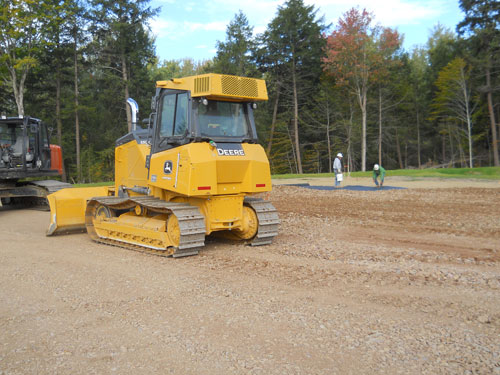 Vermont Business Magazine photos by CB Hall.
According to a Shelburne News article, he specifically wanted information on what security Barrett provided to obtain the loans, granted by the Vermont State Infrastructure Bank and Merchants Bank.
In a pre-hearing filing, attorneys for the Vermont Railway (VTR) termed the town's motion for release of the documents “beyond risible,” but Sessions felt otherwise, and directed the railroad to obtain and provide the documentation on an expedited basis.
In an October 20 email interview, VTR vice president Selden Houghton said his company would provide the court with the requested information “shortly.”
The extent and nature of Barrett Trucking's role constitutes a pivotal issue in the litigation. In a September press release, the town described the facility is “a Barrett Trucking project hiding behind Vermont Railways’ [sic] assertion of federal pre-emption.”
If the town's assertion holds true in the eyes of the courts, the facility would become subject to the town's zoning and planning strictures, which railroads are exempt from under federal law.
In their filing, the railroad's lawyers asserted “the Railroad’s ownership, construction, and control over the operation of the rail freight facility being built by the Railroad.”
However, Houghton told VBM, his railroad has hired Barrett to operate the facility.
Sessions' decision came in response to the disclosure by Shelburne, in its September 16 motion, that the Vermont State Infrastructure Bank had on August 10 approved a loan of almost $1.5 million to Barrett Trucking to assist in development of the transloading site. In an affidavit to the court, Shelburne selectboard chair Gary von Stange also referred to the additional, $2.5 million loan that Barrett had received from Merchants Bank for the construction.
In the town's September press release, von Stange accused the railroad and Barrett Trucking of “scheming to avoid proper land use regulations.”
Barrett Trucking president Joe Barrett declined to comment for this article.
Shelburne has been pressing for what it considers proper enforcement of those land use regulations on more than one front. The town's partial victory on October 18 came in the wake of a Department of Environmental Conservation (DEC) hearing on VTR's application for a stormwater discharge permit for the transloading facility.
 That hearing, held in the Shelburne town hall on October 13, came in response to a complaint from the town that Vermont Railway should not receive the federally mandated but state-administered permit for discharges flowing from the transloading operations into the adjacent LaPlatte River. The Nature Conservancy, which owns property adjacent to the VTR site, joined in requesting the hearing.
Between 50 and 60 people attended the hearing. Asked how opinions expressed broke down, DEC's Kevin Burke told VBM, “It was all con.” VTR representatives attended but did not speak.
Burke said, “I really don't have a timeline” for making a decision on VTR's application. But, he added, “When we issue a public notice of the application [as done in this case], that signifies that we're prepared to authorize the project as applied for, generally speaking.”
He added, however, that a review of the hearing testimony and the 13 written comments his agency received “could influence our decision.”
State policy, as articulated in the state rail plan published this May, is to “support the development of transload facilities.”
“We remain confident in the professionally engineered design of the Shelburne transload facility,” Houghton said.
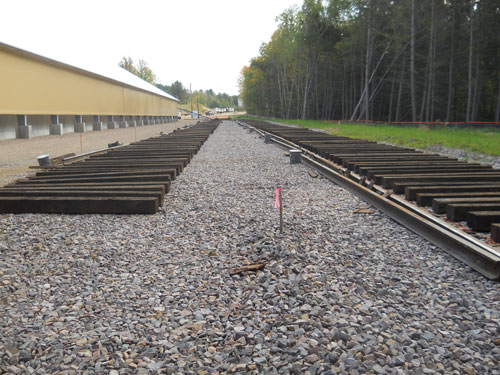
That design encompasses a rail spur leading from the VTR mainline to two branch tracks. Barrett's trucks would carry road salt from the rail cars spotted on those tracks to two huge adjacent sheds – one of which was complete as of mid-October - and would subsequently take the salt to towns around the state.
As of mid-October the spur was still under construction, although Houghton expected it would be complete by the first week of November. He did not have a date for the arrival of the first rail cars in Shelburne, but said, “We look forward to serving our Vermont community from this new facility this winter.”
Federal law states that the jurisdiction of the federal Surface Transportation Board (STB) “over ... the construction, acquisition, operation, abandonment, or discontinuance of spur. . . tracks ... is exclusive.”
That law in effect overrides local regulation that could interfere with the right of railroads to operate as such, given their position as common carriers and quasi-public facilities essential to interstate commerce.
That legal history underpinned a June 29 decision by Sessions, in which he denied Shelburne's request to enjoin VTR from proceeding with the project. Sessions' October 18 decision opened a path to his reconsideration of the June decision, but, separately, Shelburne has also appealed the June decision denying the injunction to the US Court of Appeals in Washington, DC. No date has been announced for that court's hearing of the appeal.
The legal forces are thus deployed on multiple fronts. The Burlington court's official notice of its October 18 decision went out to eight lawyers, five of whom had been present at the hearing.
Vermont Railway president David Wulfson estimated, in a July Burlington Free Press article, that his company had spent over $300,000 to date for its legal efforts in the case. Shelburne's legal costs for the litigation to date totaled about $220,000 for serviced provided as of the end of August.
While their amount is uncertain, the legal fees have continued to pile up for both litigants, and the burgeoning costs have some Shelburne residents looking for the exit.
“I guess I don't understand what the town is fighting for,” one Shelburne citizen, Carol Smith, told VBM. “The land has been cleared, there's a salt shed up. I don't understand what we're trying to accomplish at this point. And when we raise that question [with town officials], no one will answer us.”
“My question is, How much are we willing to spend?”
VTR took a position like Smith's, but added confident declarations that Shelburne's litigation was going nowhere.
“We are disappointed,” Houghton said, “that town officials chose to waste, and continue to [waste], so much money on a court case instead of even trying to work cooperatively with the railroad.”
Shelburne resident Derrick Senior, who has been prominent in opposing the salt shed project, declined in an interview to address the question of legal costs, but affirmed his support for the town.
“The town's attention to this matter, and keeping an eye on what's going on [at the salt shed site], is justified, certainly, given the judge's ruling” of October 18, he said. “We're lucky that we have town officials that are looking after our best interests.”
The town's budget for the fiscal year that ended June 30 allocated only $30,000 for legal fees. By that date costs in the case had already exceeded $200,000. The town paid the overage out of savings for other budget items, and from the town's accumulated cash surplus, according to town financial director Peter Frankenburg. For the fiscal year in progress, the town budget for legal costs is $32,000, he said.
“Certainly the town of Shelburne doesn't have unlimited funds,” town manager Joe Coangelo told VBM. “Having said that, I do think that there's a responsibility to ensure that ... rules and procedures are followed properly.” VTR, he said, is “not the only developer that we give a hard time to.”
“We're just trying to ensure that the health, safety and general welfare of the people of Shelburne are protected.”
C.B. Hall is a freelance writer from southern Vermont.