

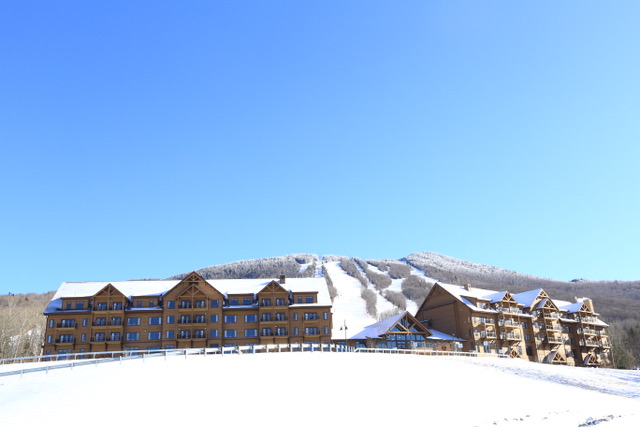
The Burke Hotel finally opened in September. Courtesy photo.
by Timothy McQuiston Vermont Business Magazine United States District Judge Darrin P Gayles in Miami on Monday issued a preliminary injunction against Jay Peak owner Ariel Quiros, while also denying Quiros’ motion to dismiss the SEC complaint against him. The two rulings thus keep in place the federal receiver, forbid Quiros from being involved in any of the related businesses and continue to freeze most of Quiros’ assets. Quiros is charged by the Securities & Exchange Commission of defrauding foreign investors in an EB-5 scheme involving Jay Peak and Burke Mountain resorts and the intended biomedical facility, called AnC Bio, in Newport. Some $200 million was allegedly diverted from projects funded by foreign investors.
In conclusion, the judge said, “The record supports a preliminary finding that Quiros was the architect of a fraudulent scheme to use investor funds to enrich himself. The result is a financially strapped ski resort, unpaid contractors, unfinished projects, and unhappy investors at risk of losing their residency status in the United States. Accordingly, the Court finds a preliminary injunction is necessary to maintain the status quo pending a trial on the merits.”
|
11/21/2016 Preliminary Injunction against Ariel Quiros [ECF No.: 238] |
Quiros had sought to wrestle the businesses away from the federally appointed receiver, Michael Goldberg. Quiros said he had not violated any laws in how investor money was spread around the various projects. Some of those projects have long been finished, the last of which is the long-awaited Burke Hotel, which opened at the end of summer.
RELATED: Q&A: Michael Goldberg
Other projects are unfinished, some have barely started construction (AnC Bio) and others were never begun, even though the vast bulk of the EB-5 funding had been raised. (See related Q&A with Michael Goldberg).
 Ariel Quiros at the AnC Bio ribbon cutting May 2015. VBM photo.
The November 21, 2016, court order below includes background to the case, which broke last April. Quiros' business partner Bill Stenger, the longtime president of Jay Peak Resort, has settled his civil case with the SEC and is no longer working at the resort. He apparently had no equity stake in the resort. The two men could still possibly face federal criminal charges.
“The SEC weaves a compelling and well-documented account,” Gayles writes, “of one man’s use of his control over multiple entities to squander investor funds, enrich himself, and, ultimately, commit securities fraud. Presenting 141 exhibits and the testimony of 5 witnesses, the SEC argues that Quiros was the architect of an eight-year fraudulent scheme designed to loot more than $50 million from investors. Quiros, relying primarily on his own and four other declarations, disputes the SEC’s rendition of events and asserts that he and the companies under his control were entitled to use the investor funds at issue. The Court finds that, based on the record before it, a preliminary injunction is necessary to preserve the status quo pending the resolution of this litigation.”
UNITED STATES DISTRICT COURT
SOUTHERN DISTRICT OF FLORIDA
CASE NO.: 16-cv-21301-GAYLES
SECURITIES AND EXCHANGE COMMISSION,
Plaintiff,
v.
ARIEL QUIROS,
WILLIAM STENGER,
JAY PEAK, INC.,
Q RESORTS, INC.,
JAY PEAK HOTEL SUITES L.P.,
JAY PEAK HOTEL SUITES PHASE II. L.P.,
JAY PEAK MANAGEMENT, INC.,
JAY PEAK PENTHOUSE SUITES, L.P.,
JAY PEAK GP SERVICES, INC.,
JAY PEAK GOLF AND MOUNTAIN SUITES L.P.,
JAY PEAK GP SERVICES GOLF, INC.,
JAY PEAK LODGE AND TOWNHOUSES L.P.,
JAY PEAK GP SERVICES LODGE, INC.,
JAY PEAK HOTEL SUITES STATESIDE L.P.,
JAY PEAK GP SERVICES STATESIDE, INC.,
JAY PEAK BIOMEDICAL RESEARCH PARK L.P.,
AnC BIO VERMONT GP SERVICES, LLC,
Defendants, and
JAY CONSTRUCTION MANAGEMENT, INC.,
GSI OF DADE COUNTY, INC.,
NORTH EAST CONTRACT SERVICES, INC.,
Q BURKE MOUNTAIN RESORT, LLC,
Relief Defendants.
_____________________________________________/
PRELIMINARY INJUNCTION
THIS MATTER is before the Court on Plaintiff Securities and Exchange Commission’s (“SEC”) Emergency Motion and Memorandum of Law for Temporary Restraining Order, Asset
Case 1:16-cv-21301-DPG Document 238 Entered on FLSD Docket 11/21/2016 Page 1 of 44 - 2 -
Freeze, and Other Relief [ECF No. 4], specifically the SEC’s request for preliminary injunctive relief. The Court has reviewed the Motion and the record and is otherwise fully advised.
The dispute in this action is between the SEC and Defendant Ariel Quiros (“Quiros”). Each side tells a different story about the development of the Jay Peak Resort in Vermont. The SEC weaves a compelling and well-documented account of one man’s use of his control over multiple entities to squander investor funds, enrich himself, and, ultimately, commit securities fraud. Presenting 141 exhibits and the testimony of 5 witnesses, the SEC argues that Quiros was the architect of an eight-year fraudulent scheme designed to loot more than $50 million from investors. Quiros, relying primarily on his own and four other declarations, disputes the SEC’s rendition of events and asserts that he and the companies under his control were entitled to use the investor funds at issue. The Court finds that, based on the record before it, a preliminary injunction is necessary to preserve the status quo pending the resolution of this litigation.
I. PROCEDURAL BACKGROUND
On April 12, 2016, the SEC filed its Complaint for Injunctive and Other Relief [ECF No. 1] against Defendants Quiros; William Stenger (“Stenger”); Jay Peak, Inc. (“JPI”); Q Resorts, Inc. (“Q Resorts”); Jay Peak Hotel Suites, L.P.; Jay Peak Hotel Suites Phase II, L.P.; Jay Peak Management, Inc.; Jay Peak Penthouse Suites, L.P.; Jay Peak GP Services, Inc.; Jay Peak Golf and Mountain Suites, L.P.; Jay Peak GP Services Golf, Inc.; Jay Peak Lodge and Townhouses, L.P.; Jay Peak GP Services, Lodge, Inc.; Jay Peak Hotel Suites Stateside, Inc.; Jay Peak GP Services, Stateside, Inc.; Jay Peak Biomedical Research Park, L.P.; and AnC Bio Vermont GP Services, LLC, (collectively the “Defendants”) and Relief Defendants Jay Construction Management, Inc. (“JCM”); GSI of Dade County, Inc. (“GSI”); North East Contract Services, Inc. (“NECS”); and Q Burke Mountain Resort, LLC (“Q Burke”) alleging the Defendants violated Section 17(a) of the Securities Act, 15 U.S.C. § 77q(a); Section 10(b) of the Exchange
Case 1:16-cv-21301-DPG Document 238 Entered on FLSD Docket 11/21/2016 Page 2 of 44 - 3 - On April 13, 2016, the Court appointed Receiver Michael Goldberg (the “Receiver”) to administer the affairs of the Corporate Defendants and to take necessary actions to protect the investors [ECF No. 13]. On April 21, 2016, the Court entered consent preliminary injunctions against Stenger and the Corporate Defendants [ECF Nos. 51 and 52]. On September 21, 2016, the Court entered a consent permanent injunction against Stenger [ECF No. 215].
Case 1:16-cv-21301-DPG Document 238 Entered on FLSD Docket 11/21/2016 Page 3 of 44
Act of 1934,15 U.S.C. § 78j(b);and SECRule 10b-5, 17 C.F.R § 240.10b-5.The SEC also setforth claimsagainst Quiros for aiding and abetting the other Defendants’ violations of Section10(b) and Rule 10b-5 and for controlperson liabilitypursuant to Section 20(a) of the ExchangeAct.Inconjunction withthe Complaint, the SEC filed its Emergency Motion for a TemporaryRestraining Order, AssetFreeze and Other Relief [ECF No. 4].The Court entered the TemporaryRestraining Orderand froze virtually allof Quiros’s known assets[ECF No. 11].1On April 13, 2016, the Court appointed Receiver Michael Goldberg (the “Receiver”)to administer the affairsof the Corporate Defendants and to take necessaryactionsto protect the investors [ECF No. 13].On April 21, 2016,the Courtenteredconsent preliminary injunctionsagainst Stenger and theCorporateDefendants[ECF Nos. 51 and 52].On September 21, 2016, the Courtentered aconsentpermanent injunction against Stenger[ECF No. 215].
OnMay 9th and 10th, 2016, the Court held anevidentiaryshow causehearing on theSEC’s request forpreliminaryinjunctive relief.The SEC reliedon141 exhibits and thetestimonyof five witnesses: Felipe Vieira, an investor in Stateside Phase VI;MichaelPieciak,the Deputy Commissioner of the Vermont Department of Financial Regulation;Jan Jindra, a financial economist with the SEC’s Division of Economic and Risk Analysis;Mark Dee,a staffaccountant with the SEC;and Michael Goldberg, the Receiver.Quiros reliedon his owndeclaration and the declarations ofGeorge Gulisano, the former chief financial officer of JayPeak Resortand Jay Peak Biomedical Research Park;William Kelly, the former Chief Operating
Following a hearing on April 25, 2016, the Court modified the asset freeze order andreleased $41,308.69 offunds jointly held by Quiros and hiswife at MerrillLynch [ECF No. 82]. On May 27, 2016, the Court again modified the freeze order to permit Quiros to sell or otherwiseencumber his Setai condominiumin New York, with the funds to be held in trust by theReceiver, to cover $15,000 per month forliving expenses andreasonable attorney’s fees asapproved by the Court [ECF No. 148]. On October 20, 2016, the Courtreleased an additional$80,000 to Quiros’s attorneysfor accrued fees[ECF No. 232].
-3 -Case 1:16-cv-21301-DPG Document 238 Entered on FLSD Docket 11/21/2016 Page 3 of 44 - 4 -
Officer of JPI and the owner of NECS; Won Gyu Jang, the president of AnC Biopharm, Inc.; and La Kyun Kim, the director of AnC Biophram, Inc.
On May 17, 2016, the SEC filed an Amended Complaint [ECF No. 120]. On June 24, 2016, Quiros moved to dismiss the Amended Complaint [ECF No. 171].
II. FINDINGS OF FACT
A. Investing in the United States
The investments at issue in this litigation arose out of Section 203(b)(5) of the Immigration and Nationality Act of 1990, 8 U.S.C. § 1153, often referred to as the EB-5 Immigrant Investor Program. Pursuant to the program, visas may be available “to qualified immigrants seeking to enter the United States for the purpose of engaging in a new commercial enterprise . . . which will benefit the United States economy and create full-time employment for not fewer than 10 United States citizens or [otherwise lawfully admitted immigrants].” 8 U.S.C. § 1153(b)(5)(A). To qualify, the applicant must invest either $500,000 or $1,000,000, depending on the investment’s employment area, in the new enterprise. Id. Once the applicant makes his or her investment and files the requisite I-526 petition, he or she is granted permanent residence on a conditional basis for two years. See id. § 1186b(a)(1). If the investment creates the requisite ten jobs over that two year period, the conditions are removed and the applicant becomes a lawful permanent resident. See id. § 1186b(d)(1).
The government sets aside some EB-5 visas for prospective immigrants who invest in a “Regional Center.” Applicants investing through Regional Centers only need to invest $500,000 to qualify. Vermont has a federally-designated Regional Center. The Jay Peak Ski Resort is one of the EB-5 projects approved by the Vermont Regional Center. Plaintiff’s Exhibit (“PX”) 22 ¶¶ 3-4.
Case 1:16-cv-21301-DPG Document 238 Entered on FLSD Docket 11/21/2016 Page 4 of 44 - 5 -
B. Financing a Ski Resort: Phases and Development
Jay Peak is a mountain in Vermont, located about five miles south of Canada. Jay Peak Resort, owned by JPI, is located on the mountain and has been in operation for over fifty years. PX 3. In 1972, Mont Saint-Saveur International (“MSSI”) purchased JPI, and, in 1985, it recruited Stenger to run the company. PX 58. Beginning in December 2006, while still under MSSI’s ownership, JPI began using EB-5 investments to improve and expand Jay Peak Resort.2
2 As detailed in section II.C, infra, Quiros, through Q Resorts, purchased JPI in January 2008.
1. Jay Peak Development Phases
Phase I
In December 2006, JPI began a $17.5 million offering of limited partnership interests in Jay Peak Hotel Suites, LP (“Phase I”). The purpose of Phase I was to expand the resort through the acquisition of new land and the construction of a new fifty-seven–suite hotel. PX 3. By May 2008, Phase I was fully subscribed with thirty-five EB-5 investors. PX 22. The Source and Use of Investor Funds section from the Phase I Private Offering Memorandum sets forth the amounts the project sponsor was entitled to receive from investor funds and includes fifteen percent of the total cost in developer fees ($1,918,500) and five percent of the total cost in expenses/contingency fees ($639,500) upon completion of the project. In addition, the Offering Memorandum details a $1.8 million expenditure for land that Phase I would purchase from JPI. PX 3; PX 30. JPI was the contractor/developer for Phase I. JPI deeded the land to Phase I in December 2009. PX 30.
Phase II
In March 2008, JPI began a $75 million offering of limited partnership interests in Jay Peak Hotel Suites Phase II, L.P. (“Phase II”). The purpose of Phase II was to acquire additional
Case 1:16-cv-21301-DPG Document 238 Entered on FLSD Docket 11/21/2016 Page 5 of 44 - 6 -
real estate and construct a multi-story hotel, administrative office, clubhouse, and waterpark. PX 4. By January, 2011, Phase II was fully subscribed with 150 EB-5 investors. PX 22. Pursuant to the Phase II Offering Memorandum’s “Estimated and Projected Cost of Development and Projected Revenues,” the project sponsor was entitled to receive from investor funds fifteen percent of the total cost in developer fees ($5,557,816) and five percent of the total cost in expenses/contingency fees ($3,000,443) upon completion of the project. In addition, the Offering Memorandum lists a $4.2 million expenditure for land that Phase II would purchase from JPI. PX 3; PX 30. JPI was the contractor/developer for Phase II.
Jay Peak Management, Inc., a wholly owned subsidiary of JPI, is the general partner of Phases I and II. Stenger is the sole principal of Jay Peak Management.
Phase III
In July 2010, JPI began a $32.5 million offering of limited partnership interests in Jay Peak Penthouse Suites, L.P. (“Phase III”). The purpose of Phase III was to construct fifty-five penthouse units and a mountain learning center. PX 5. By October 2012, Phase III was fully subscribed with sixty-five EB-5 investors. PX 22. Pursuant to the Phase III Offering Memorandum’s “Investor Funds Source and Application,” the project sponsor was entitled to receive fifteen percent of the total cost in construction supervision fees ($2,798,075) and five percent of the total cost in expenses/contingency fees ($932,025) upon completion of the project. PX 5. Jay Peak GP Services, Inc., is the general partner of Phase III. Stenger is the sole principal of Jay Peak GP Services.
Phase IV
In December 2010, JPI began a $45 million offering of limited partnership interests in Jay Peak Golf and Mountain Suites, L.P. (“Phase IV”). The purpose of Phase IV was to construct fifty golf and mountain suites, a mountain top café, and a wedding chapel. PX 6. By November
Case 1:16-cv-21301-DPG Document 238 Entered on FLSD Docket 11/21/2016 Page 6 of 44 - 7 -
2011, Phase IV was fully subscribed with ninety EB-5 investors. PX 22. Pursuant to the Phase IV Offering Memorandum’s “Source and Application of Funds,” the project sponsor was entitled to receive fifteen percent of the total cost in construction supervision fees ($3,412,500) and five percent of the total cost in expenses/contingency fees ($1,137,500) upon completion of the project. PX 6. JPI was the contractor/developer for Phase IV. PX 6. Jay Peak Services Golf, Inc., is the general partner of Phase IV. Stenger is the sole principal of Jay Peak Services Golf, Inc.
Phase V
In May 2011, JPI began a $45 million offering of limited partnership interests in Jay Peak Lodge and Townhouse, L.P. (“Phase V”). The purpose of Phase V was to construct thirty vacation rental townhomes, ninety vacation rental cottages, a café, and a parking garage. PX 7. By November 2012, Phase V was fully subscribed with ninety EB-5 investors. PX 22. Pursuant to the Phase V Offering Memorandum, the project sponsor was entitled to receive fifteen percent of the total cost in construction supervision fees ($1,625,355) and five percent of the total cost in expenses/contingency fees ($541,785) upon completion of the project. PX 7. JPI was the contractor/developer for Phase V. Id. Jay Peak GP Services, Inc. is the general partner of Phase V. Stenger is the sole principal of Jay Peak GP Services.
Phase VI
In October 2011, JPI began a $67 million offering of limited partnership interests in Jay Peak Hotel Suites Stateside, L.P. (“Phase VI”). The purpose of Phase VI was to build an eighty-four–unit hotel, eighty-four vacation cottages, a guest recreation center, and a medical center. PX 2. By December 2012, Phase VI was fully subscribed with 134 EB-5 investors. PX 22. Pursuant to the Phase VI Offering Memorandum’s “Source and Application of Funds,” the project sponsor was entitled to receive fifteen percent of the total costs in construction supervision fees ($3,118,500) and five percent of the total cost in supervision expenses ($1,039,500) upon
Case 1:16-cv-21301-DPG Document 238 Entered on FLSD Docket 11/21/2016 Page 7 of 44 - 8 - Id.
Case 1:16-cv-21301-DPG Document 238 Entered on FLSD Docket 11/21/2016 Page 8 of 44
completion of the project.PX 2.The offering memorandum listsJPI as the developer for Phase
VI.3Id.
The Offering Memorandum estimated that Phase VI would be operational bythe2013/2014 winter season.Id.As of May 2016, the hotel is complete andapproximatelythirty-five of theeighty-four vacation cottagesare partially constructed.HearingTranscript (“HT2”) at159(Goldberg Testimony)[ECFNo. 125].There has been no visible construction foreither themedical center or the recreationcenter.Id.ThePhase VI subcontractorshave stopped working on the project becauseDefendants owe theman estimated $2 to $3 millionin past dueconstruction costs.4Phase VI needs approximately$20 million in additional funds to completethe project, butithas less than $55,000 in its accounts.Id.
Jay Peak GP Services Stateside,Inc., is the general partner of Phase VI.Stenger is the sole principalof Jay Peak GP Services Stateside.
Phase VII
InNovember 2012, JPIbegan a $110 million offering of limited partnership interests inJay PeakBiomedical ResearchPark, L.P. (“Phase VII”).According to the Original OfferingMemorandum(“OOM”), the project involved:
(1)construction of a world class certified GMP (Good Manufacturing Practice) and GLP(Good Laboratory Practice) building and facilityin Newport, Vermont;(2) supply of allnecessary equipmentand technicians in the facility;(3)research, development,manufacture and distribution of the AnC Bio Products under intellectual and propertydistribution agreementsfrom and with AnC BioInc., South Korea(the“Existing AnCEntity”) and AnC Bio VT;and (4) operation of clean room spaces in the building by third parties, including without limitation the Existing AnC Entity, so that those third partiesmayconduct research into certain affiliated industries.
3For PhasesIV through VI, JPIcontracted with JCM to provide construction services.4The Court hasauthorized a stipulated writ ofattachment for the PhaseVI subcontractors to perfect their lien rights [ECF Nos. 161, 168, and 177].
-8 -Case 1:16-cv-21301-DPG Document 238 Entered on FLSD Docket 11/21/2016 Page 8 of 44 - 9 -
PX 56. The OOM provided that Phase VII would cost $118 million to complete, with $110 million raised from 220 EB-5 Investors. When the SEC filed this action in April 2016, Phase VII had raised approximately $83 million from 166 EB-5 investors. PX 22.
Pursuant to the Phase VII OOM’s “Estimated and Projected Cost of Development and Projected Revenues,” the contractor/developer would receive fifteen percent of the total cost in developer fees and five percent of the total cost in expenses upon completion of the project. PX 56. In addition, Phase VII would purchase land from GSI, one of Quiros’s companies, for $6 million. Id. AnC Bio Vermont GP Services, LLC, is the general partner of Phase VII. Quiros and Stenger are the managing members of AnC Bio. Stenger and Quiros had ultimate authority over the contents of the Phase VII offering materials, which they reviewed and approved. PX 13; PX 20; PX 32.
The products proposed in the OOM are subject to review and approval by the Food and Drug Administration (“FDA”). PX 66. Defendants knew that (1) the products required FDA approval, (2) the approval process could take years, and (3) Phase VII’s success depended on FDA approval. Id. As a result, any delay in or failure to obtain FDA approval would greatly reduce the project’s projected revenues. Id. Despite Defendants’ knowledge of the lengthy FDA-approval process, the OOM failed to accurately represent that JPI was nowhere near obtaining FDA approval for the Phase VII products. Id. Defendants, in an information sheet attached to the offering documents, represent that the T-PLS and the C-PAK devices are “[c]urrently under process of US FDA approval.” PX 56. However, Defendants had not submitted the T-PLS, C-PAK, or any other Phase VII device to the FDA for approval. PX 20; PX 32. To date, the Phase VII products have not been submitted to the FDA for review. PX 20.
The OOM projected that the facility would (1) be complete and operating by April 15, 2014; (2) create three thousand jobs over the two-year period of development and first three
Case 1:16-cv-21301-DPG Document 238 Entered on FLSD Docket 11/21/2016 Page 9 of 44 - 10 -
years of operation; and (3) provide revenue of $659,800,208, as well as income before tax and depreciation of $281,042,834, between 2013 and 2018. PX 56. Dr. Jindra testified, with supporting documentation, that the OOM’s revenue projections were baseless. See HT2 (Jindra Testimony). This was due in large part to the Defendants’ representations that Phase VII would begin realizing revenue in the same year that Phase VII began testing and developing products. It was not possible for the company to realize that level of revenue without FDA approved products. Some investors received other documents representing that product development would begin in January 2012, a deadline that had already passed when Defendants first distributed the OOM. At base, Defendants were projecting revenues based on a January 2012 development and testing start date when they knew that was not possible. The result was that projected revenues were off by at least two years. Id.
In January 2015, Defendants began distributing a Revised Offering Memorandum (“ROM”) to investors.5 As with the OOM, Quiros reviewed, approved, and had ultimate authority over the ROM. The revised memorandum projected that Phase VII would begin realizing revenues from products requiring FDA approval in 2016 and 2017. PX 57. However, on January 8, 2015, Stenger sent a time schedule to the Vermont Agency of Commerce & Community Development, which represented that the FDA would not approve Phase VII products until one-to-two years after the ROM’s projected dates for earning revenue. PX 66. Yet again, there was a conflict between the timing of product approval and projected revenues. Accordingly, both the OOM and ROM’s revenue projections lack foundation.
5 The ROM includes an agreement with NECS to manage the project and includes an agreement with JCM to provide services to the limited partnership. PX 57.
Aside from site preparation and minimal groundbreaking, Phase VII is essentially an idea that never came to fruition. PX 22. Of the $83 million raised, $14 million remains in escrow and
Case 1:16-cv-21301-DPG Document 238 Entered on FLSD Docket 11/21/2016 Page 10 of 44 - 11 - PX 22. There is little evidence to establish that Phase VII has received any equipment, distribution, or marketing rights from AnC BioPharm, Inc.
Case 1:16-cv-21301-DPG Document 238 Entered on FLSD Docket 11/21/2016 Page 11 of 44
approximately $10 million has been used forPhase VII vendors and related project costs.PX 30.Defendants assert that theysent $24.5 million to AnC BioPharm,Inc—an affiliated Koreanfirm—forequipment, distribution, and marketingrights.However, theSEC produced the recordsof JCM, Phase VII, AnC Bio Vermont GP Services, and the Project Sponsor which support afinding that Quiros has sent, at most, only $8 millionto AnC BioPharm, Inc.6PX 22.There islittle evidence to establish that Phase VII has received any equipment, distribution, or marketing rights from AnCBioPharm, Inc.7
Defendants seek to raiseanother $27 million fromfifty-four investorsfor Phase VII.TheReceiver testified that, even if raised, these funds would not be sufficient to complete the project.PX 30;PX 20;HT2at 168.Indeed, Defendants are at least$43 million short of the funds needed to complete Phase VII.Without completion,166 investors will not realize their promised returnand will likely lose theiropportunity to obtain permanentresidency.
2.Facts Common to All PhasesAccounts
To facilitate the investments, each phase had anescrow account at the People’s Bank in Vermontwhere investors would deposit their initial $500,000. PX 11.Once the United StatesCitizenship and Immigration Service (“USCIS”)approvedinvestors’conditional green cards, Stenger would transferthe $500,000 from thePeople’sBank accountto a Raymond James
6The OOM, in introducing PhaseVII key management, states that Quirosis “one of thefounders and owners of the Existing Asian AnCEntity (AnCBio of South Korea).” PX 56. Thisdescription is absent from the ROM. PX 57.
7The SEC, despite multiple attempts, was unable to interview either Dr. Jang or Dr. Kimabout the accuracy of their nearly identical declarations. PX 138.
-11 -Case 1:16-cv-21301-DPG Document 238 Entered on FLSD Docket 11/21/2016 Page 11 of 44 - 12 - Quiros’s former son-in-law was the broker for the Raymond James accounts. Quiros was the only signatory on all of the Raymond James accounts, giving him complete control over investor funds.
Case 1:16-cv-21301-DPG Document 238 Entered on FLSD Docket 11/21/2016 Page 12 of 44
accountin the name of the particular phase.8Quiros’s former son-in-lawwas the broker for theRaymond Jamesaccounts.Quiros was the only signatoryon all of the Raymond James accounts, giving him complete control over investor funds.
Limitations on Use of Funds
Each of the limited partnership agreements for PhasesI-VII detail how the generalpartner may use investormoney.Section 5.02 of each agreementpreventsthe general partnerfromborrowing from orcommingling investorfunds; acquiring propertywith investor funds thatdo not belong to the limited partnership; or mortgaging, conveying, orencumbering partnershipproperty that is not real property.PX 2;PX3; PX4PX5; PX6; PX7;56;PX 57.
Expected Returns
All of the investors across the seven phases soughtpermanent green cardspursuant to theEB-5 program.Like most investors, they also soughta return on their investment.See PX 46;PX 50; PX54; PX55.JayPeak represented tomultipleinvestors that returns would be anywhere fromfour-to-six percentannually.Id.Many investors never received this level of return.Some investors intheearlierphases did receive a return on their investment, but these returns wereoften the result of theDefendants using fundsfrom the later phases to pay the earlier phaseinvestors—the quintessential exampleof taking from Peter to pay Paul.PX 124.Someinstancesof misrepresentations about returnsinclude:
•B.Patel, a Phase VI investor, receivingproject overview materials, whichrepresenteda return on investment of up to six percent.PX 54 ex. A.
•B.Nesbit, a Phase VII investor, receiving via his immigration attorney,a letter from Stenger projecting a fourtosixpercentreturn on investment for Phase VII.PX 55ex. A.
As detailed below, MSSI transferred PhaseI and IIfunds to Raymond James when Quiros gained control ofJPI.
-12 -Case 1:16-cv-21301-DPG Document 238 Entered on FLSD Docket 11/21/2016 Page 12 of 44 - 13 -
• Investors in Phase II and Phase IV received returns of less than two percent despite promises of almost five percent. PX 5, 6, 124.
• Phase VI offering materials representing returns of four to five percent annually, but investors have only received $3000 (a .6% return). PX 124.
C. Quiros and Company Acquire Jay Peak, Inc.
In addition to his interests in JPI and Phases I-VII, Quiros is the sole owner and director of Q Resorts, JCM, and GSI.9 PX 8; PX 33; PX 34; PX 35; PX 36. All of these companies have their offices at the same address in Miami. PX 33; PX 36.
9 Quiros is also the managing principal of Relief Defendant Q Burke and the owner of Burke Mountain Resort, another EB-5 offering. PX 39, 41.
10 The OOM and the ROM both state that, at some point, Quiros had fourteen operating trading, importing, and exporting companies and offices in Seoul, London, Beijing, Sydney, and Hong Kong. PX 56; PX 57.
Quiros is a self-described “deal maker.” PX 10 at 30. After serving in the United States Military, Quiros settled in South Korea, where he helped the Korean government as a “deal maker, an arbitratage, and arbitrator.” Id. While still living in Korea, Quiros would visit Jay Peak in Vermont, where had a vacation home. Id. In 1995, Quiros opened his offices in Miami, Florida. PX 57.10
Sometime in 2007, MSSI decided to sell JPI. According to Quiros, MSSI, Stenger, and others implored him to purchase JPI after a deal with a Korean purchaser fell through. PX 10 at 34, 38. In January 2008, Quiros took control of JPI in contemplation of purchasing the company. Id. He testified that “[t]hey didn’t give it to me by documents, but they let me run it and manage it and let me see how the income is and see how this EB-5 works to get taught, really taught. . .” Id. at 39. For the next five months, Quiros learned the details of and became involved in the Jay Peak projects, including Phases I and II. Id.
Case 1:16-cv-21301-DPG Document 238 Entered on FLSD Docket 11/21/2016 Page 13 of 44 - 14 -
By June 2008, Quiros had negotiated a stock transfer agreement between MSSI and Q Resorts wherein MSSI agreed to transfer the real estate and other assets of JPI to Q Resorts for a price of $25.7 million. PX 11, PX 32. In preparation for closing, Quiros asked MSSI to open brokerage accounts for Phases I and II at Raymond James. During his hearing before the SEC, Quiros testified that he requested the accounts so he could confirm that the funds for Phases I and II existed. PX 10 at 99. MSSI opened the Raymond James brokerage accounts in the names of Suites Phase I (“MSSI RJ Phase I Account”) and Hotel Phase II (“MSSI RJ Phase II Account”) limited partnerships. PX 58, PX 11. On June 16 and 17, 2008, MSSI transferred $11 million in Phase I investor funds from People’s Bank to Raymond James. PX 11. On June 20, 2008, MSSI transferred $7 million in Phase II investor funds from People’s Bank to Raymond James. Id. There was no money in the Raymond James accounts prior to these transfers.
On June 18, 2008, MSSI wrote to Raymond James, copying Quiros and Stenger and explained that the funds in the MSSI RJ Phase I and Phase II accounts were investor funds and could not be used to pay for Q Resorts’ purchase of JPI, stating:
You confirmed that [Phase II] funds will not be used in any manner, including as collateral or a guarantee, to finance the purchase of the Jay Peak Resort . . . Once again [Phase I] funds may not be used in any manner, including as collateral or a guarantee, to finance the purchase of the Jay Peak Resort.
PX 11 ex. D-4.
On June 17, 2008, Quiros opened two new accounts at Raymond James: the Quiros Jay Peak Investor Phase I account (“Quiros RJ Phase I Account”) and the Quiros Jay Peak Investor Phase II account (“Quiros RJ Phase II Account”). PX 11. Quiros was the sole signatory on these accounts. Id.
On June 23, 2008, the parties closed on Q Resorts’ purchase of JPI. That same day, Phase I and II investor funds moved through multiple Raymond James accounts. First MSSI transferred
Case 1:16-cv-21301-DPG Document 238 Entered on FLSD Docket 11/21/2016 Page 14 of 44 - 15 -
$11 million from the MSSI RJ Phase I Account to the Quiros RJ Phase I Account and $7 million from the MSSI RJ Phase II Account to the Quiros RJ Phase II Account. PX 11. At this point, Quiros had not commingled funds. That changed when Quiros, the sole signatory on the now funded Quiros RJ Phase I and II accounts, transferred $7.6 million from the Quiros RJ Phase I Account and $6 million from the Quiros RJ Phase II Account to the Q Resorts Raymond James Account. Id. In so doing, Quiros commingled investor funds. Quiros, the sole signatory on the Q Resorts Raymond James Account, then authorized a wire transfer from the Q Resorts Raymond James account to MSSI’s attorney’s trust account in the amount of $13.544 million to pay for Q Resorts’s purchase of JPI. Id. In the span of one day, Quiros orchestrated the movement of restricted and segregated funds from MSSI directly to Q Resorts—a company in which he is the sole owner—to finance the purchase of JPI. See App. A.
Quiros asserts that MSSI owed JPI over $13 million for supervision and architectural fees and that, therefore, he was entitled to use investor funds to purchase JPI. PX 10 at pg. 49. Having only contributed approximately $2.5 million of his own funds, Qurios recognized that the transaction was the “perfect, perfect, perfect situation.” Id. However, as detailed above, pursuant to the Phase I and II Offering Memoranda, JPI was only entitled to compensation for cost overruns, developer fees, and the land purchases upon completion of the project. When Quiros took control of and commingled investor funds, JPI had only started construction of Phase I, and it had not started any work on Phase II. In addition, JPI had not paid for the property. As a result, at the time of closing, JPI was only entitled to take approximately $60,000 of the Phase I investor funds and none of the Phase II investor funds. PX 30.
D. Quiros Encumbers Investor Funds
When Quiros opened the RJ Phase I and II Accounts, he signed a credit agreement with Raymond James to allow both accounts to hold margin balances. PX 11. If the accounts
Case 1:16-cv-21301-DPG Document 238 Entered on FLSD Docket 11/21/2016 Page 15 of 44 - 16 -
borrowed money and held negative cash balances, they would be in debt to Raymond James. Id. Quiros pledged the amounts in both the RJ Phase I and II accounts as well as all of the assets of the Phase I Limited Partnership as collateral for any margin loans that the accounts incurred. Id.
For each new phase, Quiros opened new accounts at Raymond James in the name of the limited partnership. PX 10; PX 32; PX 80. As with Phases I and II, Stenger would transfer the funds from the People’s Bank account to the new Raymond James account. Quiros had sole signatory authority and control over all of the Raymond James accounts. In making the transfers, Stenger—the principal of the general partners of Phases I-VI—gave up control of the funds to Quiros, in direct violation of the terms of the limited partnership agreements. See PX 2–7; PX 56.
For each new phase, and corresponding Raymond James account, Quiros also signed a new credit agreement pledging the account as collateral for the margin loans, in violation of the terms of the limited partnership agreements. PX 30; PX 58; PX 59; PX 60; PX 61; PX 62; PX 63; PX 64. Indeed, each of the agreements specifically prohibits the projects’ general partners from encumbering or pledging investor funds as collateral without the express approval of the investors. PX 2–7; PX 56–57. In addition, the offering memoranda for each phase details exactly how the Defendants would utilize investor funds. None of the offering documents indicate that Defendants would use investor funds as collateral or to pay off margin loans. Id.
Just after Q Resorts closed on its acquisition of JPI, Quiros ordered the purchase of treasury bills in the amount of $11 million, the same amount MSSI had transferred to the Quiros RJ Phase I Account. However, due to Quiros’s prior transfer of $7.6 million of investor funds out of the Phase I Account to the Q Resorts account, the Phase I Account only had $3.4 million in investor funds remaining to purchase the treasury bills. As a result, the Phase I account incurred a margin loan balance of $7.6 million. Quiros pursued a similar strategy with the Phase II
Case 1:16-cv-21301-DPG Document 238 Entered on FLSD Docket 11/21/2016 Page 16 of 44 - 17 -
account, purchasing $7 million in treasury bills when there was only $1 million remaining in the Phase II account. Consequently, investors did not have a claim to the $18 million in treasury bills and the remaining investor funds in the two accounts were at risk of being forfeited to Raymond James if there was a margin call. PX 11.
Quiros continued to maintain margin loan balances on the Phase I and II accounts. By February 2009, the combined margin loan balances were $23.8 million, collateralized by investor funds from Phases I and II. PX 30. Quiros then consolidated the two margin loans into one (Margin Loan III), with Phases I and II investor funds as collateral. As the investors funded Phases II-VI, Quiros signed additional credit agreements, pledging the new investor funds as collateral for Margin Loan III. Quiros used more than $105 million of investor funds from Phases I-V to pay down Loan III.
In February 2012, Quiros used investor funds from Phases V and VI to pay off the $23.4 million balance on Margin Loan III. A few days later, he opened another margin loan at Raymond James in the name of Jay Peak (Margin Loan IV). Investor Funds from Phase V and VI served as collateral for Margin Loan IV. Quiros used $6.5 million of investor funds from Phases V and VI to pay down Margin Loan IV. However, because he used approximately $25.5 million in Margin Loan IV for project-related and non-project expenses, the margin loan balance was approximately $19.4 million in February 2014. PX 30.
On March 5, 2014, after Raymond James demanded that Quiros pay off Margin Loan IV, Quiros transferred approximately $18.2 million of investor funds from the Phase VII account at People’s Bank to pay off the bulk of the $19.4 million loan. PX 13; PX 42. This $18.2 million transfer contributed to Phase VII running out of funds to complete the project. PX 30; PX 64.
E. Documenting the Misuse of Investor Funds
At the Preliminary Injunction hearing, the SEC introduced a demonstrative exhibit which
Case 1:16-cv-21301-DPG Document 238 Entered on FLSD Docket 11/21/2016 Page 17 of 44 - 18 -
traces the movement of funds to and from the various Quiros accounts. See App. B. The exhibit is difficult to follow—just like the flow of investor funds. Indeed, the image shows just how much and how often the Defendants commingled investor funds in violation of the limited partnership agreements.
The SEC provided ample evidence of commingling including:
• Quiros and Q Resort’s use of different phase investor funds to pay down margin loans;
• Quiros and Q Resort’s use of Phase II investor funds to finance the purchase of JPI;
• Quiros and Q Resort’s use of $4.7 million of Phase II investor funds for Phase I project costs and their use of $3 million of Phase II investor funds for Phase III project costs. PX 30;
• Defendants mixing funds from the various phases in Q Resort’s Raymond James Account. Id.;
• Defendants commingling $34.3 million of Phase IV through VII funds by putting them into a JCM account at Raymond James. Id.;
• Quiros and the Defendants taking $12.8 million in investor funds out of Phase IV as fees when they were only entitled to $6.3 million in fees. Of this $12.8 million, Quiros used $3.8 million to purchase a condominium at the Setai Fifth Avenue Hotel and Residences. PX 133; HT2 at 80-82 (Dee Testimony); [ECF No. 93] at 84-87 (Pieciak Testimony); PX 133; PX 101;
• Quiros and the Defendants taking $8.6 million in investor funds out of Phase V as fees when they were only entitled to $7.4 million in fees. Id.;
• Quiros and the Defendants taking $10 million in investor founds out of Phase VI as fees when they were entitled to much less as the project was not completed. Id.;
Case 1:16-cv-21301-DPG Document 238 Entered on FLSD Docket 11/21/2016 Page 18 of 44 - 19 -
• Defendants failing to make required contributions to the projects, including a failure to contribute $3.8 million to Phase IV, $6.6 million to Phase V, $7.4 million to Phase VI, and $6 million to Phase VII. Id.;
• Quiros using $10.7 million of Phase VII investor funds to back his personal line of credit, of which he used $6 million for personal income taxes, $1.4 million to pay purported returns to investors in earlier projects, and $3.5 million to pay Stateside construction vendors. PX 30;
• Quiros transferring $3 million in Phase VII investor funds to GSI, then six weeks later using $2.2 million of those funds to purchase a Trump Place condominium in New York for personal use. Id.;
• Quiros using $7 million of Phase VII investor funds to purchase Q Burke Resort. Id.;
• Defendants paying NECS $7.9 million for construction supervision fees on Phase VII when very little construction has taken place. Of this $7.9 million, Quiros or his related entities received $5.5 million. Id.’
• Paying GSI a significant markup on the seven acres of land purchased for the Phase VII research facility. Quiros, through GSI, purchased the land in July 2011 for $3.15 million. GSI sold the land to Phase VII in December 2012 for $6 million, despite its appraised value of only $620,000.11 PX 30; PX 68; PX 70; and
• JCM submitting false invoices for construction of Phase VII Clean Rooms (when they had not been equipped or completed) in the amount of $47 million. PX 30; PX 71. Rather than use the $47 million to construct the Clean Rooms, Quiros used the money to pay $4.2 million in JCM taxes and used $10.7 million as collateral for a $15 million personal
11 The property deed showing transfer of ownership from GSI to Phase VII has not been recorded. PX 30; PX 68; PX 70.
Case 1:16-cv-21301-DPG Document 238 Entered on FLSD Docket 11/21/2016 Page 19 of 44 - 20 -
line of credit at Citibank. Quiros used the personal line of credit to pay $6 million of his personal taxes, $3.5 million for Phase VI vendors, and $1.4 million in returns to Phases III-IV investors. PX 30.
F. Project Managers
Quiros attempts to justify the frequent commingling of investor funds and/or his use of investor funds by arguing that JCM, the construction manager for several of the phases, was entitled to fees and that, once JCM received its fee, it could use the funds in any way it deemed appropriate. While Quiros will certainly be permitted to prove this assertion on a motion for summary judgment or at trial, the current record does not support his claim. First, JCM was not involved in the earlier phases. Second, JCM’s role as construction manager for Phases IV through VI was not disclosed to investors. Third, JCM’s role was only disclosed to Phase VII investors in the ROM. This ROM, however, like the other offering memoranda, strictly limits the fees a contractor is entitled to take. Finally, Quiros’s calculations are not accurate, as JCM has not completed much of the work that would justify a fee.
III. CONCLUSIONS OF LAW
Congress enacted the federal securities laws “to substitute a philosophy of full disclosure for the philosophy of caveat emptor and thus to achieve a high standard of business ethics in the securities industry.” Affliated Ute Citizens v. United States, 406 U.S. 128, 151 (1972). To adhere to Congress’s intent, courts broadly and liberally interpret the federal securities laws. See id. (explaining that the Act is “to be construed not technically and restrictively, but flexibly to effectuate its remedial purpose”); see also SEC v. Shiner, 268 F. Supp. 2d 1333, 1340 (S.D. Fla. 2003) (citing SEC v. Carriba Air, Inc., 681 F.2d 1318, 1324 (11th Cir. 1982)). It is with this flexible framework in mind that the Court makes the following conclusions of law.
Case 1:16-cv-21301-DPG Document 238 Entered on FLSD Docket 11/21/2016 Page 20 of 44 - 21 -
A. Standards for Granting a Preliminary Injunction
The Securities Act and the Exchange Act each authorize the Securities and Commission to bring an action to enjoin any person from engaging in acts that will violate the securities laws. See 15 U.S.C. §§ 77t(b) & 78u(d)(1). The purpose of a preliminary injunction is to maintain the status quo pending a trial on the merits. Univ. of Tex. v. Camenisch, 451 U.S. 390, 395 (1981).
Given this limited purpose, and given the haste that is often necessary if those positions are to be preserved, a preliminary injunction is customarily granted on the basis of procedures that are less formal and evidence that is less complete than in a trial on the merits. A party thus is not required to prove his case in full at a preliminary-injunction hearing . . . and the findings of fact and conclusions of law made by a court granting a preliminary injunction are not binding at a trial on the merits.
Id. Because the procedures are less formal, the evidentiary rules are relaxed and the Court is permitted to rely on evidence that might not be admissible for a permanent injunction, “so long as the evidence is appropriate given the character and purpose of the injunction proceedings.” Caron Found. of Fla., Inc. v. City of Delray Beach, 879 F. Supp. 2d 1353, 1360 (S.D. Fla. 2012) (citing Levi Strauss & Co. v. Sunrise Int'l Trading, Inc., 51 F.3d 982, 985 (11th Cir. 1995) and McDonald's Corp. v. Robertson, 147 F.3d 1301, 1310–13 (11th Cir. 1998)).
The SEC is permitted to seek injunctive relief whenever it appears that a person is engaged in or about to engage in acts or practices which constitute a violation of the federal securities laws. 15 U.S.C. §§ 77t(b) & 78u(d). The Court must grant the requested injunction upon a proper showing by the SEC. Id. A proper showing exists when the SEC establishes (1) a prima facie case of previous violations, and (2) a reasonable likelihood that the Defendant will re-offend if not enjoined. SEC v. Unique Fin. Concepts, Inc., 196 F.3d 1195, 1199 n.2 (11th Cir.
Case 1:16-cv-21301-DPG Document 238 Entered on FLSD Docket 11/21/2016 Page 21 of 44 - 22 - As a guardian of the public interest, the SEC is not required to demonstrate irreparable harm. Shiner, 268 F. Supp. 2d at 1340.
Case 1:16-cv-21301-DPG Document 238 Entered on FLSD Docket 11/21/2016 Page 22 of 44
1999).12As a guardian of the public interest, theSEC is not required to demonstrateirreparable
harm.Shiner, 268 F. Supp. 2dat 1340.
B.Prima Facie Case of Previous Violations
The SEC’s claims against Quiros fall under the antifraud provisions of theSecurities Act
and the Exchange Act.Specifically, the SEC alleges thatQuirosviolated Section 17(a) of the
Securities Act, Section 10(b) of the Exchange Act,and Rule 10b-5, and that Quiros is liablefor
aidingand abetting the other Defendants’ violations of Section 10(b) and Rule 10b-5 and/oras a
control person under Section 20(a) ofthe Exchange Act.
Section 17(a) of the Securities Act makes it
unlawful for anyperson in the offer or sale of any securities . . . by the use of any
means or instruments oftransportation orcommunication in interstate commerce
or by theuse of the mails, directly or indirectly
(1)to employ any device,scheme, or artifice to defraud, or
(2)to obtain money or propertyby means ofany untrue statement ofmaterialfact or any omission to state a material fact necessary in order to make thestatements made, in light of the circumstances under which they were made,not misleading;or
(3)to engage in any transaction, practice, orcourse of business which operates or would operate as afraudor deceit upon the purchaser.
15 U.S.C. § 77q(a).
12Quiros argues that the SEC must make a “clear showing” of both its prima facie case and areasonable likelihood that the wrong will be repeated. Quiros relies on the Second Circuit’sopinion in SEC v. Unique Fin. Concepts, Inc.,which held that a district court “should bear in mind the nature of the preliminaryrelief theSEC is seeking, and should require a moresubstantial showing oflikelihood of success, both as to violation and risk of recurrence, whenever the relief sought is more than preservation of the status quo.” 910 F.2d 1028, 1039 (2dCir. 1990). The Courtis not bound by the Second Circuit’s ruling and the SEC’s proposedpreliminary injunction is prohibitoryas opposed to mandatory. However, even if thisheightenedstandard applied, the SEC hasmade a clearand substantial showing oflikelihood of success on the merits related to the prior violations and the risk ofrecurrence.
-22 -Case 1:16-cv-21301-DPG Document 238 Entered on FLSD Docket 11/21/2016 Page 22 of 44 - 23 -
Rule 10b-5, which implements Section 10(b) of the Exchange Act, makes it
unlawful for any person, directly or indirectly, by the use of any means or instrumentality of interstate commerce or by use of the mails or of any facility of any national securities exchange
(a) To employ any device, scheme, or artifice to defraud;
(b) To make any untrue statement of a material fact or to omit to state a material fact necessary in order the make the statements made, in the light of the circumstances under which they were made, not misleading; or
(c) To engage in any act, practice or course of business which operates or would operate as a fraud or deceit upon any person
in connection with the purchase or sale of any security.
17 C.F.R. § 240.10b-5.
And Section 20(a) of the Exchange Act provides:
Every person who, directly or indirectly, controls any person liable under any provision of this chapter or of any rule or regulation thereunder shall also be liable jointly and severally with and to the same extent as such controlled person to any person to whom such controlled person is liable (including to the Commission in any action brought under paragraph (1) or (3) of section 78u(d) of this title), unless the controlling person acted in good faith and did not directly or indirectly induce the act or acts constituting the violation or cause of action.
15 U.S.C. §78t(a)
Liability may attach under both Section 17(a)(1) and (3) and Rule 10b-5(a) and (c) without the defendant making a material misrepresentation. See SEC v. Big Apple Consulting USA, Inc., 783 F.3d 786, 796 (11th Cir. 2015) (holding that a defendant may be held liable for a scheme to defraud without a “maker” of an untrue statement of material fact); SEC v. Monterosso, 756 F.3d 1326, 1334 (11th Cir. 2014) (“The operative language of section 17(a) does not require a defendant to ‘make’ a statement in order to be liable. . . . Likewise, subsections (a) and (c) of Rule 10b-5 ‘are not so restricted’ as subsection (b), because they are not limited to ‘the making of an untrue statement of material fact.’”) (quoting Affiliated Ute Citizens, 406 U.S. at 152-53); SEC v. Strebinger, 114 F. Supp. 3d 1321, 1331 (N.D. Ga. 2015)
Case 1:16-cv-21301-DPG Document 238 Entered on FLSD Docket 11/21/2016 Page 23 of 44 - 24 -
(“[S]ubsection (a) and (c) of Rule 10b-5, unlike subsection (b), do not require an individual to “make” a false statement to establish liability.”)
Liability may also attach under Section 17(a)(2) without the primary violator “making” a material misrepresentation or omission. See Big Apple, 783 F.3d at 796. In Janus Capital Corp. v. First Derivative Traders, the Supreme Court defined what it meant to “make” a statement in the context of Rule 10b-5(b), holding that “[f]or purposes of Rule 10b-5, the maker of a statement is the person or entity with ultimate authority over the statement, including its content and whether and how to communicate it.” 564 U.S. 135, 142 (2011). However, the Eleventh Circuit has held that the holding in Janus does not apply to Section 17(a)(2), concluding that “‘obtain[ing] money . . . by means of any untrue statement’ under § 17(a)(2) of the Securities Act encompasses a broader range of conduct than ‘mak[ing]’ such a statement as defined in SEC Rule 10b-5.” Big Apple, 783 F.3d at 797-98;13 see also SEC v. Radius Capital Corp., 653 F. App’x 744, 751 (11th Cir. 2016) (per curiam) (“Based on Big Apple, we conclude that the requirement that a defendant “make” the misrepresentations is limited to Rule 10b-5(b) claims.”).
13 In addition to considering that Rule 10b-5(b) and Section 17(a)(2) utilize different terms, the Eleventh Circuit, in accordance with Janus, found it significant that, in contrast to Rule 10b-5, Section 17(a)(2) does not create a private right of action. Big Apple, 783 F.3d at 797.
14 Both sections apply to the selling, offering, and/or purchasing securities through the use of any means or instrumentality of interstate commerce. It is uncontested that the investments at issue are “securities” and were offered and/or sold through the use of an instrumentality of interstate commerce.
Accordingly, under both Sections 17(a) of the Securities Act and Section 10(b) and Rule 10b-5 of the Exchange Act, it is unlawful to either (a) employ a scheme to defraud; (b) make a material misrepresentation or omission or obtain money or property by means of a material misrepresentation or omission; or (c) engage in a fraudulent course of conduct.14 The same misconduct may give rise to liability for each source of liability. See VanCook v. SEC, 653 F.3d
Case 1:16-cv-21301-DPG Document 238 Entered on FLSD Docket 11/21/2016 Page 24 of 44 - 25 -
130, 138 (2nd Cir. 2011); In re Altisource Portfolio Solutions, S.A. Sec. Litig., No. 14-81156, 2015 WL 11988900 at *5 (S.D. Fla. Dec. 22, 2015) (holding that “conduct falling within the purview of one section my also fall within another” (citing SEC Release No. 3981 at 20 (2014))).
1. Scheme to Defraud/Fraudulent Course of Conduct
To establish prima facie claim under Sections 17(a)(1) and (3) of the Securities Act and subsections (a) and (c) of Rule 10b-5, the SEC must show that (1) the defendant committed a deceptive or manipulative act (2) in furtherance of the alleged scheme to defraud (3) with scienter.15 In re Altisource, 2015 WL 1198890 at *5; In re Alstom SA Sec. Litig., 406 F. Supp. 2d 433, 474 (S.D.N.Y. 2005).16
15 Section 17(a)(3) requires only a showing of negligence. See SEC v. Morgan Keegan & Co., Inc., 678 F.3d 1233, 1244 (11th Cir. 2012) (per curiam).
16 Unlike private litigants, the SEC is not required to establish reliance, causation, or damages. See SEC v. Merch. Capital, LLC, 483 F.3d 747, 766 (11th Cir. 2007).
As detailed above, the record supports a finding that Quiros committed many deceptive and manipulative acts across all seven phases in furtherance of a scheme to defraud the EB-5 investors. The scheme began when Quiros began managing JPI, prior to purchase, to learn about the EB-5 investments and projects. He used that information to enrich himself, misappropriating Phase I and II investor funds to purchase JPI, in direct violation of the use of proceeds documents and limited partnership agreements. Through his control over the Raymond James accounts, Quiros repeatedly misused investor funds, including: (1) taking funds as management fees and cost overruns in excess of that permitted by the Agreements; (2) commingling funds from all seven phases to pay off and pay down Margin Loans III and IV; (3) improperly collateralizing all four margin loans with investor funds from all seven phases; (4) using investor funds from Phase II for Phase I project costs; (5) Using Phase II funds for Phase III costs; (6) directing that Stateside Phase VI spend its funds to cover a shortfall in Phase II project costs;
Case 1:16-cv-21301-DPG Document 238 Entered on FLSD Docket 11/21/2016 Page 25 of 44 - 26 -
(7) using Phase VII funds to pay off Margin Loan IV; (8) using investor funds from multiple phases for his personal use, including to purchase two luxury condominiums, to back a line of credit and pay personal income taxes; and (9) using Phase VII investor funds to pay Korean affiliates for patents, equipment, and distribution rights that were never received. Quiros’s actions violated the terms of the offering documents and limited partnership agreements and ultimately led to extreme shortfalls for Phases VI and VII. As a result, Phase VI is not fully complete and Phase VII is $43 million short of funds. The investors have been left without an adequate return on their investment and with the very real prospect of losing their residency status in the United States.
The Court also finds that Quiros has acted with scienter. Scienter is “a mental state embracing intent to deceive, manipulate, or defraud.” Ernst & Ernst v. Hochfelder, 425 U.S. 185, 193 n.12 (1976). To establish scienter, the Defendant must have acted, at the very least, with severe recklessness. Bryant v. Avado Brands, Inc., 187 F.3d 1271, 1282 (11th Cir. 1999). “Severe recklessness is limited to those highly unreasonable omissions or misrepresentations that involve not merely simple or even inexcusable negligence, but an extreme departure from the standards of ordinary care, and that present a danger of misleading buyers or sellers which is either known to the defendant or is so obvious that the defendant must have been aware of it.” Broad v. Rockwell Int’l Corp., 642 F.2d 929, 961-62 (5th Cir. 1981) (en banc).17 The record reflects that Quiros acted with the intent to defraud the investors in virtually all of the phases.
17 The Eleventh Circuit has adopted as binding precedent all decisions of the former Fifth Circuit rendered before October 1, 1981. Bonner v. City of Prichard, 661 F.2d 1206, 1207 (11th Cir. 1981) (en banc).
The Court recognizes that Phases I–V are complete and operating. However, the existence of an operating business does not negate Quiros’s fraudulent conduct. While the typical Ponzi scheme involves earlier investors receiving their returns from the funds of later investors,
Case 1:16-cv-21301-DPG Document 238 Entered on FLSD Docket 11/21/2016 Page 26 of 44 - 27 -
often with no underlying business, the facts of this case still sound in fraud. “The likelihood that [the defendant] conducted some legitimate business operations does not counteract the existence of a Ponzi scheme because the distributions made to investors were nevertheless funded by other investors’ money.” See SEC v. Helms, No. 13-1036, 2015 WL 1040443, at *8 (W.D. Tex. Mar. 10, 2015). In addition, commingling funds “is a common characteristic of a Ponzi scheme.” Id. Quiros commingled funds. Quiros paid obligations from prior phases with later phase funds. Quiros used investor funds for his personal expenses. This all supports the Court’s finding that the SEC has established a prima facie case that Quiros was the architect of a scheme to defraud in violation of Section 17(a) subsections (1) and (3) and Rule 10b-5 subsections (a) and (c).
2. Section 10(b) and Rule 10b-5(b) Misrepresentations/Omissions
The SEC also presented evidence that Quiros made materially misleading statements and/or omissions in connection with Phase VII. To establish a violation of Section 10(b) and Rule 10b-5(b), the SEC must prove that the defendant (1) made a material misrepresentation or materially misleading omission, (2) in connection with the sale or purchase of securities, (3) with scienter. Monterosso, 756 F.3d at 1333-34. Under Rule 10b-5, the “maker of the statement is the person or entity with ultimate authority over the statement, including its content and whether and how to communicate it.” Janus Capital, 564 U.S. at 142. More than one person or entity may have authority over a statement and therefore may be considered the maker of a false statement or responsible for a material omission. City of Pontiac Gen. Emps’ Ret. Sys. v. Lockheed Martin Corp., 875 F. Supp. 2d 359, 374 (S.D.N.Y. 2012) (“It is not inconsistent with Janus Capital to presume that multiple people in a single corporation have the joint authority to ‘make’ an SEC filing, such that a misstatement has more than one ‘maker.’” (quoting City of Roseville Emps.’ Ret. Sys. v. EnergySolutions, Inc., 814 F. Supp. 2d 395, 417 n.9 (S.D.N.Y. 2011)).
Case 1:16-cv-21301-DPG Document 238 Entered on FLSD Docket 11/21/2016 Page 27 of 44 - 28 -
Misrepresentations/Omissions
As detailed above, both the Phase VII OOM and ROM contain misrepresentations, including (1) the status of FDA approval for products, (2) how Phase VII would spend funds in the use of proceeds section, and (3) that the general partner could not commingle funds or use investor funds to borrow or collateralize loans or use investor funds for non-approved purposes. The ROM for Phase VII also failed to disclose the Defendants’ prior misuse of investor funds.
Quiros, as one of the principals of the Phase VII general partner, reviewed and approved the contents of both offering memoranda. He agreed that he had ultimate authority over the statements in both memoranda. PX 13 at 270-71. Quiros, therefore, is liable as a “maker” of the false statements.
Quiros is also liable for the baseless revenue projections in both the Phase VII OOM and the ROM. The evidence supports a finding that Quiros and the other Defendants knew and/or were extremely reckless in their revenue projections. Indeed, as detailed above, in both of the offering memoranda, the revenue projects did not comport whatsoever with the dates for product testing and development. Projections are actionable as misrepresentations if there is no reasonable basis to support them. SEC v. Kirkland, 521 F. Supp. 2d 1281, 1298 (M.D. Fla. 2007) (citing SEC v. Merch. Capital, LLC, 483 F.3d 747, 766-67 (11th Cir. 2007)). At the hearing, Quiros argued that he cannot be held liable for misstatements based on projections because the offering documents contained cautionary language. However, cautionary statements do not render projections about future performance immaterial where the maker of the projections is aware of adverse information about past performance but fails to disclose it. Rubenstein v. Collins, 20 F.3d 160, 171 (5th Cir. 1994) (“To warn that the untoward may occur when the event is contingent is prudent; to caution that it is only possible for the unfavorable events to happen
Case 1:16-cv-21301-DPG Document 238 Entered on FLSD Docket 11/21/2016 Page 28 of 44 - 29 -
when they have already occurred is deceit.” (quoting Huddleston v. Herman & MacLean, 640 F.2d 534, 544 (5th Cir. 1981), rev’d in part on other grounds, 459 U.S. 375 (1983))).
Materiality
For Quiros to be liable, his Phase VII misrepresentations must be material. The test for materiality is “whether a reasonable man would attach importance to the fact misrepresented or omitted in determining his course of action.” Merchant Capital, 483 F.3d at 766. It is not necessary for Quiros’s false statements to be outcome determinative. Rather, the investor must only consider the false statement to be significant enough “to change his investment decision.” SEC v. City of Miami, 988 F. Supp. 2d 1343, 1357 (S.D. Fla. 2013) (quoting SEC v. Meltzer, 440 F. Supp. 2d 179, 190 (E.D.N.Y. 2006)). The SEC has provided more than enough evidence to establish that Quiros’s false statements are material. Phase VII investors would certainly want to know that the Defendants had not submitted the products to the FDA for review and approval. Indeed, the success of the project, and therefore their investment, depended on the products. Investors would also want to know that Phase VII revenue projections were impossible to attain. Finally, investors would consider it important that Quiros was not using investor funds as described in the OOM or ROM, but rather to pay prior phase investors and to enrich himself. See SEC v. Cochran, 214 F.3d 1261, 1268 (10th Cir. 2000); SEC v. Merrill Scott & Assocs., Ltd, No. 02-0039, 2011 WL 5834271, at *11 (D. Utah Nov. 21, 2011) (stating that a reasonable investor “would consider it important to know [his] funds were being misappropriated and used for purposes other than those stated when solicited”).
Scienter
The evidence also supports a finding that Quiros acted with scienter. At the very least, Quiros’s actions in misrepresenting the FDA-approval process, revenue projections, and the use of investor funds constitute an extreme departure from the standards of ordinary care. It is
Case 1:16-cv-21301-DPG Document 238 Entered on FLSD Docket 11/21/2016 Page 29 of 44 - 30 -
inconceivable that, when approving the OOM and ROM, Quiros did not know that Phase VII was nowhere near obtaining FDA approval for the products or attaining the stated revenue projections. He also had to have known that he was using Phase VII funds in a manner inconsistent with the representations in the OOM and ROM, particularly because a good portion of those funds paid for Quiros’s personal needs.
3. Section 17(a)(2) Violations
Section 17(a)(2) of the Securities Act makes it illegal for “any person in the offer or sale of any securities . . . to obtain money or property by means of any untrue statement of material fact.” 15 U.S.C. §77q(a)(2) (emphasis added). While both Rule 10b-5(b) and Section 17(a)(2) require misrepresentation, the Eleventh Circuit has held that the phrase “by means of” is broader than the term “make,” and that under Section 17(a)(2) “it is irrelevant for the purposes of liability whether the seller uses his own false statement or one made by another individual.” Big Apple, 783 F.3d at 797-8.
Clearly Quiros is liable for his own misstatements and omissions for Phase VII. As detailed above, he was the maker of those statements by virtue of his ultimate authority over the OOM and ROM, in violation of Rule 10b-5(b). The same misrepresentations would trigger liability under Section 17(a)(2). However, Quiros’s liability under Section 17(a)(2) goes beyond Phase VII because he obtained money and property by means of his own and the other Defendants’ material misrepresentations and omissions in Phases II–VI, including using investor funds to purchase JPI, pay down margin loans, fund his Q Resorts account, and purchase the Setai Condominium. The Court finds that the SEC has established a prima facie case that Quiros, through his personal gain by means of his and the other Defendants’ misrepresentations and omissions, violated Section 17(a)(2). See Big Apple, 783 F.3d at 797-80.
Case 1:16-cv-21301-DPG Document 238 Entered on FLSD Docket 11/21/2016 Page 30 of 44 - 31 -
4. Aiding and Abetting
The SEC has also established a prima facie case that Quiros aided and abetted the other Defendants’ violations of Section 10(b) and Rule 10b-5(b) in connection with the offerings, misrepresentations, and omissions in Phases II–VI. To establish aiding and abetting liability, the SEC must show: (1) a primary violation by another party; (2) a general awareness by the aider and abettor that his role was part of an overall activity that is improper; and (3) the aider and abettor provided “substantial assistance” to the violator. Big Apple, 783 F.3d at 800 (citing Woods v. Barnett Bank of Ft. Lauderdale, 765 F.2d 1004, 1009-10 (11th Cir. 1985)). General awareness can be established by extreme recklessness, “which can be shown by ‘red flags,’ ‘suspicious events creating reasons for doubt,’ or ‘a danger . . . so obvious that the actor must have been aware of’ the danger of the violations.” SEC v. K.W. Brown & Co., 555 F. Supp. 2d 1275, 1307 (S.D. Fla. 2008) (quoting Howard v. SEC, 376 F.3d 1136, 1143 (D.C. Cir. 2004)).
The Court finds that the SEC has established a prima facie case for aiding and abetting liability. The record reflects a primary violation by the other Defendants of misrepresentations, including how each phase would use investor funds and restrictions on the general partners’ use of funds in the limited partnership agreement. In addition, Quiros provided “substantial assistance” to the other Defendants. “Substantial assistance” can be proved by demonstrating the accused aider and abetter associated himself with the venture, participated in the venture “as something that he wished to bring about,” and sought to make the venture succeed. SEC v. Apuzzo, 689 F.3d 204, 214 (2d Cir. 2012). Quiros was aware of the limitations of the offering documents regarding use of investor funds, but chose to use them anyway. Indeed, he not only “associated himself with the venture,” he was the venture. Finally, Quiros, who controlled JPI and the flow of money between accounts, must have been aware of the danger of violations.
Case 1:16-cv-21301-DPG Document 238 Entered on FLSD Docket 11/21/2016 Page 31 of 44 - 32 -
5. Control Person Liability under Section 20(e) of the Exchange Act
The Court also finds that the SEC has established a prima facie case against Quiros for control person liability. Section 20(e) of the Exchange Act provides for liability if the defendant “had the power to control the general affairs of the entity primarily liable at the time the entity violated the securities laws . . . [and] had the requisite power to directly or indirectly control or influence the specific corporate policy which resulted in the primary liability.” SEC v. Huff, 758 F. Supp. 2d 1288, 1343 (S.D. Fla. 2010) (quoting Brown v. Enstar Group, Inc., 84 F.3d 393, 397 (11th Cir. 1996)), aff’d, 455 F. App’x 882 (11th Cir. 2012) (per curiam). The Eleventh Circuit has held that the control person is not required to have participated in the wrongful transactions to establish liability. See Brown, 84 F.3d at 397 n.5.
At this stage of the litigation, the record reflects that Quiros exercised almost unlimited control over JPI and each of the general partners and limited partnerships in Phases I–VII. He is the sole owner, officer, and director of Q Resorts, which wholly owns JPI. He is also the Chairman of the Board of JPI, which is the umbrella entity that is the project sponsor for all of the projects, and he manages and operates all of the completed projects. He had sole control over the Raymond James accounts. He was the sole JPI link to the Korean entities. He was the principal of JCM, which received significant investor funds from Phases VI and VII. Quiros had a tight grasp on every aspect of the business. Accordingly, the SEC has established a prima face case of §20(a) control person liability.
C. Reasonable Likelihood that Defendant will Re-offend
In addition to finding a prima facie case of previous violations, the Court must also find a reasonable likelihood that Quiros will re-offend if not enjoined. To make this determination, the Court should consider
Case 1:16-cv-21301-DPG Document 238 Entered on FLSD Docket 11/21/2016 Page 32 of 44 - 33 -
the egregiousness of the defendant’s actions, the isolated or recurrent nature of the infraction, the degree of scienter involved, the sincerity of the defendant’s assurances against future violations, the defendant’s recognition of the wrongful nature of the conduct, and the likelihood that the defendant’s occupation will present opportunities for future violations.
SEC v. Calvo, 378 F.3d 1211, 1216 (11th Cir. 2004).
The Court finds that each factor weighs in favor of entering a preliminary injunction. The weight of the evidence shows that Quiros’s actions are egregious. Indeed, in addition to his misuse of $200 million of investor funds, he used over $50 million for his personal use. The fraudulent conduct has continued over a period of more than eight years and therefore is not isolated. The evidence also establishes a concerted effort by Quiros to perpetrate this fraud—clearly establishing a high level of scienter—despite his denial of wrongdoing. Finally, based on evidence currently before the Court, permitting Quiros to regain control of JPI and the related entities pending trial could have deleterious consequences. When the Receiver took control of the property, it was in poor financial condition, due in large part to Quiros’s misuse of investor funds. Accordingly, the Court finds a reasonable likelihood that Quiros will re-offend if not enjoined, and that a preliminary injunction should issue.
D. Requested Relief
1. Injunction
The SEC requests a preliminary injunction against Quiros preventing him from (1) further violating, directly or indirectly, Section 17(a) of the Securities Act and Section 10(b) and Rule 10b-5 of the Exchange Act; (2) further violating Section 20(a) of the Exchange Act as a control person; (3) participating in any EB-5 offering or sale; and (4) holding management positions or controlling any enterprise that has issued or is issuing EB-5 securities. The Court
Case 1:16-cv-21301-DPG Document 238 Entered on FLSD Docket 11/21/2016 Page 33 of 44 - 34 -
Case 1:16-cv-21301-DPG Document 238 Entered on FLSD Docket 11/21/2016 Page 34 of 44
finds, as detailed above, thatthe SEC has met its burden and isentitled to therequested injunctive relief.18
2.Asset Freeze
In addition to injunctiverelief, the SEC also seeksan asset freeze, based on its request inthe Complaint fordisgorgementof nearly$200 million.
Courts are permitted to freeze assets pending trial “as a means to preserv[e] funds forthe equitable remedy of disgorgement.”SEC v. ETS Payphones, Inc., 408 F.3d 727, 734 (11th Cir. 2005).The “burden forshowing the amount of assets subject to disgorgement (and, thereforeavailable for freeze) is light: ‘a reasonable approximation of a defendant’s ill-gotten gains.’” Id.at 735(quotingCalvo, 378 F.3d at 1217).In addition, theSEC does not need to present evidencethat the assets will be dissipated;rather, it need only show a concern thatthe Defendants’ assetswill disappear.FTC v. IABMktg.Assocs., LP, 972 F. Supp. 2d 1307, 1313 n.3 (S.D. Fla. 2013);SEC v. Gonzalez de Castilla, 145 F. Supp. 2d 405, 415 (S.D.N.Y. 2001).The Court findsthat theSEC has established, atthis stage ofthe litigation,that up to $200 million in misused investorfunds are subject to disgorgement and that there is a concern that Quiroswill dissipate the assetsthat remain if not enjoined.
Quiros argues that the SEC’s requestfor disgorgement isoverly broad because(1) theSEChas not shown that all of thefrozenassets can be traced to the fraud,(2)that the SECcannot claim disgorgement for more than the amounts from which Quiros personallygained ($50 million), and (3) thatthe allegations relate toactivities beginning in 2006, which time-barsdisgorgement, as itis subject to a five-year statuteof limitations.
The SEC is seeking, in part, to enjoin the Defendants fromfurther violating federalsecurities laws. Such “obey the law” injunctions are unenforceable.See SEC v. Gobles, 682 F.3d934, 949 (11thCir. 2012) (condemning obey the law injunctions “because they lack specificityand deprive defendantsof theprocedural protections that would ordinarilyaccompanya futurecharge of a violation of the securities laws.”)
-34 -Case 1:16-cv-21301-DPG Document 238 Entered on FLSD Docket 11/21/2016 Page 34 of 44 - 35 -
With respect to Quiros’s claim that the assets must be “tainted” for the Court to freeze them, the Court disagrees. The Court “may exercise its full range of equitable powers, including a preliminary asset freeze, to ensure that permanent equitable relief will be possible.” Levi Strauss & Co. v. Sunrise Int’l Trading, Inc., 51 F.3d 982, 987 (11th Cir. 1995); see also SEC v. Lauer, 445 F. Supp. 2d 1362, 1370 (S.D. Fla. 2006) (“[T]here is no requirement that frozen assets be traceable to the fraudulent activity underlying a lawsuit” (citations and alteration omitted)).
The Court also finds that, if it prevails at trial, the SEC may seek disgorgement of not only the amounts of investor funds that Quiros personally pocketed but also the amount of funds that companies under his control—Q Resorts, Jay Peak, the Relief Defendants, and the Limited Partnerships—gained from fraud. See Calvo, 378 F.3d at 1215 (stating that “[i]t is a well settled principle that joint and several liability is appropriate in securities law cases where two or more individuals or entities have close relationships engaging in illegal conduct” and finding that the founder and owner of partnership was jointly and severally liable for all of the partnership’s gains where he was a “substantial factor” in illegal securities sales); see also Monterosso, 756 F.3d at 1337-38 (holding that defendants were jointly and severally liable for disgorgement amount).
Quiros also argues that the statute of limitations under 28 U.S.C. § 2462 bars many of the SEC’s claims and therefore reduces the amount of assets subject to the freeze. Section 2462 provides that “an action, suit, or proceeding for the enforcement of any civil fine, penalty, or forfeiture, pecuniary or otherwise, shall not be entertained unless commenced within five years of the date when the claim first accrued.” 28 U.S.C. § 2462. The SEC has not disputed that, unless tolled, the five-year statute of limitations would apply to its requests for civil fines and penalties. However, during the initial briefing and argument, the SEC asserted that the five-year
Case 1:16-cv-21301-DPG Document 238 Entered on FLSD Docket 11/21/2016 Page 35 of 44 - 36 -
limitations period did not apply to its claim for disgorgement. On May 26, 2016, after the preliminary injunction hearing, the Eleventh Circuit held that disgorgement is the same as forfeiture and therefore subject to § 2462’s limitations. SEC. v. Graham, 823 F.3d 1357, 1364 (11th Cir. 2016) (“Because forfeiture includes disgorgement, § 2462 applies to disgorgement.”). Section 2462 also applies to any claims for declaratory relief, as “[a] declaration of liability goes beyond compensation and is intended to punish because it serves neither a remedial nor a preventative purpose: it is designed to redress previous infractions rather than stop any ongoing or future harm.” Id. at 1362. Accordingly, the SEC’s claims for civil penalties, declaratory relief, and disgorgement, all of which seek to penalize the Defendants, are subject to the five-year statute of limitations, unless tolled. However, the SEC’s claims for prospective injunctive relief are equitable remedies and therefore not subject to the statute of limitations. Id. at 1360 (“An injunction requiring (or forbidding) future conduct is not subject to § 2462’s statute of limitations.”)
Securities fraud claims accrue when the allegedly fraudulent activity occurred. See Gabelli v. SEC, 133 S. Ct. 1216, 1221-24 (2013). Therefore, § 2462 generally bars any claims for civil penalties, disgorgement, or declaratory relief that accrued prior to April 12, 2011 – five years before the instant complaint was filed. This would certainly encompass claims related to Quiros’s purchase of JPI, Phase I, Phase II, and portions of Phases III and IV. However, § 2462 is subject to equitable tolling where the fraud goes undiscovered because the defendant has taken steps to keep it concealed. Huff, 758 F. Supp. 2d at 1339 (citing IBT Int’l, Inc. v. Northern (In re Int’l Admin Servs., Inc.), 408 F.3d 689, 701 (11th Cir. 2005)). If the defendant has actively concealed the fraud, “the statute of limitations is tolled until the plaintiff actually discovers the
Case 1:16-cv-21301-DPG Document 238 Entered on FLSD Docket 11/21/2016 Page 36 of 44 - 37 - In addition, pursuant to the continuing violations doctrine, the statute of limitations is tolled for a claim that would otherwise be time-barred if the violation continues to occur within the limitations period. Id. “In determining whether to characterize a violation as ‘continuing,’ it is important to distinguish between the ‘present consequences of a one-time violation,’ which do not extend the limitations period, and ‘a continuation of a violation into the present,’ which does.” Nat’l Parks & Conservation Ass’n, Inc. v. Tenn. Valley Auth., 502 F.3d 1316, 1322 (11th Cir. 2007)) (quoting Ross v. Buckeye Cellulose Corp., 980 F.2d 648, 658 (11th Cir. 1993)).
Case 1:16-cv-21301-DPG Document 238 Entered on FLSD Docket 11/21/2016 Page 37 of 44
fraud.”Id.(quotingIn re Int’l Admin. Servs., Inc., 408 F.3d at 701).19In addition, pursuant to the continuing violations doctrine, thestatute of limitations is tolled for a claim that would otherwisebe time-barred if theviolation continues to occur within the limitations period.Id.“Indetermining whethertocharacterize a violationas ‘continuing,’ it is important todistinguish between the ‘present consequences of a one-time violation,’which do notextend the limitationsperiod, and‘a continuation of a violation into the present,’which does.”Nat’l Parks & Conservation Ass’n, Inc. v. Tenn. Valley Auth., 502 F.3d 1316, 1322 (11thCir. 2007)) (quotingRoss v. Buckeye Cellulose Corp., 980 F.2d 648, 658 (11thCir. 1993)).
The SEC has established a prima facie casethat the Defendantsengaged in a schemeto defraud investors, beginning with Quiros’s purchase of JPIand continuing through Phase VII.Inaddition, there is sufficient evidence to suggest that the Defendants activelyconcealed the fraud.The Court finds, at this stage of the litigation, that theSEC has established a basis to toll thestatute of limitations.The Court appreciates that it must balance the need to limit the time periodin which the SEC can bringan action for penalties with the need to protect investors.InHuff, Judge Rosenbaum aptly summarized the reason the continuing violations doctrine should apply:
While time passes . . . such violations can inflict significant harm on the investingpublic.Ifwrongdoers may continue to reap the benefit of theircontinuingviolations with no threat of punitive enforcement actions, then, for some, thepossibility that they mayeventually merely have to return what may be left oftheir ill-gotten gains may become simply a cost of doing business.Such anoutcome conflicts with congressional intentto prevent securities fraud.Consequently, the Courtfinds that the“continuing violations”doctrine mayapplywhere the appropriate facts exist.
19The Court notes that theSupreme Court has held that the discoveryrule, which tolls the statuteof limitations until a private litigant discovers thefraud through due diligence, does not apply to SEC enforcement actions. Gabelli, 133 S. Ct. at 1224. The Supreme Court did not discuss thefraudulentconcealmentor continuing violations doctrine. Id.;see alsoSEC v. Geswein, 2 F. Supp. 2d 1074, 1084 (N.D. Ohio 2014) (noting that the Supreme Court “did not discuss thesedoctrines because the SEC abandoned reliance on the fraudulent concealment doctrine and otherequitable tolling principles in the lower court”).
-37 -Case 1:16-cv-21301-DPG Document 238 Entered on FLSD Docket 11/21/2016 Page 37 of 44 - 38 -
Huff, 758 F. Supp. 2d at 1341.
However, the applicability of the equitable tolling and continuing violations doctrines are fact sensitive inquiries. SEC v. Wall Street Commc’ns, Inc., No. 09-1045, 2010 WL 3189976, at *5 (M.D. Fla. Aug. 10, 2010) (finding on motion for summary judgment that disputed facts in the record precluded a finding that there was a continuing scheme). Accordingly, Quiros may refute any tolling of the statute of limitations, following discovery, in a dispositive motion or at trial.
3. Continued Appointment of a Receiver
“The appointment of a receiver is a well-established equitable remedy available to the SEC in its civil enforcement proceedings for injunctive relief.” SEC v. Torchia, — F. Supp. 3d —, 2016 WL 1650779, at *22 (N.D. Ga. 2016) (quoting SEC v. First Fin. Grp. of Tex., 645 F.2d 429, 438 (5th Cir. Unit A May 1981). The record clearly reflects a continued need for the Receiver in this action. Quiros and the Defendants left the Jay Peak Resort in a precarious financial position. The Receiver is in a position to clean up the Defendants’ mess and protect what remains of the investors’ assets, and therefore should be permitted to continue his work.
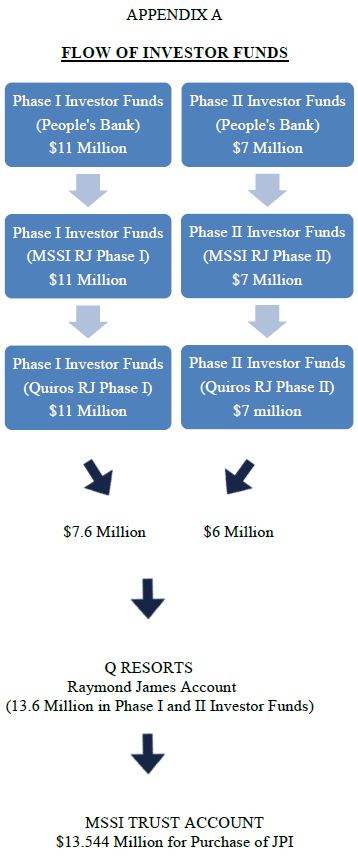 IV. CONCLUSION
The record supports a preliminary finding that Quiros was the architect of a fraudulent scheme to use investor funds to enrich himself. The result is a financially strapped ski resort, unpaid contractors, unfinished projects, and unhappy investors at risk of losing their residency status in the United States. Accordingly, the Court finds a preliminary injunction is necessary to maintain the status quo pending a trial on the merits.
Case 1:16-cv-21301-DPG Document 238 Entered on FLSD Docket 11/21/2016 Page 38 of 44 - 39 -
It is therefore ORDERED AND ADJUDGED as follows:
A. Defendant Quiros is preliminarily enjoined from violating Section 17(a) of the Securities Act [15 U.S.C. § 77q(a)] in the offer or sale of any security by the use of any means or instruments of transportation or communication in interstate commerce or by use of the mails, directly or indirectly:
(1) to employ any device, scheme, or artifice to defraud;
(2) to obtain money or property by means of any untrue statement of a material fact or
any omission of a material fact necessary in order to make the statements made, in light of the circumstances under which they were made, not misleading; or
(3) to engage in any transaction, practice, or course of business which operates or would operate as a fraud or deceit upon the purchaser;
by directly or indirectly (i) creating a false appearance or otherwise deceiving any person, or (ii) disseminating false or misleading documents, materials, or information or making, either orally or in writing, any false or misleading statement in any communication with any investor or prospective investor; about: (A) any investment in or offering of securities, (B) the registration status of such offering or of such securities, (C) the prospects for success of any product or company, (D) the use of investor funds, or (E) the misappropriation of investor funds or investment proceeds.
B. Quiros is preliminarily enjoined from violating, directly or indirectly, Section 10(b) of the Exchange Act [15 U.S.C. § 78j(b)] and Rule 10b-5 promulgated thereunder [17 C.F.R. § 240.10b-5], by using any means or instrumentality of interstate commerce, or of the mails, or of any facility of any national securities exchange, in connection with the purchase or sale of any security:
(1) to employ any device, scheme, or artifice to defraud;
Case 1:16-cv-21301-DPG Document 238 Entered on FLSD Docket 11/21/2016 Page 39 of 44 - 40 -
(2) to make any untrue statement of a material fact or to omit to state a material fact necessary in order to make the statements made, in the light of the circumstances under which they were made, not misleading; or
(3) to engage in any act, practice, or course of business which operates or would operate as a fraud or deceit upon any person;
by (i) creating a false appearance or otherwise deceiving any person, or (ii) disseminating false or misleading documents, materials, or information or making, either orally or in writing, any false or misleading statement in any communication with any investor or prospective investor, about: (A) any investment in or offering of securities, (B) the registration status of such offering or of such securities, (C) the prospects for success of any product or company, (D) the use of investor funds, or (E) the misappropriation of investor funds or investment proceeds.
C. Quiros is preliminarily enjoined from directly or indirectly, unless he acts in good faith and does not directly or indirectly induce the act or acts constituting the violation, controlling any person who violates Section 10(b) of the Exchange Act [15 U.S.C. § 78j(b)] and Rule 10b-5 promulgated thereunder [17 C.F.R. § 240.10b-5], by using any means or instrumentality of interstate commerce, or of the mails, or of any facility of any national securities exchange, in connection with the purchase or sale of any security:
(1) to employ any device, scheme, or artifice to defraud;
(2) to make any untrue statement of a material fact or to omit to state a material fact necessary in order to make the statements made, in the light of the circumstances under which they were made, not misleading; or
(3) to engage in any act, practice, or course of business which operates or would operate as a fraud or deceit upon any person;
by (i) creating a false appearance or otherwise deceiving any person, or (ii) disseminating false
Case 1:16-cv-21301-DPG Document 238 Entered on FLSD Docket 11/21/2016 Page 40 of 44 - 41 -
or misleading documents, materials, or information or making, either orally or in writing, any false or misleading statement in any communication with any investor or prospective investor, about: (A) any investment in or offering of securities, (B) the registration status of such offering or of such securities, (C) the prospects for success of any product or company, (D) the use of investor funds, or (E) the misappropriation of investor funds or investment proceeds.
D. The asset freeze set forth in the April 12, 2016, Temporary Restraining Order [ECF No. 11], and as modified by the Court’s April 25, 2016, and May 27, 2016, Orders [ECF Nos. 82 and 148] remains pending the outcome of the litigation.
E. Quiros is preliminarily enjoined from, directly or indirectly, destroying, mutilating, concealing, altering, disposing of, or otherwise rendering illegible in any manner, any of the books, records, documents, correspondence, brochures, manuals, papers, ledgers, accounts, statements, obligations, files and other property of or pertaining to any of the Defendants or Relief Defendants, wherever located and in whatever form, electronic or otherwise, until further Order of this Court.
F. Pending further Order of the Court, pursuant to Section 21(d)(5) of the Exchange Act, Section 305(b)(5) of the Sarbanes-Oxley Act of 2002, and the Court’s equitable powers, Quiros is prohibited from, directly or indirectly, including through any entity he owns or controls: (a) participating in the issuance, offer or sale of any securities issued through the EB-5 Immigrant Investor Program (provided, however, that such injunction would not prevent him from purchasing or selling securities for his own accounts); and (b) are prohibited from participating in the management, administration, or supervision of, or otherwise exercising any control over, any commercial enterprise or project that has issued or is issuing any securities through the EB-5 Immigrant Investor program.
Case 1:16-cv-21301-DPG Document 238 Entered on FLSD Docket 11/21/2016 Page 41 of 44 - 42 -
G. As provided in Federal Rule of Civil Procedure 65(d)(2), the foregoing paragraphs also bind the following who receive actual notice of this Preliminary Injunction by personal service or otherwise: (a) any of Quiros’s officers, directors, agents, servants, employees, and attorneys; and (b) other persons in active concert or participation with Quiros.
H. This Court shall retain jurisdiction over this matter and Quiros in order to implement and carry out the terms of all Orders and Decrees that may be entered and/or to entertain any suitable application or motion for additional relief within the jurisdiction of this Court, and will order other relief that this Court deems appropriate under the circumstances.
DONE AND ORDERED in Chambers at Miami, Florida this 21st day of November, 2016.
____________________________
HONORABLE DARRIN P. GAYLES
UNITED STATES DISTRICT JUDGE
Case 1:16-cv-21301-DPG Document 238 Entered on FLSD Docket 11/21/2016 Page 42 of 44