

by Chris Graff Vermont Business Magazine Time for a change is the most powerful campaign theme. It helped to elect both Donald Trump and Phil Scott. Yet there is no comparison between the two winners. One was elected to blow things up while the other was elected to slow things down. Scott’s election fit a pattern now a deep part of Vermont’s history. For the past 54 years, without fail, when changing governors, Vermonters have replaced the governor of one party with one from the other.
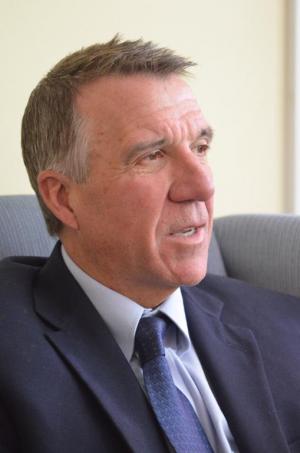 Phil Scott on the campaign trail October 2016. VBM photo.
Periods of expansion follow periods of retrenchment. Republicans follow Democrats. Like clockwork. Since 1962.
The 2016 election held true to this pulse: Scott, who campaigned as the un-Peter Shumlin, easily won election over Democrat Sue Minter.
It is wrong, however, to brush off Scott’s win as merely a reaction to Shumlin’s unpopularity. Scott faced headwinds that could easily have led to a loss: He is a Republican in the most Democratic state; the GOP presidential nominee was incredibly unpopular in Vermont; Minter had the backing of Barack Obama and Bernie Sanders. Turnout in a presidential year favors Democrats.
Working to his advantage, however, was Scott’s well-carved image as a common man in touch with the concerns of average Vermonters.
Also helping him was a gamble by Minter that Vermonters would embrace a candidate who candidly talked about the need to raise certain taxes in the state, a position that put her at odds with the last two Democrats who won the office of governor.
People may not remember given his record in office, but in Shumlin’s successful 2010 gubernatorial campaign he touted himself as a fiscal conservative who would not consider tax increases.
“Vermonters are already overtaxed,” he said. His campaign position on taxes in 2010 was summed up in one news profile this way: “He does not, for example, favor raising taxes on anything or anybody.”
That strong no-tax increase stance helped elect him in what was a narrow win over Lieutenant Governor Brian Dubie.
Howard Dean had taken the same stand. He became governor in 1991 upon the death of Governor Richard Snelling, a Republican, and worked hard to implement a bipartisan plan developed by Snelling to balance the state budget. But Dean held true to his pledge of no-tax increases even when he won election in his own right in 1992. Dean proudly touted himself as the “most fiscally conservative governor in the history of Vermont.”
Minter did not. She did not take a strong no-tax-increase-pledge and matter of fact was pretty open that some taxes might need to be implemented, raised or expanded. Although she said she would oppose raising the sales tax and income tax rates, she talked about expanding those taxes and discussed support for very broad tax reform, an idea that makes sense but does not win votes.
Another factor in the gubernatorial outcome was that most Vermonters were focused intently on the presidential race. All of the oxygen in the political universe was being sucked up by the Trump-Clinton match-up.
The most important message to emerge from the 2016 election is not, however, about our race for governor. It is quite simply a reminder that Vermont is an outlier in the United States.
Vermont is a Democratic state and the Democrats gained strength in the state with the 2016 voting. But the state of Bernie Sanders is the exception, not the rule, in America.
The GOP dominance in the rest of the country is astonishing: Republicans have won the White House, will continue to control both chambers of Congress and will control more state legislative chambers than any time in history, and more governor’s offices than they have held in nearly a century.
With some races still undecided it appears that the Republicans will control the governor’s office and both legislative chamber in at least 24 states. Democrats have that dominance in only five or six states, depending on some final outcomes.
Americans for Tax Reform, a conservative group, estimates that roughly 80 percent of the population is living in a state either all or partially controlled by Republicans.
There are many reasons for this GOP dominance, some of which, like legislative redistricting, may not reflect popular sentiments.
But this election – even with Scott’s win – makes even clearer that there is a big political divide between Vermont and the country at large.
Chris Graff, a former Vermont bureau chief of The Associated Press and host of VPT's Vermont This Week, is now vice president for communications at National Life Group. He is author of, Dateline Vermont: Covering and uncovering the newsworthy stories that shaped a state - and influenced a nation.