

Vermont Business Magazine Weekly unemployment claims fell last week for the first time this fall and are below levels from a year ago. Among industrial sectors Manufacturing claims fell by more than half from previous week, while Construction was up slightly. After running at a very low level during the latter part of the summer, overall claims have increased during the fall and have been running steadily ahead of 2015. Looking ahead, the holidays typically produce wild swings in unemployment claims, because of an increase in hiring in the Service sector, from retail to delivery-related businesses, and then an abrupt round of layoffs after Christmas.
For the week of October 29, 2016, there were 544 claims, down 74 from the previous week's total and 83 fewer than than they were a year ago.
 Altogether 3,494 new and continuing claims were filed, an increase of 94 from a week ago, and 218 fewer than a year ago.
The Department processed 0 First Tier claims for benefits under Emergency Unemployment Compensation, 2008 (EUC08).
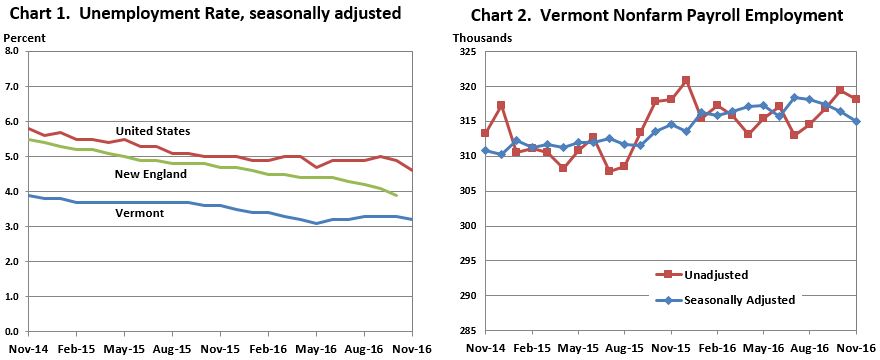
Vermont's unemployment rate remained at 3.3 percent in September, as the labor force and total employment decreased, along with a small increase in the number of unemployed. SEE STORY.
RELATED: PAI: Jobs increase, but educational and digital divides persist
The Unemployment Weekly Report can be found at: http://www.vtlmi.info/. Previously released Unemployment Weekly Reports and other UI reports can be found at: http://www.vtlmi.info/lmipub.htm#uc
NOTE: Employment (nonfarm payroll) - A count of all persons who worked full- or part-time or received pay from a nonagricultural employer for any part of the pay period which included the 12th of the month. Because this count comes from a survey of employers, persons who work for two different companies would be counted twice. Therefore, nonfarm payroll employment is really a count of the number of jobs, rather than the number of persons employed. Persons may receive pay from a job if they are temporarily absent due to illness, bad weather, vacation, or labor-management dispute. This count is based on where the jobs are located, regardless of where the workers reside, and is therefore sometimes referred to as employment "by place of work." Nonfarm payroll employment data are collected and compiled based on the Current Employment Statistics (CES) survey, conducted by the Vermont Department of Labor. This count was formerly referred to as nonagricultural wage and salary employment.