

Vermont Business Magazine Yesterday, the Department of Vermont Health Access (DVHA) submitted a report to the Health Reform Oversight and Joint Fiscal committees detailing DVHA’s increased Medicaid payments for the Enhanced Primacy Care Program (EPCP). The new payment structure results in a net increase of approximately 8.9 percent to eligible primary care providers.
 This spring, the Vermont legislature and Shumlin Administration collaborated on Act 172 which directed DVHA to use up to $4 million of funds appropriated to the Department for State Fiscal Year (SFY) 2017 to increase EPCP payments. These payments had temporarily been increased after the passage of the federal Affordable Care Act. The goal of the legislation was to restore the payments to a level closer to what had been in effect under the expired federal program.
DVHA increased baseline reimbursement rates by $4 million for Evaluation and Management (E&M) and Vaccine Administration services provided by eligible primary care physicians. These reimbursement changes effectively reallocate $4 million previously paid to academic medical centers for Medicaid covered services and increased payments for specific primary care services by the same amount. The payment structure became effective October 1, 2016 and has no net impact on DVHA’s budget.
2016 EPCP increases
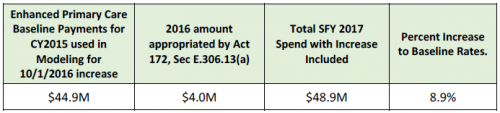
During the 2016 Legislative Session, Act 172, Section E.306.13(a) required DVHA to use up to $4 million of funds appropriated to the Department for State Fiscal Year (SFY) 2017 to increase EPCP payments effective October 1, 2016. The intent was to further restore the enhanced payments to eligible primary care providers to a level closer to what had been in effect prior to the expiration of the federal EPCP program funded through the ACA. DVHA increased baseline reimbursement rates by $4 million for E&M and Vaccine Administration services provided by eligible primary care physicians. This appropriation of additional funds resulted in an increase of approximately 8.9% and became effective October 1, 2016 as shown below.
A public notice was posted in the Vermont Global Commitment Register and in the Burlington Free Press Newspaper on August 31, 2016. The public comment period was open for 30 days. The increase to primary care reimbursements for enhanced payments must be submitted to CMS as an amendment to the Medicaid State Plan (known as a SPA). The SPA must be submitted to CMS by December 31, 2016; approval and match of federal funds will be retrospective back to October 1, 2016.
Reduction to Academic Medical Center Rates
In order to be able to manage within its appropriated budget for SFY 2017, DVHA was also authorized in Act 172, Section E.306.13(b) to offset the October 1, 2016 increase to EPCP reimbursement rates by adjusting downwards the reimbursement rates paid to Academic Medical Centers for inpatient, outpatient or professional services. This rate adjustment was effective on October 1, 2016.
Methodology
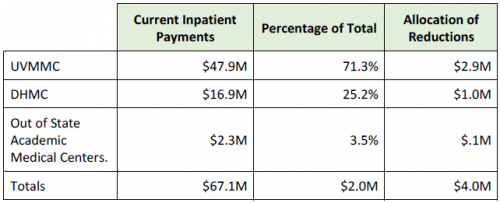
DVHA modeled various alternatives and approaches to reduce reimbursements to academic medical centers. As a result of this work, DVHA determined that the most appropriate and equitable approach was to reduce inpatient hospital rates, effective October 1, 2016. Having decided this, DVHA then developed an approach for allocating the reduction of $4 million to the impacted academic medical centers. This was accomplished by comparing and analyzing current inpatient payment amounts to the University of Vermont Medical Center (UVMMC), Dartmouth Hitchcock Medical Center (DHMC) and other Out of State (OOS) Academic Medical Centers, and apportioning the total reductions to each.
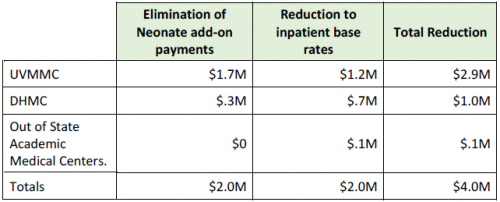
With the targeted reduction amounts known, DVHA then addressed the method within the inpatient rate methodology to reduce the $4 million in payments. Two elements of the methodology were chosen: (a) First, a provision in the inpatient reimbursement methodology that made an additional per diem payment above the case rate for neonatal cases was eliminated. Most of these payments had been made to UVMMC and DMHC. Other OOS academic medical centers were not eligible for the payment. The elimination of these payments resulted in a reduction of payments to academic medical centers of approximately $2 million. (b)The remaining $2 million reduction was made by reducing the per case payment amount to the academic medical centers. This was accomplished by reducing what is known as the hospital’s base rate.
A public notice was posted in the Vermont Global Commitment Register and in the Burlington Free Press Newspaper on September 8, 2016. The changes to inpatient hospital rates which include the elimination of neonate add-on payments and reductions to base rates for academic medical centers to offset the increase to EPCP rates will be submitted to CMS as SPA. Consistent with the changes to the EPCP payments, the SPA must be submitted to CMS by December 31, 2016; approval and match of federal funds will be retrospective back to October 1, 2016.
SUMMARY
As described above in detail and pursuant to Act 172, Section E.306.13, DVHA implemented provider reimbursement changes effective October 1, 2016 that have the effect of reallocating approximately $4 million previously paid to academic medical centers for Medicaid covered services and increased payments for specific primary care services by the same amount. The net result to DVHA SFY 17 budget is $0.
Source: DVHA 11.1.2016