

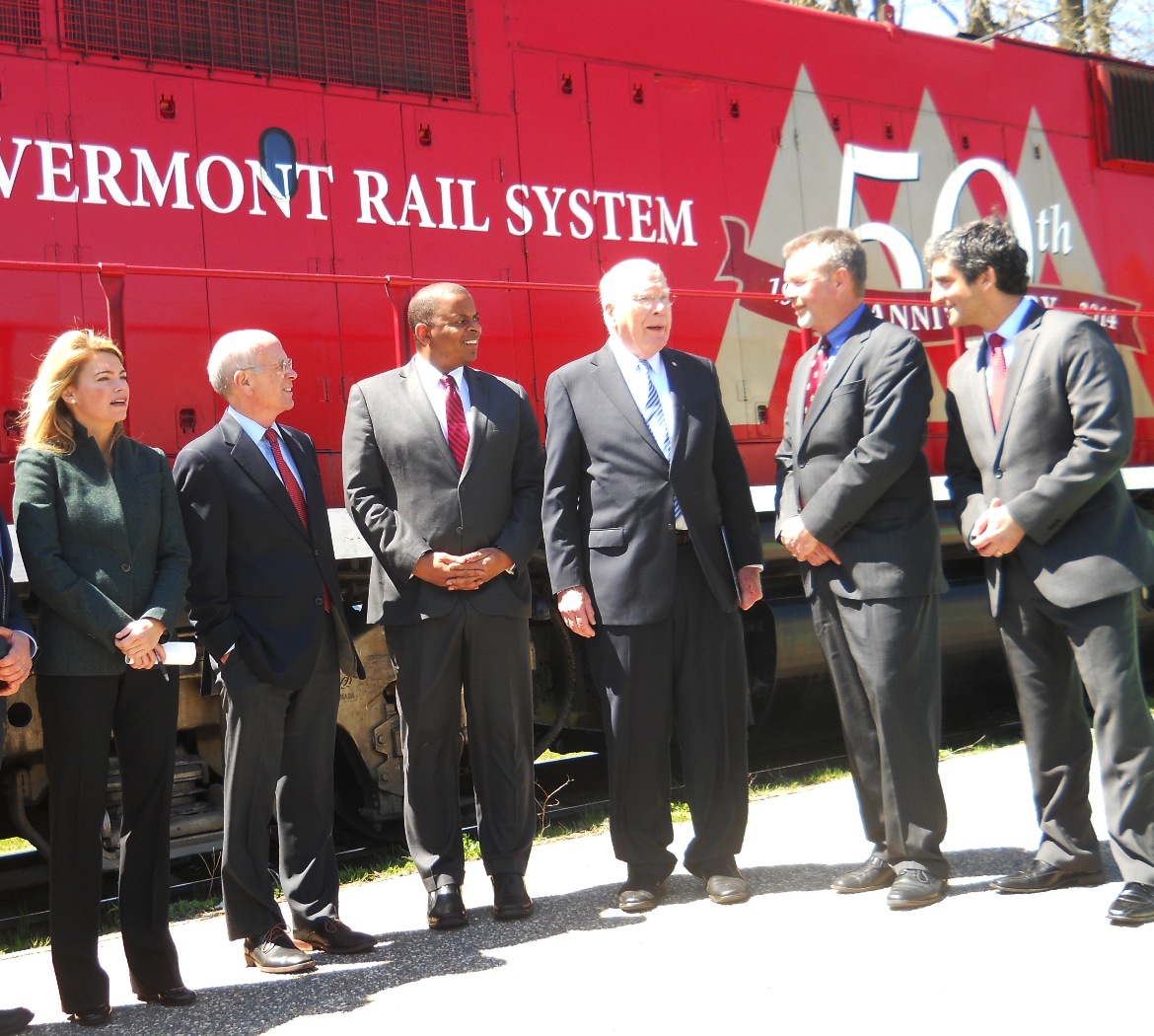
Left to right, Sarah Feinberg, Peter Welch, Anthony Foxx, Patrick Leahy, Chris Cole, Miro Weinberger. Photo C.B. Hall VBM
by C.B. Hall Vermont Business Magazine Federal and state officials converged on Burlington's Union Station Friday afternoon, May 6, to celebrate the award of $10 million in federal funds for the upgrading of the Rutland-Burlington rail line for passenger service. Leading the federal delegation were U.S. secretary of transportation Anthony Foxx and Sarah Feinberg, head of the Federal Railroad Administration. They were joined by Senator Patrick Leahy and Representative Peter Welch, with staffer David Weinstein standing in for the Vermont congressional delegation's third member, Senator Bernie Sanders. Also speaking was Burlington mayor Miro Weinberger, while state secretary of transportation Chris Cole emceed the event.
The completion of the upgrade will allow for extension of Amtrak's Ethan Allen Express train to Burlington from its current northern terminus in Rutland. The train's southern terminus is New York City.
The $10 million will be matched by a state appropriation of about $11 million, while over $5 million from other federal sources will complete the financing for the $26-plus million undertaking. The project will encompass the laying of improved rail at points along the 67-mile route, bridge repairs, safety improvements at road crossings, and station platforms in Middlebury and Vergennes as well as Burlington.
Passenger trains last served the Queen City in 1953.
“It's going to be a major breakthrough” for Burlington, Weinberger said. After conveying Sanders regrets for his absence, Weinstein noted that the presidential candidate, while mayor of Burlington in the early 1980s, directed city staffers to look into restoring passenger service to the city.
Since then, the campaign to bring passenger trains back to Union Station has been a matter of baby steps. Cole noted that the current $26 million investment will “unlock” some $70 million in previous investments on the rail route, which the state has owned since the 1960s. The Vermont Railway carries freight traffic on the line through a lease agreement with the state. The investment program will improve the route's capacity for freight, too.
There was no shortage of mutual back-slapping at Friday's event, as speaker yielded to speaker at the podium. The federal funding source, the Transportation Investment Generating Economic Recovery (TIGER) grant program, has proven wildly popular, Foxx noted – and Vermont has gotten a nice share of the funds available. In the most recent funding round, the federal government received 627 applications, but grant awards went to only 40 recipients, the Vermont Department of Transportation (VTrans) among them.
“Getting a TIGER grant is a little like getting into Harvard,” he put it, by way of congratulating Vermont.
“We have to be in the construction and repair business – or we're going to choke on our own traffic,” he expressed his view of what his department and its state analogs need to be doing.
He and other speakers emphasized passenger rail improvements as a matter of expanding economic opportunities. “In his remarks, Leady added that “when the government makes infrastructure investments, the private sector follows suit.”
Cole concluded the event by handing out a golden railroad spike to each of the speakers, but with a caveat. “We'd like to have that returned,” he advised, “when this project is completed in four years.” That would mean, come the target date of 2020, a spike-driving ceremony reminiscent of the joining of the rails in Utah, in 1869, to complete the nation's first transcontinental rail link.
The restoration of passenger rail - and tracks capable of sustaining it - between Burlington and Rutland may not rival that watershed event in the Utah desert, but connecting the state's two largest urban centers with passenger service after a hiatus of 60-odd years seems, if nothing else, the closing of a major gap in Vermont's transportation system.
Interviewed after the meeting, VTrans rail program manager Dan Delabruere told VBM that he expected a travel time of just over an hour and a half between the two cities. The object is to be “very competitive with car,.” Cole added.
All public road crossings will be gated, and 11 miles of jointed rail will be replaced with continuous welded rail, which provides a smoother ride and reduces maintenance needs. The track will be capable of carrying freight cars weighing up to 143 tons, the industry standard.
Delabruere said that some technical aspects of the project remain unsettled. They include the construction of wyes - triangular track configurations for turning the train around. VTrans, he said, continues to consider the possibility of taking the empty train from Burlington eight miles onward to Essex Junction, where a wye already exists, thus removing any need to build a wye in a possibly cramped location in Burlington.
He said that the state and the feds were in the midst of drafting a cooperative agreement on how the federal money will be applied. He guessed that that agreement would be finalized within the next two months, approximately. That will allow establishment of a sort of escrow account from which the state will be able to draw on the funding incrementally as the project work unfolds.
Foxx was formerly the mayor of Charlotte, the largest city in North Carolina, which, in cooperation with Amtrak, has implemented one of the nation's more successful passenger rail programs. Asked after the event if he had any advice for Vermont as it moves forward with the Rutland-Burlington initiative, he said, “the biggest thing is having city-pairs the people want to take advantage of,” referring to a trip's beginning and destination. In his state that meant Charlotte and Raleigh, whose populations dwarf Burlington's and Rutland's - but the fact that the Vermont's new service will connect its two largest cities indicates if nothing else that the passenger rail system that the state has underwritten since the 1990s will have closed one of the yawning gaps in its coverage.