

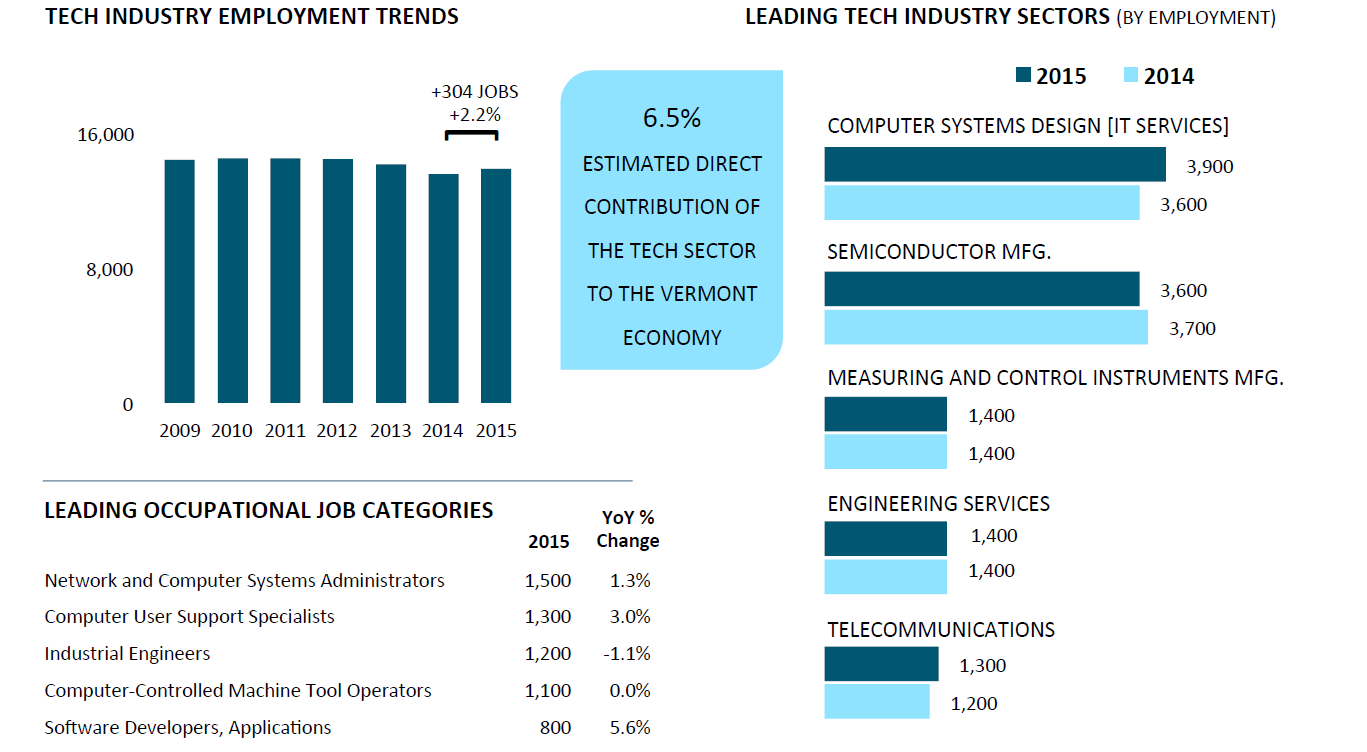
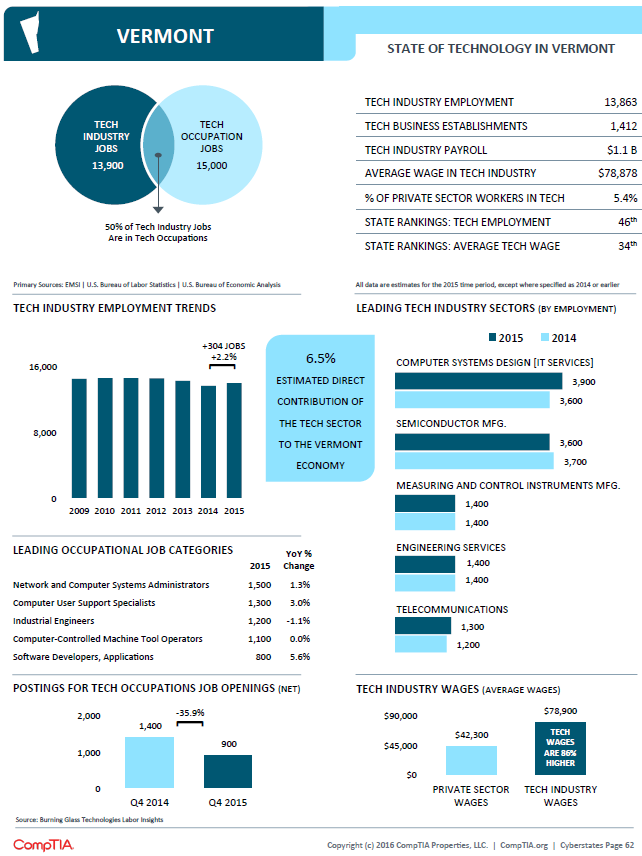
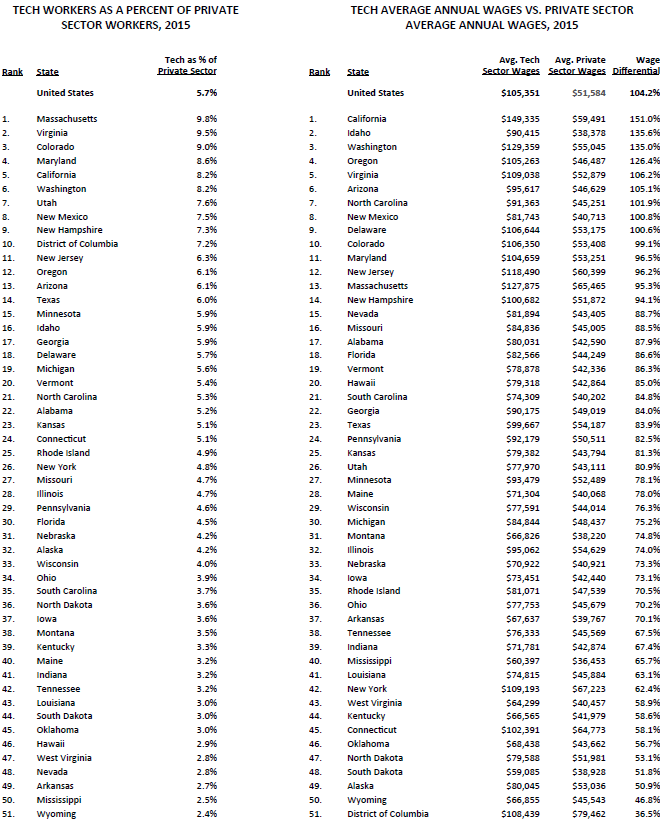
Vermont Business Magazine Vermont's tech industry is relatively larger than most states and pays a lot better than the average private sector job here, but it has lost ground in recent years until rebounding slightly in 2015. Vermont surprisingly has a relatively low number of women in the tech sector. According a CompTIA report released Tuesday, Vermont’s tech industry employment ranked 46th in the country and employed 13,863 workers in 2015. On top of this, Vermont added 304 jobs between 2014 and 2015 – a number that’s expected to continue to rise in 2016. These workers also had an annual average salary of $78,878, which was 86 percent more than the average private sector wage in the entire state. Perhaps more importantly, according to the report, Vermont's tech payroll of $1.1 billion in 2015 ranked 34th nationwide, accounting for 5.4 percent of all private sector payroll in Vermont and 6.5 percent of the state economy is from the tech industry. Vermont ranks 49th in total population (California is first and Wyoming is last).
However, according to the report (Cyberstates 2016 ) Vermont's tech employment peaked in 2011 at 14,510 and fell to 13,559 in 2014 before rebounding to 13,863 in 2015. The state's 2014-2015 increase was 2.2 percent, while the national rate increased 3 percent. Vermont's average wage peaked in 2009 at $80,375, while the 2015 average wage was up very slightly from 2014. The US average peaked at $80,375 in 2015, up 1.2 percent from 2014. Average US tech average was 7.1 percent of GSP, with Oregon first at 23 percent of GSP and Wyoming last at 1.5 percent. Vermont ranked 13th in number of tech businesses as percent of total private sector businesses (6.1 percent) and 19th in total payroll as percent of total private sector payroll (10.1 percent).
Vermont was near the bottom (48th) in the number of women in the tech workforce (30.2 percent).
 The Computing Technology Industry Association (CompTIA) presents its 17th annual edition of Cyberstates. CompTIA designed this report to serve as a reference tool, making national and state-level data accessible to a wide range of users. Cyberstates quantifies the size and scope of the tech sector and the tech workforce across multiple vectors. To provide additional context, Cyberstates includes: trending, average wages, business establishments, job postings, gender ratios, tech patents and venture capital funding, and more.