

by Michael Bielawski Vermont Watchdog After dozens of hours of testimony and debate — and plenty of jargon about renewable energy credits and portfolio standards — the Senate Committee on Natural Resources and Energy approved a bill aimed at reforming Vermont’s energy siting process. On Friday afternoon, the five-member committee voted unanimously to approve S230, the Energy Development Improvement Act.
“I think it’s a very meaningful piece of legislation,” said state Senator Diane Snelling, R-Chittenden, the committee vice chair (SEE TEXT OF BILL BELOW). “We’ve taken the recommendations of the siting commission, and we’ve given municipalities a very clear path to express their preferred locations and to work within the guidelines to improve the process (of) the Public Service Board with the Public Assistant Officers. So there’s a lot of pieces in there.”
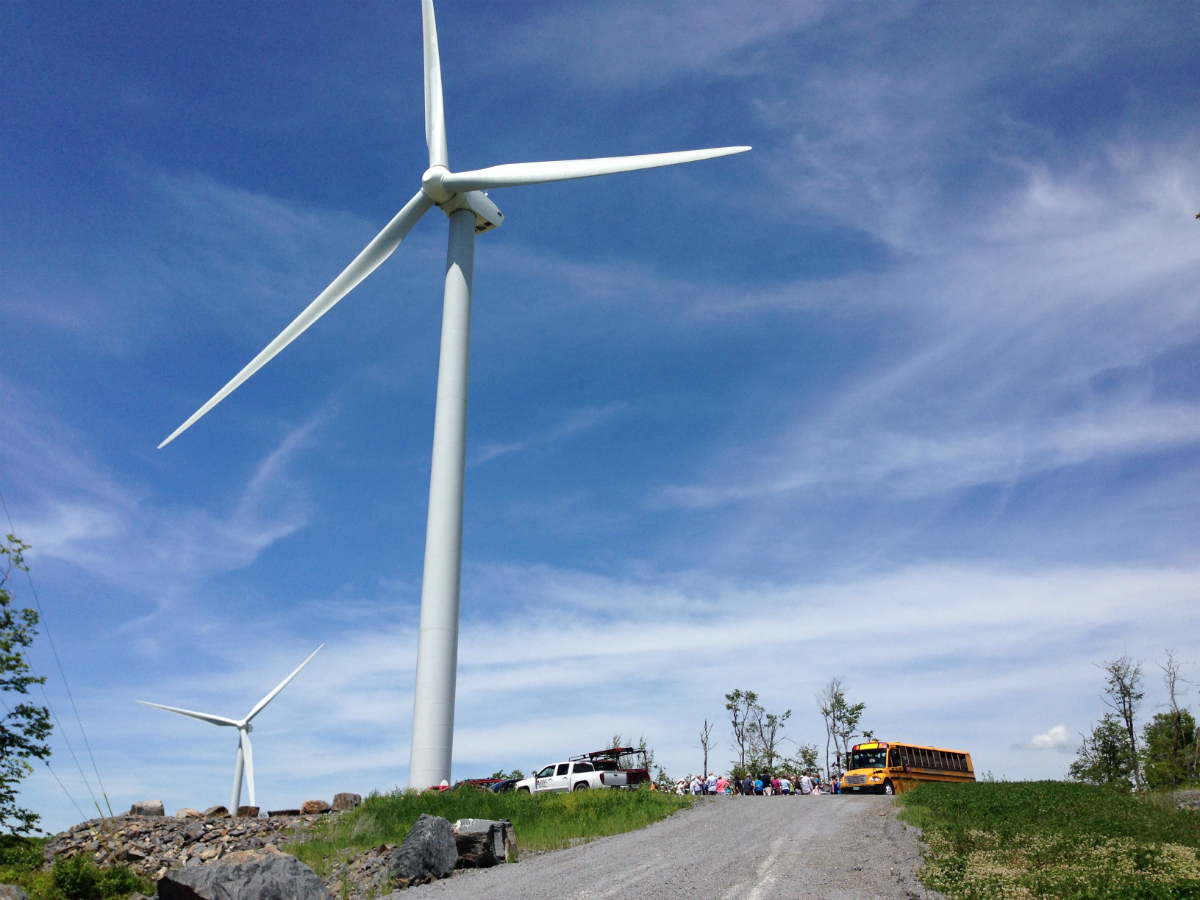
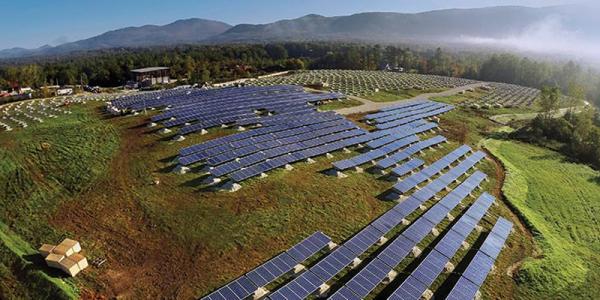 Right, The Stafford solar farm in Rutland. Above, Georgia wind mills. Courtesy photos.
State Senator Brian Campion, D-Bennington, celebrated the lack of dissent.
“With a vote of 5-0, that’s a big committee vote. It’s a strong endorsement,” he said. “I think it will be interesting to see what the House does. I’m sure there will be some tweaks.”
RELATED: Bray: Giving Vermonters greater voice in our energy future
The Energy Development Improvement Act aims to give more leverage to municipal and regional planners during the siting process. That means taking some power away from the PSB, a quasi-judicial board that has rubber-stamped nearly every renewable energy project submitted for approval.
State Sen. John Rodgers, D-Essex/Orleans, said the PSB still makes the final call despite increased local participation.
The siting reform effort started largely from towns signing on to the “Rutland Resolution,” a resolution calling for increased input of municipalities regarding energy projects in certificate of public good proceedings before the PSB. About 96 towns have signed the resolution since it was first introduced in 2014.
S.230 offers financial and process incentives for decision makers to choose locations that don’t disrupt property value, rich farm land or the environment. The bill’s preferred locations include existing structures, parking lots, brownfields and other non-intrusive choices.
Other provisions include appropriations for a public finance officer to help gather information for the public, but not to advise them. New net metering projects greater than 150 kilowatts should be bonded for decommission, and those greater than 15 kilowatts but less than 150 kilowatts should have plans for decommission. Petitions for a certificate of public good should include an analysis of greenhouse gas impacts.
State Rep. Marianna Gamache, R-Swanton, a member of the House Energy Committee, noted that S.230 lacks a wind turbine component.
“This passed without any reference to sound regarding the wind turbines,” she said. “I’m very disappointed because this is a real issue for people who are living under the blade. This will now affect those people going forward.”
An amendment by Rodgers regarding wind turbine noise was rejected by a 3-2 vote. Rodgers said there is no apparent criteria for determining the appropriate distance and decibel noise levels for siting wind turbines. Rodgers proposed that turbines be located a distance of at least 10 times the height of a turbine, in addition to decibel limits for home locations.
The failed amendment might have affected seven wind turbines proposed in Swanton, which would be within 2,500 feet of homes, less than half the standard proposed by Rodgers.
Annette Smith, executive director of Vermonters for a Clean Environment, said she’s not satisfied with the legislation.
“The idea that municipal plans have to get certified in order to get substantial deference at the Public Service Board, I think that’s absurd,” Smith said. “I hope that it does not pass the Senate.”
Smith called some of the changes “a really inappropriate intrusion into the planning process.” She also noted regional plans are supposed to last for eight years and town plans for five, and they cannot be updated in a timely manner.
“We just adopted the new energy section of the Rutland Regional Plan last June, and we are looking to have to update it again,” Smith said. “This just means that planners become these perpetual paper generators, as you are constantly reopening your plan. The fact is that energy plans change with governors.”
The bill now heads to the Senate Finance and Appropriations Committees and then to the Senate Floor.
Contact Michael Bielawski at [email protected]
S. 230.
An act relating to improving the siting of energy projects.
Reported favorably with recommendation of amendment by Senator Bray for the Committee on Natural Resources & Energy.
The Committee recommends that the bill be amended by striking out all after the enacting clause and inserting in lieu thereof the following:
* * * Designation * * *
Sec. 1. DESIGNATION OF ACT
This act shall be referred to as the Energy Development Improvement Act.
* * * Integration of Energy and Land Use Planning * * *
- 739 -
Sec. 2. 24 V.S.A. § 4302 is amended to read:
§ 4302. PURPOSE; GOALS
* * *
(c) In addition, this chapter shall be used to further the following specific goals:
(1) To plan development so as to maintain the historic settlement pattern of compact village and urban centers separated by rural countryside.
(A) Intensive residential development should be encouraged primarily in areas related to community centers, and strip development along highways should be discouraged.
(B) Economic growth should be encouraged in locally designated growth areas, employed to revitalize existing village and urban centers, or both, and should be encouraged in growth centers designated under chapter 76A of this title.
(C) Public investments, including the construction or expansion of infrastructure, should reinforce the general character and planned growth patterns of the area.
(D) Development should be undertaken in accordance with smart growth principles as defined in subdivision 2791(13) of this title.
(2) To provide a strong and diverse economy that provides satisfying and rewarding job opportunities and that maintains high environmental standards, and to expand economic opportunities in areas with high unemployment or low per capita incomes.
* * *
(4) To provide for safe, convenient, economic, and energy efficient transportation systems that respect the integrity of the natural environment, including public transit options and paths for pedestrians and bicyclers.
(A) Highways, air, rail, and other means of transportation should be mutually supportive, balanced, and integrated.
(5) To identify, protect, and preserve important natural and historic features of the Vermont landscape, including:
(A) significant natural and fragile areas;
(B) outstanding water resources, including lakes, rivers, aquifers, shorelands, and wetlands;
(C) significant scenic roads, waterways, and views;
- 740 -
(D) important historic structures, sites, or districts, archaeological sites, and archaeologically sensitive areas.
(6) To maintain and improve the quality of air, water, wildlife, and land resources.
(A) Vermont’s air, water, wildlife, mineral, and land resources should be planned for use and development according to the principles set forth in 10 V.S.A. § 6086(a).
(B) Vermont’s water quality should be maintained and improved according to the policies and actions developed in the basin plans established by the Secretary of Natural Resources under 10 V.S.A. § 1253.
(7) To encourage the efficient use of energy and the development of renewable energy resources, consistent with the following:
(A) Vermont’s greenhouse gas reduction goals under 10 V.S.A. § 578(a);
(B) Vermont’s 25 by 25 goal for renewable energy under 10 V.S.A. § 580;
(C) Vermont’s building efficiency goals under 10 V.S.A. § 581;
(D) State energy policy under 30 V.S.A. § 202a and the specific recommendations identified in the State energy plans adopted pursuant to 30 V.S.A. §§ 202 and 202b pertaining to the efficient use of energy and the siting and development of renewable energy resources; and
(E) the distributed renewable generation and energy transformation categories of resources to meet the requirements of the Renewable Energy Standard under 30 V.S.A. §§ 8004 and 8005.
* * *
(9) To encourage and strengthen agricultural and forest industries.
(A) Strategies to protect long-term viability of agricultural and forest lands should be encouraged and should include maintaining low overall density.
(B) The manufacture and marketing of value-added agricultural and forest products should be encouraged.
(C) The use of locally-grown food products should be encouraged.
(D) Sound forest and agricultural management practices should be encouraged.
- 741 -
(E) Public investment should be planned so as to minimize development pressure on agricultural and forest land.
* * *
Sec. 3. 24 V.S.A. § 4345 is amended to read:
§ 4345. OPTIONAL POWERS AND DUTIES OF REGIONAL PLANNING
COMMISSIONS
Any regional planning commission created under this chapter may:
* * *
(6) Undertake studies and make recommendations on land development, urban renewal, transportation, economic, industrial, commercial, and social development, urban beautification and design improvements, historic and scenic preservation, the conservation of energy and the development of renewable energy resources, State capital investment plans, and wetland protection.
* * *
Sec. 4. 24 V.S.A. § 4345a is amended to read:
§ 4345a. DUTIES OF REGIONAL PLANNING COMMISSIONS
A regional planning commission created under this chapter shall:
* * *
(14) Appear before the Public Service Board to aid the Board in making determinations under 30 V.S.A. § 248 and shall have the right to appear and participate in proceedings under that statute.
* * *
(19) Undertake studies and make recommendations on the conservation of energy and the development of renewable energy resources.
Sec. 5. CLARIFICATION OF EXISTING LAW
Sec. 4 of this act, amending 24 V.S.A. § 4345a(14) (participation in Section 248 proceedings), clarifies existing law.
Sec. 6. 24 V.S.A. § 4348a is amended to read:
§ 4348a. ELEMENTS OF A REGIONAL PLAN
(a) A regional plan shall be consistent with the goals established in section 4302 of this title and shall include the following:
- 742 -
(1) A statement of basic policies of the region to guide the future growth and development of land and of public services and facilities, and to protect the environment.
(2) A land use element, which shall consist of a map and statement of present and prospective land uses:
(A) indicating those areas proposed for forests, recreation, agriculture (using the agricultural lands identification process established in 6 V.S.A. § 8), residence, commerce, industry, public, and semi-public uses, open spaces, and areas identified by the State, regional planning commissions or municipalities, which require special consideration for aquifer protection, wetland protection, or for other conservation purposes;
(B) indicating those areas within the region that are likely candidates for designation under sections 2793 (downtown development districts), 2793a (village centers), 2793b (new town centers), and 2793c (growth centers) of this title;
(C) indicating locations proposed for developments with a potential for regional impact, as determined by the regional planning commission, including flood control projects, surface water supply projects, industrial parks, office parks, shopping centers and shopping malls, airports, tourist attractions, recreational facilities, private schools, public or private colleges, and residential developments or subdivisions;
(D) setting forth the present and prospective location, amount, intensity, and character of such land uses and the appropriate timing or sequence of land development activities in relation to the provision of necessary community facilities and services;
(E) indicating those areas that have the potential to sustain agriculture and recommendations for maintaining them which may include transfer of development rights, acquisition of development rights, or farmer assistance programs.
(3) An energy element, which may include an a comprehensive analysis of energy resources, needs, scarcities, costs, and problems within the region, across all energy sectors, including electric, thermal, and transportation; a statement of policy on the conservation and efficient use of energy and the development and siting of distributed and utility-scale renewable energy resources, and; a statement of policy on patterns and densities of land use and control devices likely to result in conservation of energy; and a statement of policy on and identification of potential areas for the development and siting of renewable energy resources and areas that are inappropriate for siting those resources or particular categories or sizes of those resources.
- 743 -
(4) A transportation element, which may consist of a statement of present and prospective transportation and circulation facilities, and a map showing existing and proposed highways, including limited access highways, and streets by type and character of improvement, and where pertinent, anticipated points of congestion, parking facilities, transit routes, terminals, bicycle paths and trails, scenic roads, airports, railroads and port facilities, and other similar facilities or uses, and recommendations to meet future needs for such facilities, with indications of priorities of need, costs, and method of financing.
* * *
Sec. 7. 24 V.S.A. § 4352 is added to read:
§ 4352. CERTIFICATION OF ENERGY COMPLIANCE; REGIONAL AND
MUNICIPAL PLANS
(a) Regional plan certification. A regional planning commission may submit its adopted regional plan to the Commissioner of Public Service appointed under 30 V.S.A. § 1 for a certification of energy compliance. The Commissioner shall issue such a certification on finding that the regional plan is consistent with the statutes, goals, and policies listed in subdivision 4302(c)(7) of this title.
(b) Municipal plan certification. If the Commissioner of Public Service has certified a regional plan that is in effect, a municipal legislative body within the region may submit its adopted municipal plan to the regional planning commission for a certification of energy compliance. Such a submission may be made separately from or at the same time as a request for review and approval of the municipal plan under section 4350 of this title. The regional planning commission shall issue such a certification on finding that the regional plan is consistent with the statutes, goals, and policies listed in subdivision 4302(c)(7) of this title and the portions of the regional plan that implement those statutes, goals, and policies.
(c) Standards. In determining whether to issue a certification of energy compliance under this section, the Commissioner or regional planning commission shall employ the standards for issuing such a certification developed pursuant to 30 V.S.A. §§ 202(b)(6) and 202b(a)(3).
(d) Process. Review of whether to issue a certification under this section shall include a public hearing noticed at least 15 days in advance by direct mail to the requesting regional planning commission or municipal legislative body, posting on the website of the entity from which the certification is requested, and publication in a newspaper of general publication in the region or municipality affected. The Commissioner or regional planning commission
- 744 -
shall grant or deny certification within two months of the receipt of a request for certification. If certification is denied, the Commissioner or regional planning commission shall state the reasons for denial in writing and, if appropriate, suggest acceptable modifications. Submissions for certification that follow a denial shall receive a grant or denial of certification within 45 days.
Sec. 8. 24 V.S.A. § 4382 is amended to read:
§ 4382. THE PLAN FOR A MUNICIPALITY
(a) A plan for a municipality may shall be consistent with the goals established in section 4302 of this title and compatible with approved plans of other municipalities in the region and with the regional plan and shall include the following:
(1) A statement of objectives, policies, and programs of the municipality to guide the future growth and development of land, public services, and facilities, and to protect the environment.
(2) A land use plan:
(A) consisting of a map and statement of present and prospective land uses, indicating those areas proposed for forests, recreation, agriculture (using the agricultural lands identification process established in 6 V.S.A. § 8), residence, commerce, industry, public, and semi-public uses and open spaces reserved for flood plain, wetland protection, or other conservation purposes;
(B) setting forth the present and prospective location, amount, intensity, and character of such land uses and the appropriate timing or sequence of land development activities in relation to the provision of necessary community facilities and service; and
(C) identifying those areas, if any, proposed for designation under chapter 76A of this title, together with, for each area proposed for designation, an explanation of how the designation would further the plan’s goals and the goals of section 4302 of this title, and how the area meets the requirements for the type of designation to be sought.
(3) A transportation plan, consisting of a map and statement of present and prospective transportation and circulation facilities showing existing and proposed highways and streets by type and character of improvement, and where pertinent, parking facilities, transit routes, terminals, bicycle paths and trails, scenic roads, airports, railroads, and port facilities, and other similar facilities or uses, with indications of priority of need.
(4) A utility and facility plan, consisting of a map and statement of present and prospective community facilities and public utilities showing
- 745 -
existing and proposed educational, recreational and other public sites, buildings and facilities, including hospitals, libraries, power generating plants and transmission lines, water supply, sewage disposal, refuse disposal, storm drainage, and other similar facilities and activities, and recommendations to meet future needs for community facilities and services, with indications of priority of need, costs and method of financing.
(5) A statement of policies on the preservation of rare and irreplaceable natural areas, and scenic and historic features and resources.
* * *
(9) An energy plan, including an a comprehensive analysis of energy resources, needs, scarcities, costs, and problems within the municipality, across all energy sectors, including electric, thermal, and transportation; a statement of policy on the conservation and efficient use of energy, including programs, such as thermal integrity standards for buildings, to implement that policy,; a statement of policy on the development and siting of distributed and utility-scale renewable energy resources,; a statement of policy on patterns and densities of land use likely to result in conservation of energy and a statement of policy on and identification of potential areas for the development and siting of renewable energy resources and areas that are inappropriate for siting those resources or particular categories or sizes of those resources.
* * *
Sec. 9. 30 V.S.A. § 202 is amended to read:
§ 202. ELECTRICAL ENERGY PLANNING
(a) The Department of Public Service, through the Director for Regulated Utility Planning, shall constitute the responsible utility planning agency of the State for the purpose of obtaining for all consumers in the State proper utility service at minimum cost under efficient and economical management consistent with other public policy of the State. The Director shall be responsible for the provision of plans for meeting emerging trends related to electrical energy demand, supply, safety, and conservation.
(b) The Department, through the Director, shall prepare an electrical energy plan for the State. The Plan shall be for a 20-year period and shall serve as a basis for State electrical energy policy. The Electric Energy Plan shall be based on the principles of “least cost integrated planning” set out in and developed under section 218c of this title. The Plan shall include at a minimum:
(1) an overview, looking 20 years ahead, of statewide growth and development as they relate to future requirements for electrical energy,
- 746 -
including patterns of urban expansion, statewide and service area economic growth, shifts in transportation modes, modifications in housing types, and design, conservation, and other trends and factors which, as determined by the Director, will significantly affect State electrical energy policy and programs;
(2) an assessment of all energy resources available to the State for electrical generation or to supply electrical power, including, among others, fossil fuels, nuclear, hydro-electric, biomass, wind, fuel cells, and solar energy and strategies for minimizing the economic and environmental costs of energy supply, including the production of pollutants, by means of efficiency and emission improvements, fuel shifting, and other appropriate means;
(3) estimates of the projected level of electrical energy demand;
(4) a detailed exposition, including capital requirements and the estimated cost to consumers, of how such demand shall be met based on the assumptions made in subdivision (1) of this subsection and the policies set out in subsection (c) of this section; and
(5) specific strategies for reducing electric rates to the greatest extent possible in Vermont over the most immediate six-year period, for the next succeeding six-year period, and long-term sustainable strategies for achieving and maintaining the lowest possible electric rates over the full 20-year planning horizon consistent with the goal of maintaining a financially stable electric utility industry in Vermont; and
(6) the following for use as guidance to municipal and regional planning commissions in preparing municipal and regional plans under 24 V.S.A. chapter 117 that are consistent with the statutes listed in 24 V.S.A. § 4302(c)(7) and with the Plan and in obtaining a certification of energy compliance under that chapter:
(A) specific recommendations on the conservation and efficient use of electric energy and the development and siting of renewable electric generation, developed in accordance with 24 V.S.A. § 4302(c)(7); and
(B) based on 24 V.S.A. § 4302(c)(7) and the recommendations developed under subdivision (A) of this subdivision (6), a list of standards for use in determining whether municipal and regional plans should receive a certificate of energy compliance under 24 V.S.A. § 4352.
(c) In developing the Plan, the Department shall take into account the protection of public health and safety; preservation of environmental quality; the goals of 24 V.S.A. § 4302; the potential for reduction of rates paid by all retail electricity customers; the potential for reduction of electrical demand through conservation, including alternative utility rate structures; use of load
- 747 -
management technologies; efficiency of electrical usage; utilization of waste heat from generation; and utility assistance to consumers in energy conservation.
(d) In establishing plans, the Director shall:
(1) Consult with:
(A) the public;
(B) Vermont municipal utilities and planning commissions;
(C) Vermont cooperative utilities;
(D) Vermont investor-owned utilities;
(E) Vermont electric transmission companies;
(F) environmental and residential consumer advocacy groups active in electricity issues;
(G) industrial customer representatives;
(H) commercial customer representatives;
(I) the Public Service Board;
(J) an entity designated to meet the public’s need for energy efficiency services under subdivision 218c(a)(2) of this title;
(K) other interested State agencies; and
(L) other energy providers; and
(M) the regional planning commissions.
* * *
(h) The Plans adopted under this section shall become the electrical energy portion of the State Energy Plan.
* * *
Sec. 10. 30 V.S.A. § 202b is amended to read:
§ 202b. STATE COMPREHENSIVE ENERGY PLAN
(a) The Department of Public Service, in conjunction with other State agencies designated by the Governor, shall prepare a State Comprehensive Energy Plan covering at least a 20-year period. The Plan shall seek to implement the State energy policy set forth in section 202a of this title and shall be consistent with the goals of 24 V.S.A. § 4302. The Plan shall include:
- 748 -
(1) a comprehensive analysis and projections regarding the use, cost, supply, and environmental effects of all forms of energy resources used within Vermont; and
(2) recommendations for State implementation actions, regulation, legislation, and other public and private action to carry out the comprehensive energy plan; and
(3) the following for use as guidance to municipal and regional planning commissions in preparing municipal and regional plans under 24 V.S.A. chapter 117 that are consistent with the statutes listed in 24 V.S.A. § 4302(c)(7) and with the Plan and in obtaining a certification of energy compliance under that chapter:
(A) specific recommendations on the conservation and efficient use of energy and the development and siting of energy facilities, developed in accordance with 24 V.S.A. § 4302(c)(7); and
(B) based on 24 V.S.A. § 4302(c)(7) and the policies developed under subdivision (A) of this subdivision (3), a list of standards for use in determining whether municipal and regional plans should receive a certificate of energy compliance under 24 V.S.A. § 4352.
(b) In developing or updating the Plan’s recommendations, the Department of Public Service shall seek public comment by holding public hearings in at least five different geographic regions of the State on at least three different dates, and by providing notice through publication once a week and at least seven days apart for two or more successive weeks in a newspaper or newspapers of general circulation in the regions where the hearings will be held, and by delivering notices to all licensed commercial radio and television stations with transmitting facilities within the State, plus Vermont Public Radio and Vermont Educational Television.
(c) The Department shall adopt a State Energy Plan on or before January 1, 2016 and shall readopt the Plan by every sixth January 1 thereafter. On adoption or readoption, the Plan shall be submitted to the General Assembly. The provisions of 2 V.S.A. § 20(d)(expiration of required reports) shall not apply to such submission.
(1) Upon adoption of the Plan, analytical portions of the Plan may be updated and published biennially.
(2) Every fourth year after the adoption or readoption of a Plan under this section, the Department shall publish the manner in which the Department will engage the public in the process of readopting the Plan under this section.
- 749 -
(3) The publication requirements of subdivisions (1) and (2) of this subsection may be met by inclusion of the subject matter in the Department’s biennial report.
(4) The Plan’s implementation recommendations shall be updated by the Department no less frequently than every six years. These recommendations shall be updated prior to the expiration of six years if the General Assembly passes a joint resolution making a request to that effect. If the Department proposes or the General Assembly requests the revision of implementation recommendations, the Department shall hold public hearings on the proposed revisions.
(d) Distribution of the Plan to members of the General Assembly shall be in accordance with the provisions of 2 V.S.A. § 20(a)-(c).
Sec. 11. INITIAL IMPLEMENTATION; CERTIFICATION
STANDARDS
(a) On or before October 1, 2016, the Department of Public Service shall publish specific recommendations and standards in accordance with 30 V.S.A. §§ 202(b)(6) and 202b(a)(3) as enacted by Secs. 8 and 10 of this act. Prior to issuing these recommendations and standards, the Department shall post on its website a draft set of initial recommendations and standards and provide notice and an opportunity to comment and request a public hearing to all persons listed in 30 V.S.A. § 202(d)(1). The Commissioner may elect to hold one or more public hearings on the Commissioner’s own initiative.
(b) On publication under subsection (a) of this section, the specific recommendations and standards shall be considered an appendix to the currently adopted plans under 30 V.S.A. §§ 202 and 202b. After this publication, the Department may revise these policies and procedures in accordance with the procedures for adopting and revising plans under those statutes.
Sec. 12. 30 V.S.A. § 248(b) is amended to read:
(b) Before the Public Service Board issues a certificate of public good as required under subsection (a) of this section, it shall find that the purchase, investment, or construction:
(1) With respect to an in-state facility, will not unduly interfere with the orderly development of the region with due consideration having been given to the recommendations of the municipal and regional planning commissions, the recommendations of the municipal legislative bodies, and the land conservation measures contained in the plan of any affected municipality. However:
- 750 -
(A) with With respect to a natural gas transmission line subject to Board review, the line shall be in conformance with any applicable provisions concerning such lines contained in the duly adopted regional plan; and, in addition, upon application of any party, the Board shall condition any certificate of public good for a natural gas transmission line issued under this section so as to prohibit service connections that would not be in conformance with the adopted municipal plan in any municipality in which the line is located; and.
(B) with With respect to a ground-mounted solar electric generation facility, the facility shall comply with the screening requirements of a municipal bylaw adopted under 24 V.S.A. § 4414(15) or a municipal ordinance adopted under 24 V.S.A. § 2291(28), and the recommendation of a municipality applying such a bylaw or ordinance, unless the Board finds that requiring such compliance would prohibit or have the effect of prohibiting the installation of such a facility or have the effect of interfering with the facility’s intended functional use.
(C) With respect to an in-state electric generation facility, the Board shall give substantial deference to the land conservation measures and specific policies contained in a duly adopted regional and municipal plan that has received a certificate of energy compliance under 24 V.S.A. § 4352. In this subdivision (C), “substantial deference” means that a land conservation measure or specific policy shall be applied in accordance with its terms unless there is a clear and convincing demonstration that other factors affecting the general good of the State outweigh the application of the measure or policy.
* * *
* * * Regulatory and Financial Incentives; Preferred Locations * * *
Sec. 13. 30 V.S.A. § 8002(30) is added to read:
(30) “Preferred location” means a site within the State on which a renewable energy plant will be located that is one of the following:
(A) A new or existing structure, including a commercial or residential building, a parking lot, or parking lot canopy, whose primary use is not the generation of electricity or providing support for the placement of equipment that generates electricity.
(B) A tract previously developed for a use other than siting a plant on which a structure or impervious surface was lawfully in existence and use prior to January 1 of the year in which an application for a certificate of public good under section 248 of this title for the plant is filed or in which the plant seeks an award of a contract under the standard offer program under section 8005a of
- 751 -
this title, whichever is earlier. To qualify under this subdivision (B), the limits of disturbance of a proposed renewable energy plant must include either the existing structure or impervious surface and shall not include any headwaters, streams, shorelines, floodways, rare and irreplaceable natural areas, necessary wildlife habitat, wetlands, endangered species, productive forestlands, and primary agricultural soils, all of which are as defined in 10 V.S.A. chapter 151.
(C) Land certified by the Secretary of Natural Resources to be a brownfield site as defined under 10 V.S.A. § 6642.
(D) A sanitary landfill as defined in 10 V.S.A. § 6602, provided that the Secretary of Natural Resources certifies that the land constitutes such a landfill and is suitable for the development of the plant.
(E) The disturbed portion of a gravel pit, quarry, or similar site for the extraction of a mineral resource, provided that all activities pertaining to site reclamation required by applicable law or permit condition are satisfied prior to the installation of the plant.
(F) A specific location designated in a duly adopted municipal plan under 24 V.S.A. chapter 117 for the siting of a renewable energy plant or specific type or size of renewable energy plant, provided that the plant meets any siting criteria recommended in the plan for the location. On or after January 1, 2019, to qualify under this subdivision (F), the plan must be certified under 24 V.S.A. § 4352.
(G) If the plant constitutes a net metering system, then in addition to subdivisions (A) through (F) of this subdivision (30), a site designated by Board rule as a preferred location.
Sec. 14. 30 V.S.A. § 8004(g) is added to read:
(g) Preferred locations. With respect to a renewable energy plant to be located in the State whose energy or environmental attributes may be used to satisfy the requirements of the RES, the Board shall exercise its authority under this section and sections 8005 and 8006 of this title to promote siting such a plant in a preferred location.
Sec. 15. 30 V.S.A. § 8005a is amended to read:
§ 8005a. STANDARD OFFER PROGRAM
(a) Establishment. A standard offer program is established. To achieve the goals of section 8001 of this title, the Board shall issue standard offers for renewable energy plants that meet the eligibility requirements of this section. The Board shall implement these standard offers by rule, order, or contract and shall appoint a Standard Offer Facilitator to assist in this implementation. For
- 752 -
the purpose of this section, the Board and the Standard Offer Facilitator constitute instrumentalities of the State.
(b) Eligibility. To be eligible for a standard offer under this section, a plant must constitute a qualifying small power production facility under 16 U.S.C. § 796(17)(C) and 18 C.F.R. part 292, must not be a net metering system under section 219a of this title, and must be a new standard offer plant. In this section, “new standard offer plant” means a renewable energy plant that is located in Vermont, that has a plant capacity of 2.2 MW or less, and that is commissioned on or after September 30, 2009.
(c) Cumulative capacity. In accordance with this subsection, the Board shall issue standard offers to new standard offer plants until a cumulative plant capacity amount of 127.5 MW is reached.
(1) Pace. Annually commencing April 1, 2013, the Board shall increase the cumulative plant capacity of the standard offer program (the annual increase) until the 127.5-MW cumulative plant capacity of this subsection is reached.
(A) Annual amounts. The amount of the annual increase shall be five MW for the three years commencing April 1, 2013, 7.5 MW for the three years commencing April 1, 2016, and 10 MW commencing April 1, 2019.
(B) Blocks. Each year, a portion of the annual increase shall be reserved for new standard offer plants proposed by Vermont retail electricity providers (the provider block), and the remainder shall be reserved for new standard offer plants proposed by persons who are not providers (the independent developer block).
(i) The portion of the annual increase reserved for the provider block shall be 10 percent for the three years commencing April 1, 2013, 15 percent for the three years commencing April 1, 2016, and 20 percent commencing April 1, 2019.
(ii) If the provider block for a given year is not fully subscribed, any unsubscribed capacity within that block shall be added to the annual increase for each following year until that capacity is subscribed and shall be made available to new standard offer plants proposed by persons who are not providers.
(iii) If the independent developer block for a given year is not fully subscribed, any unsubscribed capacity within that block shall be added to the annual increase for each following year until that capacity is subscribed and:
- 753 -
(I) shall be made available to new standard offer plants proposed by persons who are not providers; and
(II) may be made available to a provider following a written request and specific proposal submitted to and approved by the Board.
(C) Adjustment; greenhouse gas reduction credits. The Board shall adjust the annual increase to account for greenhouse gas reduction credits by multiplying the annual increase by one minus the ratio of the prior year’s greenhouse gas reduction credits to that year’s statewide retail electric sales.
(i) The amount of the prior year’s greenhouse gas reduction credits shall be determined in accordance with subdivision 8006a(a) of this title.
(ii) The adjustment in the annual increase shall be applied proportionally to the independent developer block and the provider block.
(iii) Greenhouse gas reduction credits used to diminish a provider’s obligation under section 8004 of this title may be used to adjust the annual increase under this subsection (c).
(D) Pilot project; preferred locations. For a period of three years commencing on January 1, 2017:
(i) The Board shall allocate the following portions of the annual increase to new standard offer plants that will be wholly located in one or more preferred locations other than parking lots or parking lot canopies:
(I) one-sixth of the annual increase, during the first year;
(II) one-quarter of the annual increase, during the second year; and
(III) one-third of the annual increase, during the third year.
(ii) The Board separately shall allocate the following portions of the annual increase to new standard offer plants that will be wholly located on parking lots or parking lot canopies:
(I) one-sixth of the annual increase, during the first year;
(II) one-quarter of the annual increase, during the second year; and
(III) one-third of the annual increase, during the third year.
(iii) To qualify for these allocations, the plant shall not require the construction of a new substation by the interconnecting retail electricity
- 754 -
provider or by increasing the capacity of one or more of the provider’s existing facilities.
(iv) These allocations shall apply proportionally to the independent developer block and provider block.
(v) If in a given year an allocation under this pilot project is not fully subscribed, the Board in the same year shall allocate the unsubscribed capacity to new standard offer plants outside the pilot project.
(2) Technology allocations. The Board shall allocate the 127.5-MW cumulative plant capacity of this subsection among different categories of renewable energy technologies. These categories shall include at least each of the following: methane derived from a landfill; solar power; wind power with a plant capacity of 100 kW or less; wind power with a plant capacity greater than 100 kW; hydroelectric power; and biomass power using a fuel other than methane derived from an agricultural operation or landfill.
* * *
(f) Price. The categories of renewable energy for which the Board shall set standard offer prices shall include at least each of the categories established pursuant to subdivision (c)(2) of this section. The Board by order shall determine and set the price paid to a plant owner for each kWh generated under a standard offer required by this section, with a goal of ensuring timely development at the lowest feasible cost. The Board shall not be required to make this determination as a contested case under 3 V.S.A. chapter 25.
(1) Market-based mechanisms. For new standard offer projects, the Board shall use a market-based mechanism, such as a reverse auction or other procurement tool, to obtain up to the authorized amount of a category of renewable energy, if it first finds that use of the mechanism is consistent with:
(A) applicable federal law; and
(B) the goal of timely development at the lowest feasible cost.
(2) Avoided cost.
(A) The price paid for each category of renewable energy shall be the avoided cost of the Vermont composite electric utility system if the Board finds either of the following:
(i) Use of the pricing mechanism described in subdivision (1)(market-based mechanisms) of this subsection (f) is inconsistent with applicable federal law.
(ii) Use of the pricing mechanism described in subdivision (1)(market-based mechanisms) of this subsection (f) is reasonably likely to
- 755 -
result in prices higher than the prices that would apply under this subdivision (2).
(B) For the purpose of As used in this subsection (f), the term “avoided cost” means the incremental cost to retail electricity providers of electric energy or capacity or both, which, but for the purchase through the standard offer, such providers would obtain from distributed renewable generation that uses the same generation technology as the category of renewable energy for which the Board is setting the price. For the purpose of As used in this subsection (f), the term “avoided cost” also includes the Board’s consideration of each of the following:
(i) The relevant cost data of the Vermont composite electric utility system.
(ii) The terms of the contract, including the duration of the obligation.
(iii) The availability, during the system’s daily and seasonal peak periods, of capacity or energy purchased through the standard offer, and the estimated savings from mitigating peak load.
(iv) The relationship of the availability of energy or capacity purchased through the standard offer to the ability of the Vermont composite electric utility system or a portion thereof to avoid costs.
(v) The costs or savings resulting from variations in line losses and other impacts to the transmission or distribution system from those that would have existed in the absence of purchases through the standard offer.
(vi) The supply and cost characteristics of plants eligible to receive the standard offer.
* * *
(5) Price; preferred location pilots. For the period during which the Board allocates capacity to new standard offer plants that will be wholly located in one or more preferred locations as set forth in subdivision (c)(1)(D) of this section, the following shall apply to the price paid to such a plant:
(A) In using a market-based mechanism such as a reverse auction to determine this price for each of the two allocations of capacity, the Board shall compare only the proposals of plants that qualify for the allocation.
(B) In using avoided costs to determine this price for each of the two allocations of capacity, the Board shall derive the incremental cost from distributed renewable generation that is sited on a location that qualifies for the
- 756 -
allocation and uses the same generation technology as the category of renewable energy for which the Board is setting the price.
Sec. 16. STANDARD OFFER PILOT; REPORT
On or before January 15, 2018, the Public Service Board shall file a report with the House Committee on Commerce and Economic Development, the Senate Committee on Finance, and the House and Senate Committees on Natural Resources and Energy on the progress of the standard offer pilot project on preferred locations authorized in Sec. 15 of this act. This report shall itemize the size, type of preferred location, generation technology, and cost per kilowatt hour of each application received under the pilot project and shall identify each generation facility approved under the pilot and the bill credit per kilowatt hour awarded to each such facility.
Sec. 17. 30 V.S.A. § 8010 is amended to read:
§ 8010. SELF-GENERATION AND NET METERING
* * *
(c) In accordance with this section, the Board shall adopt and implement rules that govern the installation and operation of net metering systems.
(1) The rules shall establish and maintain a net metering program that:
* * *
(G) accounts for changes over time in the cost of technology; and
(H) allows a customer to retain ownership of the environmental attributes of energy generated by the customer’s net metering system and of any associated tradeable renewable energy credits or to transfer those attributes and credits to the interconnecting retail provider, and:
(i) if the customer retains the attributes, reduces the value of the credit provided under this section for electricity generated by the customer’s net metering system by an appropriate amount; and
(ii) if the customer transfers the attributes to the interconnecting provider, requires the provider to retain them for application toward compliance with sections 8004 and 8005 of this title; and
(I) promotes the siting of net metering systems in preferred locations.
* * *
(3) The rules shall establish standards and procedures governing application for and issuance or revocation of a certificate of public good for net
- 757 -
metering systems under the provisions of section 248 of this title. In establishing these standards and procedures, the rules:
(A) The rules may waive the requirements of section 248 of this title that are not applicable to net metering systems, including criteria that are generally applicable to public service companies as defined in this title;.
(B) The rules may modify notice and hearing requirements of this title as the Board considers appropriate;.
(C) The rules shall seek to simplify the application and review process as appropriate; and.
(D) with With respect to net metering systems that exceed 150 kW in plant capacity, shall apply the so-called “Quechee” test for aesthetic impact as described by the Vermont Supreme Court in the case of In re Halnon, 174 Vt. 515 (2002) (mem.). The rules and application form shall state the components of this test.
(E) With respect to a net metering system exceeding 15 kW in plant capacity, the rules shall not waive or include provisions that are less stringent than the following, notwithstanding any contrary provision of law:
(i) the requirement of subdivision 248(a)(4)(C) of this title to provide a copy of the application to the Agencies of Agriculture, Food and Markets and of Natural Resources; the Department of Public Service; the Division for Historic Preservation; the municipal legislative body; and the municipality and regional planning commissions; and
(ii) the requirements of subdivision 248(a)(4)(J) (required information) and subsections 248(f) (preapplication submittal) and (t) (aesthetic mitigation) and, with respect to a net metering system exceeding 150 kW in plant capacity, of subsection (u) (decommissioning) of this title.
* * *
* * * Regulatory Process; Public Assistance Officer * * *
Sec. 18. 30 V.S.A. § 3 is amended to read:
§ 3. PUBLIC SERVICE BOARD
(a) The public service board Public Service Board shall consist of a chairperson chair and two members. The chairperson Chair and each member shall not be required to be admitted to the practice of law in this state State.
* * *
(g) The chairperson Chair shall have general charge of the offices and employees of the board Board.
- 758 -
(h) The Board shall employ a Public Assistance Officer (PAO) in accordance with this subsection.
(1) The PAO shall provide guidance to and answer questions from parties and members of the public on all matters under this title concerning the siting and construction of facilities in the State that generate or transmit electricity, constitute a meteorological station as defined in section 246 of this title, or constitute a natural gas facility as defined in subdivision 248(a)(3) of this title. As used in this section:
(A) “Contested case” has the same meaning as in 3 V.S.A. § 801.
(B) “Matter” means any proceeding before or by the Board, including an application for a certificate of public good, a petition for condemnation, rulemaking, and the issuance of guidance or procedures.
(2) Guidance and information to be provided by the PAO shall include the following:
(A) An explanation of the proceeding, including its purpose; its type, such as rulemaking or contested case; and the restrictions or lack of restrictions applicable to the type of proceeding, such as whether ex parte communications are prohibited.
(B) Answers to procedural questions and direction to the statutes and rules applicable to the proceeding.
(C) How to participate in the proceeding including, if necessary for participation, how to file to a motion to intervene and how to submit prefiled testimony. The Board shall create forms and templates for motions to intervene, prefiled testimony, and other types of documents commonly filed with the Board, which the PAO shall provide to a person on request. The Board shall post these forms and templates on the Board’s website.
(D) The responsibilities of intervenors and other parties.
(E) The status of the proceeding. Examples of a proceeding’s status include: a petition has been filed; the proceeding awaits scheduling a prehearing conference or hearing; parties are conducting discovery or submitting prefiled testimony; hearings are concluded and parties are preparing briefs; and the proceeding is under submission to the Board and awaits a decision. For each proceeding in which the next action constitutes the issuance of an order, decision, or proposal for decision by the Board or a hearing officer, the Chair or assigned hearing officer shall provide the PAO with an expected date of issuance and the PAO shall provide this expected date to requesting parties or members of the public.
- 759 -
(3) For each proceeding within the scope of subdivision (1) of this subsection, the Board shall post, on its website, electronic copies of all filings and submissions to the Board and all orders of the Board.
(4) The Board shall adopt rules or procedures to ensure that the communications of the PAO with the Board’s members and other employees concerning contested cases do not contravene the requirements of the Administrative Procedure Act applicable to such cases.
(5) The PAO shall have a duty to provide requesting parties and members of the public with information that is accurate to the best of the PAO’s ability. The Board and its other employees shall have a duty to transmit accurate information to the PAO. However, the Board and any assigned hearing officer shall not be bound by statements of the PAO.
(6) The PAO shall not be an advocate for any person and shall not have a duty to assist a person in the actual formation of the person’s position or arguments before the Board or the actions necessary to advance the person’s position or arguments such as the actual preparation of motions, memoranda, or prefiled testimony.
(7) The Board may assign secondary duties to the PAO that do not conflict with the PAO’s execution of his or her duties under this subsection.
Sec. 19. POSITION; APPROPRIATION
The following classified position is created in the Public Service Board—one permanent, full-time Public Assistance Officer—for the purpose of Sec. 2 of this act. There is appropriated to the Public Service Board for fiscal year 2017 from the special fund described in 30 V.S.A. § 22 the amount of $100,000.00 for the purpose of this position.
Sec. 20. 30 V.S.A. § 248(a)(4) is amended to read:
(4)(A) With respect to a facility located in the State, the Public Service Board shall hold a nontechnical public hearing on each petition for such finding and certificate in at least one county in which any portion of the construction of the facility is proposed to be located.
(B) The Public Service Board shall hold technical hearings at locations which it selects.
(C) At the time of filing its application with the Board, copies shall be given by the petitioner to the Attorney General and the Department of Public Service, and, with respect to facilities within the State, the Department of Health, Agency of Natural Resources, Historic Preservation Division, Agency of Transportation, Agency of Agriculture, Food and Markets, and to the chair or director of the municipal and regional planning commissions and
- 760 -
the municipal legislative body for each town and city in which the proposed facility will be located.
(D) Notice of the public hearing shall be published and maintained on the Board’s website for at least 12 days before the day appointed for the hearing. Notice of the public hearing shall be published once in a newspaper of general circulation in the county or counties in which the proposed facility will be located, and the notice shall include an Internet address where more information regarding the proposed facility may be viewed.
(E) The Agency of Natural Resources shall appear as a party in any proceedings held under this subsection, shall provide evidence and recommendations concerning any findings to be made under subdivision (b)(5) of this section, and may provide evidence and recommendations concerning any other matters to be determined by the Board in such a proceeding.
(F) The Agency of Agriculture, Food and Markets shall have the right to appear as a party in any proceedings held under this subsection.
(G) The regional planning commission for the region in which the facility is located shall have the right to appear as a party in any proceedings held under this subsection. The regional planning commission of an adjacent region shall have the same right if the facility is located within 500 feet of the boundary of that planning commission.
(H) The legislative body and the planning commission for the municipality in which a facility is located shall have the right to appear as a party in any proceedings held under this subsection. The legislative body and planning commission of an adjacent municipality shall have the same right if the facility is located within 500 feet of the boundary of that adjacent municipality.
(I) When a person has the right to appear and participate in a proceeding before the Board under this chapter, the person may activate this right by filing a letter with the Board stating that the person appears through the person’s duly authorized representative, signed by that representative.
(J) With respect to an application for an electric generation facility with a capacity that is greater than 15 kilowatts, and in addition to any other information required by the Board, the application shall include information that delineates:
(i) the full limits of physical disturbance due to the construction and operation of the facility and related infrastructure, including areas disturbed due to the creation or modification of access roads and utility lines and the clearing or management of vegetation;
- 761 -
(ii) the presence and total acreage of primary agricultural soils as defined in 10 V.S.A. § 6001 on each tract to be physically disturbed in connection with the construction and operation of the facility and the amount of those soils to be disturbed;
(iii) all visible infrastructure associated with the facility; and
(iv) all impacts of the facility’s construction and operation under subdivision (b)(5) of this section, including impacts due to the creation or modification of access roads and utility lines and the clearing or management of vegetation.
Sec. 21. 30 V.S.A. § 248(f) is amended to read:
(f) However, plans for the construction of such a facility within the State must be submitted by the petitioner to the municipal and regional planning commissions no less than 45 days prior to application for a certificate of public good under this section, unless the municipal and regional planning commissions shall waive such requirement.
(1) Such municipal or regional planning commission may hold a public hearing on the proposed plans. Such commissions shall make recommendations, if any, to the Public Service Board and to the petitioner at least seven days prior to filing of the petition with the Public Service Board.
(2) The petitioner’s application shall address the substantive written comments related to the criteria of subsection (b) of this section received by the petitioner within 45 days of the submittal made under this subsection and the substantive oral comments related to those criteria made at a public hearing under subdivision (1) of this subsection.
* * * CPG Conditions: Aesthetics Mitigation and Decommissioning * * *
Sec. 22. 30 V.S.A. § 248(t) and (u) are added to read:
(t) A certificate under this section for an in-state facility shall require the following with respect to all measures to be undertaken to mitigate the impacts of the facility on aesthetics and scenic beauty:
(1) The certificate holder shall obtain a certification from a qualified expert that all required mitigation measures have been undertaken and all required plantings have been installed.
(2) The certificate holder shall have control over all vegetation used to demonstrate that the facility will not have an undue adverse effect on aesthetics and all locations on which mitigation plantings are required to be installed. As used in this subdivision, “control” means that the certificate holder has an enforceable right to install and maintain plantings and to manage vegetation.
- 762 -
(3) For three years after installation of all required plantings, the certificate holder annually shall submit documentation by a qualified expert that the plantings have been maintained in accordance with the approved plans.
(4) The certificate holder shall have an ongoing duty to maintain the plantings in accordance with the approved plans and replace dead or diseased plantings as soon as seasonably possible.
(5) The Board shall approve each qualified expert employed to issue a certification under this subsection. However, a qualified expert retained by the Department of Public Service shall be the one to make the certification if the Department has retained such an expert during the course of the proceeding leading to issuance of the certificate.
(u) A certificate under this section for an in-state electric generation facility with a capacity that is greater than 150 kilowatts shall require the decommissioning or dismantling of the facility and ancillary improvements at the end of the facility’s useful life and the posting of a bond or other security acceptable to the Board that is sufficient to finance the decommissioning or dismantling activities in full.
* * * Greenhouse Gases; Life Cycle Analysis * * *
Sec. 23. 30 V.S.A. § 248(v) is added to read:
(v) A petition under this section for an in-state facility that is not a net metering system as defined in this title shall include a life cycle analysis of the greenhouse gas impacts of the facility that the Board shall consider in issuing findings under subdivisions (b)(2) and (5) of this section. In this subsection, “facility” includes all generating equipment, poles, wires, substations, structures, roads, and infrastructure, and all other associated land development. This analysis shall include:
(1) emissions embodied in all facility components;
(2) emissions associated with the transportation of all such components to the site or sites at which they will be installed;
(3) emissions associated with site preparation, including the clearing of forested areas and reductions in future carbon sequestration potential from the facility site or sites;
(4) emissions associated with the construction of all facility components;
(5) emissions associated with the operation of the facility;
(6) emissions associated with the decommissioning of the facility; and
- 763 -
(7) for facilities that employ renewable energy as defined under section 8002 of this title, the reduction in greenhouse gas emissions achieved by the facility as compared to alternative generation facilities that do not employ renewable energy.
* * * Sound Standards Docket; Energy Facilities * * *
Sec. 24. SOUND STANDARDS DOCKET; COMPLETION DATE
On or before September 1, 2016, the Public Service Board shall issue a final order in its pending Docket 8167, Investigation into the potential establishment of standards related to sound levels from the operation of generation, transmission, and distribution equipment by entities subject to Public Service Board jurisdiction.
* * * Agency of Agriculture, Food and Markets; Fees; Billback * * *
Sec. 25. 30 V.S.A. § 248c is added to read:
§ 248c. FEES; AGENCY OF AGRICULTURE, FOOD AND MARKETS; PARTICIPATION IN ENERGY SITING PROCEEDINGS
(a) Establishment. This section establishes fees for the purpose of supporting the role of the Agency of Agriculture, Food and Markets (the Agency) in reviewing applications for in-state facilities under section 248 of this title. These fees are in addition to the fees under section 248b of this title.
(b) Payment. The applicant shall pay the fee into the State Treasury at the time the application for a certificate of public good under section 248 of this title is filed with the Public Service Board in an amount determined in accordance with this section. The fee shall be credited to a special fund that shall be established and managed pursuant to 32 V.S.A. chapter 7, subchapter 5, and which shall be available to the Agency to offset the cost of participation in proceedings under section 248 of this title.
(c) Application. The fee established under this section shall apply only if any generation equipment, utility lines, roads, or other improvements associated with an in-state facility seeking a certificate of public good under section 248 of this title will be located on a tract of land that contains primary agricultural soils as defined in 10 V.S.A. § 6001.
(c) Amount. The fee shall be 10 percent of the amount calculated in accordance with subsection 248b(d) of this title.
* * * Allocation of AAFM Costs * * *
Sec. 26. 30 V.S.A. §§ 20 and 21 are amended to read:
§ 20. PARTICULAR PROCEEDINGS; PERSONNEL
- 764 -
(a)(1) The Board or Department may authorize or retain legal counsel, official stenographers, expert witnesses, advisors, temporary employees, and other research services:
* * *
(2) The Agency of Natural Resources may authorize or retain legal counsel, official stenographers, expert witnesses, advisors, temporary employees, other research, scientific, or engineering services to:
(A) Assist the Agency of Natural Resources in any proceeding under section 248 of this title.
(B) Monitor compliance with an order issued under section 248 of this title.
(C) Assist the Board or Department in any proceedings described in subdivisions (b)(9) (Federal Energy Regulatory Commission) and (11) (Nuclear Regulatory Commission) of this section. Allocation of Agency of Natural Resources costs under this subdivision (C) shall be in the same manner as provided under subdivisions (b)(9) and (11) of this section. The Agency of Natural Resources shall report annually to the Joint Fiscal Committee all costs incurred and expenditures charged under the authority of this subsection with respect to proceedings under subdivision (b)(9) of this section and the purpose for which such costs were incurred and expenditures made.
(3) The Agency of Agriculture, Food and Markets may authorize or retain legal counsel, official stenographers, expert witnesses, advisors, temporary employees, other research, scientific, or engineering services to:
(A) assist the Agency of Agriculture, Food and Markets in any proceeding under section 248 of this title; or
(B) monitor compliance with an order issued under section 248 of this title.
(4) The personnel authorized by this section shall be in addition to the regular personnel of the Board or Department or other State agencies; and in the case of the Department or other State agencies may be retained only with the approval of the Governor and after notice to the applicant or the public service company or companies. The Board or Department shall fix the amount of compensation and expenses to be paid such additional personnel, except that the Agency of Natural Resources or of Agriculture, Food and Markets, respectively, shall fix the amount of compensation and expenses to be paid to additional personnel that it retains under subdivision (2) of this subsection.
* * *
- 765 -
§ 21. PARTICULAR PROCEEDINGS; ASSESSMENT OF COSTS
(a) The Board, the Department, or the Agency of Natural Resources An agency may allocate the portion of the expense incurred or authorized by it in retaining additional personnel for the particular proceedings authorized in pursuant to section 20 of this title to the applicant or the public service company or companies involved in those proceedings. As used in this section, “agency” means an agency, board, or department of the State enabled to authorize or retain personnel under section 20 of this title.
(1) The Board shall upon petition of an applicant or public service company to which costs are proposed to be allocated, review and determine, after opportunity for hearing, having due regard for the size and complexity of the project, the necessity and reasonableness of such costs, and may amend or revise such allocations. Nothing in this section shall confer authority on the Board to select or decide the personnel, the expenses of whom are being allocated, unless such personnel are retained by the Board. Prior to allocating costs, the Board shall make a determination of the purpose and use of the funds to be raised hereunder, identify the recipient of the funds, provide for allocation of costs among companies to be assessed, indicate an estimated duration of the proceedings, and estimate the total costs to be imposed. With the approval of the Board, such estimates may be revised as necessary. From time to time during the progress of the work of such additional personnel, the Board, the Department, or the Agency of Natural Resources agency retaining the personnel shall render to the company detailed statements showing the amount of money expended or contracted for in the work of such personnel, which statements shall be paid by the applicant or the public service company into the State Treasury at such time and in such manner as the Board, the Department, or the Agency of Natural Resources agency may reasonably direct.
(2) In any proceeding under section 248 of this title, the Agency of Natural Resources may allocate the portion of the expense incurred in retaining additional staff authorized in subsection 21(a) of this title only if the following apply:
(A) the Agency does not have the expertise and the retention of such expertise is required to fulfill the Agency’s statutory obligations in the proceeding; and
(B) the Agency allocates only that portion of the cost for such expertise that exceeds the fee paid by the applicant under section 248b of this title.
- 766 -
(b) When regular employees of the Board, the Department, or the Agency of Natural Resources an agency are employed in the particular proceedings described in section 20 of this title, the Board, the Department, or the Agency of Natural Resources agency may also allocate the portion of their costs and expenses to the applicant or the public service company or companies involved in the proceedings. The costs of regular employees shall be computed on the basis of working days within the salary period. The manner of assessment and of making payments shall otherwise be as provided for additional personnel in subsection (a) of this section. However, with respect to proceedings under section 248 of this title, the Agency of Natural Resources shall not allocate the costs of regular employees.
* * *
(d) The Agency of Natural Resources may allocate expenses under this section only for costs in excess of the amount specified in 3 V.S.A. § 2809(d)(1)(A).
(e) On Annually on or before January 15, 2011, and annually thereafter, the Agency of Natural Resources and of Agriculture, Food and Markets each shall report to the Senate and House Committees on Natural Resources and Energy, the Senate Committee on Agriculture, and the House Committee on Agriculture and Forests Products the total amount of expenses allocated under this section during the previous fiscal year. The report shall include the name of each applicant or public service company to whom expenses were allocated and the amount allocated to each applicant or company.
* * *
* * * Effective Dates * * *
Sec. 27. EFFECTIVE DATES
This act shall take effect on July 1, 2016, except that:
(1) This section and Sec. 11 (initial implementation; certification standards) shall take effect on passage. The following in Secs. 2, 9, and 10 shall apply on passage to the activities of the Department of Public Service under Sec. 11: 24 V.S.A. § 4302(c) and 30 V.S.A. §§ 202(b)(6) and 202b(a)(3).
(2) Sec. 17 (net metering systems) shall take effect on January 2, 2017, and shall amend 30 V.S.A. § 8010 as amended by 2015 Acts and Resolves No. 56, Sec. 12.
(Committee vote: 5-0-0)