

Vermont Business Magazine The Vermont Department of Labor announced today that the seasonally-adjusted statewide unemployment rate for January was 3.4 percent. This represents a decrease of one-tenth of a percentage point from the revised December rate (3.5 percent). The national average in January was 4.9 percent. Vermont’s unemployment rate was tied for seventh lowest in the country. North and South Dakota tied for first at 2.8 percent and New Hampshire was next at 2.9 percent. The South and West generally had the highest rates, with Mississippi last at 6.7 percent (see table below). Based on initial 2015 data, the statewide annual average unemployment rate in Vermont was 3.7 percent. This represents a decline of three-tenths of a percentage point from the revised 2014 annual average. All the major indicators were better than for December, when the tough early start to the ski season lowered the numbers of skiers and workers. But while the weather and skiing rebounded somewhat across the state in January, the labor numbers versus last year were down considerably.
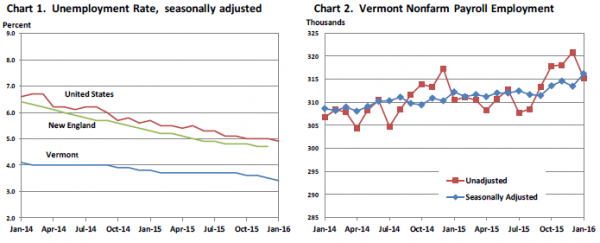 “The job numbers for January 2016 indicate job gains across the state’s employment sectors. We tracked job growth in health care, social services, construction, professional and business services, and other sectors, in a wide array of job titles and skill levels. Vermont employers have job openings for which job skills and education varies from a high school diploma to an advanced degree. The diversity of the employment base should allow most Vermonters to enter, retain and advance in Vermont’s job market. There are many programs and offerings to help Vermonters prepare for work, train for specific jobs, or continue education to be successful in today’s economy. The Vermont Department of Labor has internship and training partnerships to help both employers who need workers and Vermonters who need jobs. Current partnerships span from secondary to post-secondary education; from general career readiness to specialized technical training. There are tremendous opportunities for those looking to start or advance a career in Vermont. The Department of Labor has 12 regional offices in Vermont, and employers and job-seekers should call or visit an office to learn about our services”, said Labor Commissioner Annie Noonan.
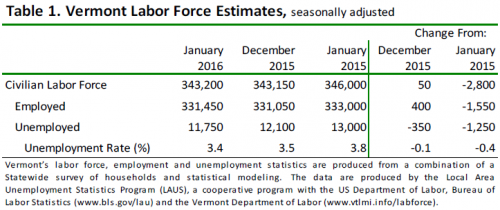 The Vermont seasonally-adjusted unemployment rate declined by one-tenth of one percentage point in January to a statewide average of 3.4 percent. The comparable rate for the United States of 4.9 percent also declined by one-tenth of one percentage point when compared to the revised December estimate. The seasonally-adjusted Vermont data for January show the Vermont civilian labor force increased by 50 from the prior month’s revised estimate. The number of employed increased by 400 and the number of unemployed decreased by 350. None of the over-the-month changes were statistically significant in the seasonally-adjusted series.
The January unemployment rates for Vermont’s 17 labor market areas ranged from 3.0 percent in White River Junction to 7.6 percent in Derby (note: local labor market area unemployment rates are not seasonally-adjusted). For comparison, the January unadjusted unemployment rate for Vermont was 4.0 percent which reflects an increase of ninth-tenths of a percentage point from the revised unadjusted December level and a decrease of four-tenths of a percentage point from a year ago.
Not-Seasonally-Adjusted
The preliminary ‘not-seasonally-adjusted’ jobs estimates for January show a decrease of 5,600 jobs when compared to the revised December numbers. There was a decrease of 1,100 jobs between the preliminary and the revised December estimates due to the inclusion of more data. The monthly decrease seen in the January numbers was spread across many industries with the notable exception of Leisure and Hospitality which increased. The broader economic trends can be detected by focusing on the over-the-year changes in this data series. As detailed in the preliminary ‘not-seasonally-adjusted’ January data, Total Private industries have increased by 4,000 jobs (1.6 percent) and Government employment has increased by 800 jobs (1.4 percent) in the past year.
Seasonally-Adjusted
The seasonally-adjusted data for January reports an increase of 2,700 jobs from the revised December data. As with the ‘not-seasonally-adjusted’ data, this over-the-month change is from the revised December numbers which experienced an 800 job decrease from the preliminary estimates. The seasonally-adjusted over-the-month changes in January were varied at the sectorial level. Those with a notable percent increase include: Professional & Business Services (+700 jobs or +2.6%), Construction (+400 jobs or +2.5%), and Durable Goods Manufacturing (+300 jobs or +1.6%). Industries with a notable percent decrease include: Private Educational Services (-200 jobs or -1.5%) and Non-Durable Goods Manufacturing (-100 jobs or -0.9%).


| Unemployment Rates for States Monthly Rankings Seasonally Adjusted Jan. 2016p |
||
|---|---|---|
| Rank | State | Rate |
| 1 | NORTH DAKOTA | 2.8 |
| 1 | SOUTH DAKOTA | 2.8 |
| 3 | NEW HAMPSHIRE | 2.9 |
| 4 | NEBRASKA | 3.0 |
| 5 | COLORADO | 3.2 |
| 5 | HAWAII | 3.2 |
| 7 | UTAH | 3.4 |
| 7 | VERMONT | 3.4 |
| 9 | IOWA | 3.5 |
| 10 | MINNESOTA | 3.7 |
| 11 | MAINE | 3.8 |
| 12 | IDAHO | 3.9 |
| 13 | KANSAS | 4.0 |
| 14 | MONTANA | 4.1 |
| 14 | OKLAHOMA | 4.1 |
| 14 | VIRGINIA | 4.1 |
| 17 | MISSOURI | 4.3 |
| 18 | ARKANSAS | 4.4 |
| 19 | NEW JERSEY | 4.5 |
| 19 | TEXAS | 4.5 |
| 21 | INDIANA | 4.6 |
| 21 | PENNSYLVANIA | 4.6 |
| 21 | WISCONSIN | 4.6 |
| 24 | DELAWARE | 4.7 |
| 24 | MASSACHUSETTS | 4.7 |
| 24 | WYOMING | 4.7 |
| 27 | MARYLAND | 4.9 |
| 27 | MICHIGAN | 4.9 |
| 27 | NEW YORK | 4.9 |
| 27 | OHIO | 4.9 |
| 31 | FLORIDA | 5.0 |
| 32 | OREGON | 5.1 |
| 33 | RHODE ISLAND | 5.3 |
| 34 | GEORGIA | 5.4 |
| 34 | TENNESSEE | 5.4 |
| 36 | CONNECTICUT | 5.5 |
| 36 | SOUTH CAROLINA | 5.5 |
| 38 | ARIZONA | 5.6 |
| 38 | NORTH CAROLINA | 5.6 |
| 40 | CALIFORNIA | 5.7 |
| 41 | KENTUCKY | 5.8 |
| 41 | WASHINGTON | 5.8 |
| 43 | LOUISIANA | 5.9 |
| 44 | ALABAMA | 6.2 |
| 44 | NEVADA | 6.2 |
| 46 | ILLINOIS | 6.3 |
| 46 | WEST VIRGINIA | 6.3 |
| 48 | DISTRICT OF COLUMBIA | 6.5 |
| 48 | NEW MEXICO | 6.5 |
| 50 | ALASKA | 6.6 |
| 51 | MISSISSIPPI | 6.7 |