

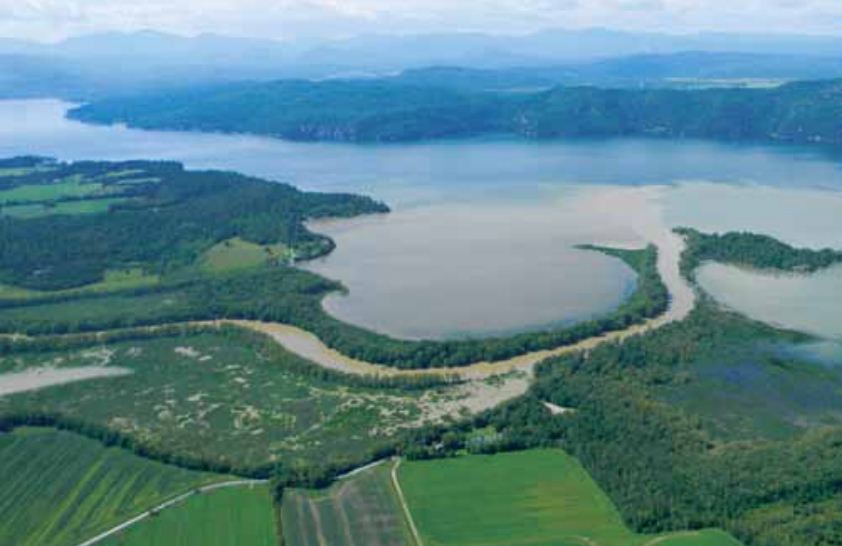
Flooding of the Otter Creek as it enters Lake Champlain following Tropical Storm Irene in 2011. State of Vermont photo.
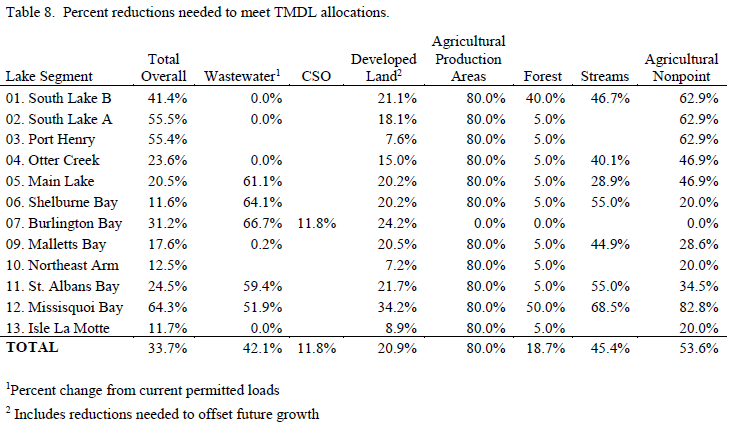
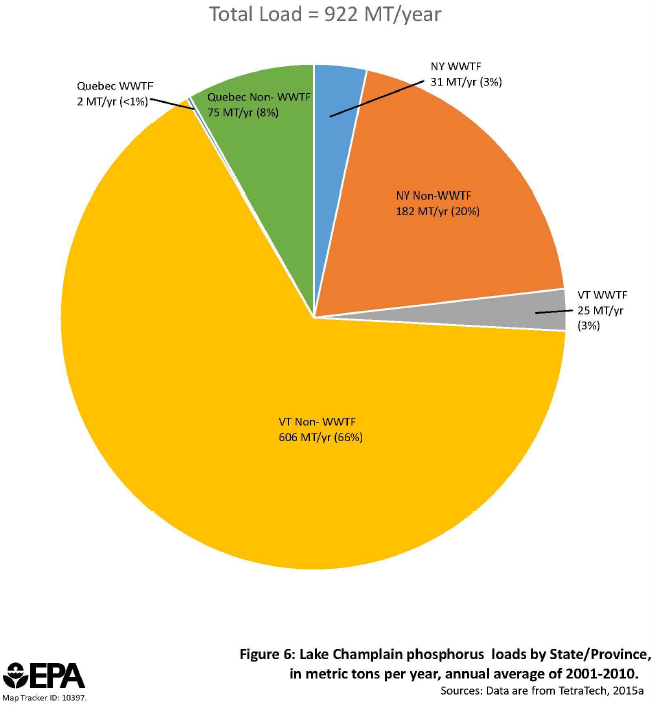
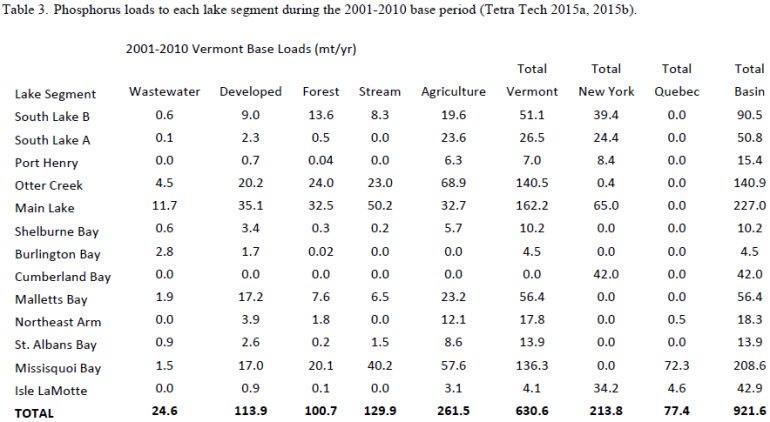
Vermont Business Magazine In Vermont, agriculture adds by far the most phosphorus to Lake Champlain and the EPA wants to cut farm-based sources by more than half under the plan it released on Friday. The EPA wants to cut total phosphorus pollution by about a third. The Otter Creek segment was the chief culprit, closely followed by the Missisquoi Bay segment. The EPA will begin judging Vermont's effort to set up a plan of action to reduce lake pollutants starting as early as the end of this year and issue a final report card by early 2018. The VNRC, for one, does not believe that the state's current rules governing Required Agricultural Practices are strict enough to achieve the EPA's goals.
RELATED STORIES:
Hearings for Ag Agency’s Required Agricultural Practices Proposed Rule to begin June 21, close July 7
Ag Agency releases second draft of Required Agricultural Practices for public review

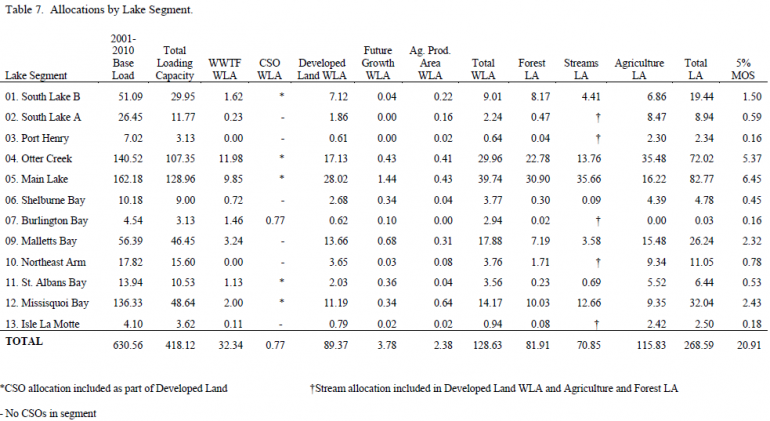
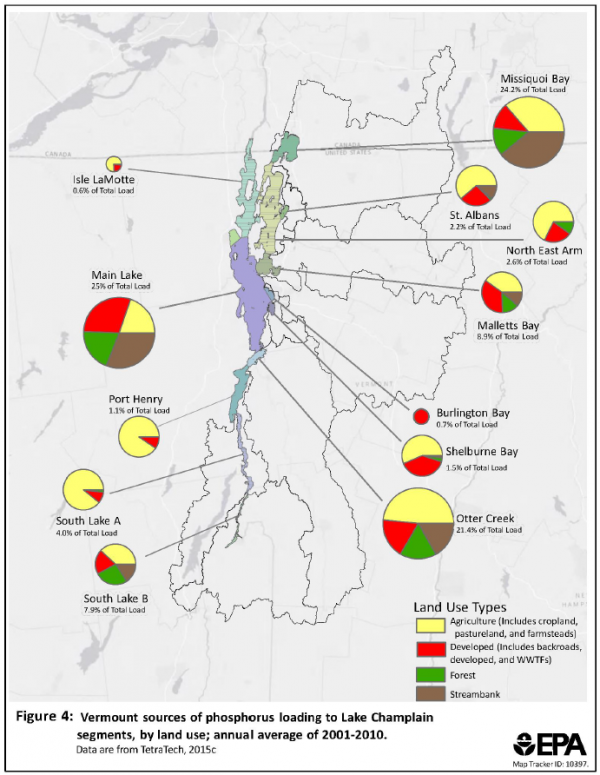 The US Environmental Protection Agency (EPA) is establishing the final Phosphorus Total Maximum Daily Loads (TMDLs) for the 12 Vermont segments of Lake Champlain.
The EPA states that too much phosphorus pollution is reaching Lake Champlain primarily from the streams and rivers draining into it. The primary concern is polluted runoff – rainwater or snowmelt that drains off of parking lots, roads and streets, logging roads, farm fields and croplands, and lawns. The runoff carries pollutants – sediment, nutrients such as phosphorus that are naturally present in soils, pet and animal wastes, fertilizers, and other pollutants – and deposits these pollutants into streams and rivers or directly into Lake Champlain. Long-term trends since 1990 indicate that phosphorus concentrations in several segments continue to increase.
EPA’s document sets targets for meeting water quality standards in each of 12 lake segments in Vermont and then subdivides the targets among the major sectors that contribute phosphorus to the Lake. Those sectors include Wastewater Treatment Facilities, runoff from developed lands and roadways, agricultural and forest lands, and erosion in unstable stream corridors. The final Phosphorus TMDLs contain refinements based on public comments received on the proposed TMDLs released in August 2015. These refinements include small adjustments among the sub-allocations within some segments, but do not significantly change the overall reduction requirements.
 “Today’s announcement marks another very important step forward in restoring the priceless beauty that is Lake Champlain,” said Curt Spalding, regional administrator of EPA’s New England office. “While EPA is setting the targets, the strategies for meeting those targets has and will continue to be led by Vermont. Act 64 and the state’s Implementation Plan provide a progressive roadmap for achieving these targets. EPA commends Vermont for some cutting edge choices on how to tackle all significant sources of phosphorus and for all the implementation planning already in motion at the state and municipal level. Our action today does not mark the end of EPA’s involvement, but rather the beginning of the next phase. EPA will continue to provide support to the Vermont agencies and will assess and report to the public on progress in meeting the commitments in Vermont’s Implementation Plan and reducing phosphorus loads to the Lake,” Spalding said.
The TMDLs are the product of a multi-year collaborative effortinvolving EPA, the VT Agency of Natural Resources, the VT Agency of Agriculture, Food and Markets and the VT Agency of Transportation. The effort also benefited from feedback from other agencies like NRCS, and organizations like the Friends of Northern Lake Champlain, the Vermont League of Cities and Towns, the Conservation Law Foundation and many other Vermonters along the way.
“This is a pivotal time for the future of Lake Champlain and Vermont,” said Deb Markowitz, Secretary of the Vermont Agency of Natural Resources. “EPA’s TMDL provides the targets to achieve a clean lake. We look forward to working across all sectors to ensure its effective implementation. Our success will lead to a more vibrant Lake, and will support the state’s tourism industry and economy overall.”
The Vermont Natural Resources Council supports the EPA report and generally wants the state to be more assertive in attaining agriculture-related requirements.
VNRC said in a statement that it is still in the process of reviewing the final document, but that it is clear that EPA's approval of the revised TMDL is a milestone and an important step forward for the future of Lake Champlain.
According to VNRC Water Program and Policy Director Jon Groveman, "The 2002 TMDL was severely flawed. The revised TMDL just approved by EPA is a significant improvement over the 2002 plan."
In particular, VNRC supports the inclusion of a detailed implementation plan, initial funding for key parts of the TMDL, and commitments to improve agricultural and stormwater regulations and to address erosion from streams and riverbanks.
“Ultimately, the success of the TMDL will be determined by the strength of the regulations to address phosphorous pollution — many of which are still being written — and a long-term commitment to funding both the programs and enforcement needed to ensure dramatic reductions in phosphorus pollution," Groveman said.
The state has recently proposed changes to the rules governing farm pollution in the form of Required Agricultural Practices. Agricultural runoff is the most significant source of phosphorous pollution in the Lake. So far VNRC has been disappointed with the strength of the regulations, in particular, the failure of the regulations to require adequate buffers between farming and surface waters and the lack of a requirement to keep livestock out of Vermont's rivers and streams.
"The TMDL will not be successful if the state does not address shortcomings in the proposed Required Agricultural Practices," Groveman said.
Similarly, the state has released a draft of potential upgrades to Vermont's stormwater regulations. VNRC has raised concerns that the phosphorous removal limits in the early draft are not stringent enough, and that the regulations do not require sufficient improvements when existing sites generating stormwater pollution are re-developed.
“Stronger stormwater regulations will be necessary to achieve the pollution reductions called for in the TMDL," Groveman said. Groveman added, “The stakes couldn't be higher for the Lake. This is our best chance to build on the hard work DEC and EPA have put into a much more viable framework for cleaning up Lake Champlain in the form of this revised TMDL than we have ever seen in the past. We can't afford to miss this opportunity.”
EPA Deadlines:
By December 30, 2016
- Required Agricultural Practices (RAP) revisions adopted [with expected elements] (Act 64, Sec. 4)
- Small Farm Operation certification program rule adopted (Act 64, Sec. 3)
- Livestock exclusion incentive program in place (Act 64, Sec. 4)
- Develop matrix and small farm template for nutrient management planning
- Develop Environmental Stewardship Incentive program in priority watersheds
- Mandate certification of custom manure applicators (Act 64, Sec. 16)
- Develop requirements for farmer training programs (Act 64, Sec. 15)
- Issue Final TS4 permit
- Adopt final Vermont Stormwater Management Manual
- Forestry AMP revisions completed (Act 64, Sec. 49)
- Legislature establishes Clean Water Improvement Fund (completed by passage of Act 64)
- Tactical Basin Plans (Phase 2) complete for Lamoille and Missisquoi basins
- Updated Report to EPA with spending plan capacity
- Issue new CSO Rule, replacing 1990 CSO Control Policy
- Develop comprehensive TMDL implementation tracking and reporting system
- Revise the Agency of Natural Resources/Agency of Agriculture, Food and Markets Memorandum of Understanding for the agricultural nonpoint source program
EPA will issue an interim report card in early 2017 assessing Vermont’s success in meeting these milestones. EPA will evaluate the substance of the various outputs as well as the completion date in assessing whether the milestone has been satisfactorily completed. Where applicable, EPA will evaluate the requirements in the various rules and programs to ensure that they include comparable measures to those EPA simulated in determining that measures would be sufficient to achieve the load and wasteload allocations.
By December 30, 2017
- NMP milestones completed
- Targeted funding for agricultural BMP and Nutrient Management Plan implementation provided in Missisquoi Bay, St. Albans Bay and South Lake
- Report to legislature on recommendations for tile drains (Act 64, Sec. 5)
- Issue Final Municipal Roads General Permit (Act 64, Sec. 31)
- Issue Final Developed Lands General Permit (Act 64, Sec. 31)
- Tactical Basin Plans (Phase 2) completed for Poultney, Mettawee and Lower Lake Champlain
- Establish long-term revenue source to support water quality improvement via the Clean Water Fund (Act 64, Sec. 40)
- Revise MS4 general permit to require existing regulated municipalities to control discharges consistent with the TMDLs’ wasteload allocations
5 The milestones scheduled for completion in 2015 in EPA”s August 2015 proposed TMDLs, have been completed.
- Propose amendments to Required Agricultural Practices to include requirements for reducing nutrient contributions form subsurface tile drainage (Act 64, Sec. 4)
- Update the Vermont Water Quality Standards, including anti-degradation, by adding a new tier that will allow for an upward reclassification of designated uses to a new, more protective class
- Complete education, outreach and compliance activities with farms in the Missisquoi Bay watershed as detailed in Section III, 6 in the Secretary of Agriculture, Food and Markets February 3, 2016 decision.
- Commence notification of affected farms about the Assessment and Plan process as detailed in section III, 7 in the February 3, 2016 decision.
EPA will issue a final report card in early 2018 assessing Vermont’s success in meeting these milestones. If EPA finds Vermont has failed to make satisfactory progress, EPA may take one or more of the following actions:
- Revise the TMDLs to reallocate additional load reductions from nonpoint to point sources, such as wastewater treatment plants (e.g., reduce the wasteload allocations for facilities in the South Lake B, Main Lake, Shelburne Bay, Burlington Bay, St. Albans Bay and Missisquoi Bay segments to loads equivalent to the limit of phosphorus removal technology).
- Expand NPDES permit coverage to unregulated sources. For example, exercise Residual Designation Authority (RDA) to increase the number of sources or communities regulated under the NPDES permit program.
- Increase and target federal enforcement and compliance assurance in the watershed.
 More information & Complete Report - Lake Champlain TMDLs: https://www.epa.gov/tmdl/lake-champlain-phosphorous-tmdl-commitment-clean-water
Notes:
A Total Maximum Daily Load (TMDL) is an important management tool that can help resource agencies determine where to focus their management efforts. A TMDL is a calculation of the loading capacity – or the maximum amount of a pollutant that a body of water can be expected to handle, while safely meeting established water quality standards.
WLA = wasteload allocation, or the portion of the TMDL allocated to existing and/or future point sources.
LA = load allocation, or the portion of the TMDL attributed to existing and/or future nonpoint sources and natural background.
MOS = margin of safety, or the portion of the TMDL that accounts for any lack of knowledge concerning the relationship between effluent limitations and water quality, such as uncertainty about the relationship between pollutant loads and receiving water quality, which can be provided implicitly by applying conservative analytical assumptions or explicitly by reserving a portion of loading capacity.
Source: EPA 6.17.2016