

Vermont Business Magazine Phil Scott, Republican candidate for governor, today introduced his plan to modernize state government by streamlining services to produce more efficiency, while also creating a better experience for Vermonters, principally by upgrading the state's Information Technology system. He also bludgeons existing management protocols by using the "disastrous" example of Vermont Health Connect to make his point. “To make Vermont more affordable, state government must be more efficient and productive,” said Scott. “As Governor, I’ll be committed to improving standards, culture and protocols so that state government works better for Vermonters, and state employees are empowered to help contribute to operational success and quality service.”
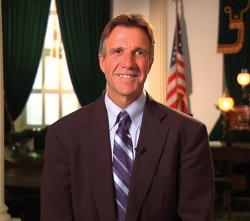 Lieutenant Governor Phil Scott.
Vermont’s state government is functioning on outdated systems that no longer meet the everyday needs and expectations of 21st century citizens. These same systems make it very difficult to identify waste, fraud and abuse, and to eliminate inefficiencies. Each year, the cost of administering and updating these old systems grows faster than the state economy.
Scott has put forward five proposals to modernize – and where necessary, restructure – government. The full plan and specifics are detailed at www.philscott.org.
The Plan's preamble states: "We need to modernize, and where necessary, restructure government by streamlining services for Vermonters to improve their experience. As the state’s disastrous and expensive experience with Vermont Health Connect has taught, we need to have far better project management protocols in place.
"Today, you must go to three different departments to register a business; you cannot track state expenditures or reliably conduct most business with the state online; and no one can view all of the services for which they are eligible on a single website. Have you ever wondered why?
"It’s because our state government functions on outdated systems that no longer meet the everyday needs and expectations of twenty-first century citizens. These same systems make it very difficult for managers to identify waste, fraud or abuse and opportunities to eliminate redundancies and achieve lower costs. Worse, each year, the cost of administering these old systems including costly updates grows faster than the state economy."
In summary, the proposals will seek to:
Create a Government Modernization & Efficiency Team Executive Order 03-17
Create the Government Modernization & Efficiency Team (GMET), through an executive order on Day One. With guidance from the State’s top IT officers and experts, GMET will be responsible for implementing agency efficiency audits, strengthening strategic IT planning, and implementing a digital government strategy focused on our citizens. The group will be charged with increasing operational efficiency, consolidating and streamlining services, accounting for the true cost of IT projects, eliminating waste, preventing fraud and abuse, and establishing clearly defined metrics to measure results and enable outcomes-based-budgeting.
Implement Proven IT Project Management Protocols and Install Experienced Professionals
Ensure enterprise wide visibility into IT projects as well as governance over IT investments. No projects will proceed without CIO approval, evaluation of risk and mitigation strategies, a trained project manager with project stopping authority, and a cost benefit analysis. The state will employ experienced IT professionals, and wherever possible, require performance-based contracts with contractors.
Set Clear, Measurable and Attainable Savings Goals Each Year
Set a goal to reduce the current operational cost of every agency and department by one cent for every dollar currently spent in Scott’s first year in office – a potential savings of $55 million. Scott’s management team will work with state employees to simplify systems and procedures, making them less costly. It will also work to reduce the size and cost of the state’s vehicle fleet, and identify opportunities to save with lower energy and supply costs, and more efficient procurement practices. Results would be transparent and progressive, with Scott proposing a quarterly report on progress and new efficiency goals each year.
Require a Citizen-Centric Management Culture
Implement a change in management strategy and culture that establishes customer service – citizen service – as a priority. Appointees will be required to manage programs based on defined outcomes, not just available funding. Scott will support investing in programs that can demonstrate measurable results, and will reform or eliminate programs that fail to do so. Clear expectations will be set to ensure Vermonters receive proper service, protocols are simplified, and questions and concerns are taken seriously and addressed promptly.
Empower Frontline State Employees with Focused Leadership that Listens
Appoint management officials who share a commitment to listening and learning from frontline staff, and who possess demonstrated expertise in significant operational improvements. Agencies and departments will be empowered – and expected – to continuously rethink and reform operations and logistics to make processes more efficient and productive. The process for rewarding state employees who contribute to substantial financial savings will also be simplified.
Source: Middlesex, Vt., June, 8th, 2016 — Scott Campaign. www.philscott.org.