

Vermont Business MagazineDespite a record winter in New England last year, year-over-year home salesincreased by 9%from 2014 to 2015 according toThe2016 RE/MAX INTEGRA, New England Housing Forecast.Single-family home transactions increased 12.6% in Vermont with 5,459 homes sold in 2015, according to NNEREN. Condominium transactions rose 1.3% with an average median selling price of $189,000.An affordable housing market in Vermont led to an increase in sales in 2015.
Median sale prices for single-family homes in Vermont remained the same at $205,000, and total volume increased by 10.5%. Single-family homes stayed on the market for an average of four fewer days in 2015, while condominiums were sold in ten fewer days on average.
According to The Vermont Realtor’s Association, 89% of homes were sold for their asking price in 2015.
“As long as homes were in the two-hundred thousand to three-hundred thousand dollar range, we had no issues,” said Russ Ingalls, Broker/Owner of RE/MAX All Seasons Realty in Lyndonville. “Because of the rough winter early in 2015, many of the buyers for the higher-priced homes waited until the spring, but never came,” he said. “We had more first-time home buyers in the market, and the inventory led us to many more sellable houses in the one-hundred-fifty-thousand and below range.”
RE/MAX INTEGRA, New England data illustrates a steady market in 2015 with approximately 13,510 additional single-family homes and condominiums sold throughout the region.Every state except Massachusetts and Rhode Island experienced double-digit sales growth year-over-year in single family homes.
RE/MAX INTEGRApredicts the 2016 market will be fueled by first-time buyers, while growing consumer confidence, low interest rates and affordability will continue to propel the regional housing market.
First-time Buyers Expected to Fuel 2016 Housing Market
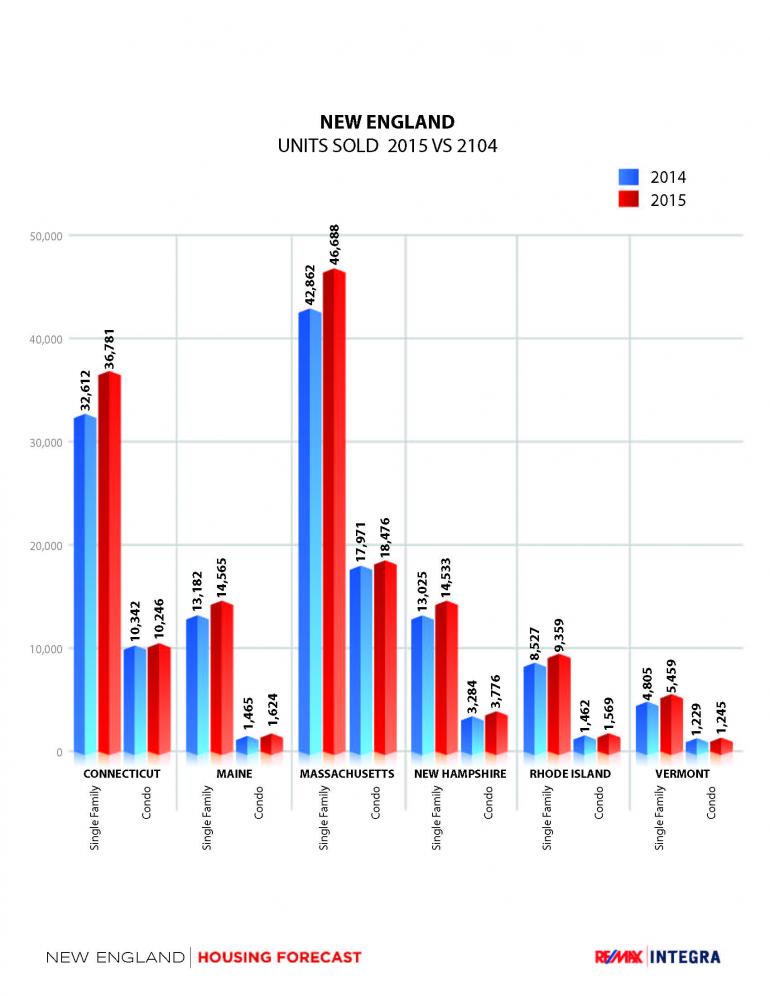 Despite a winter season that virtually closed the doors on the housing market for more than six weeks as New Englanders dug out of record snowfall, the 2015 regional housing market ended with home sales rising 9.0% higher than 2014.
Fueling the market was pent-up demand from homebuyers forced to put their plans on hold as the region struggled with historic winter conditions. Sellers reacted to the inclement weather by pulling their homes off the market and setting the stage for the perfect storm of consumer demand and limited inventory when the snow melted. Adding to the equation was speculation that the Federal Reserve would raise interest rates at the close of 2015, which it subsequently did on December 16th. This marked the first time since 2006 that the Fed has raised rates and helped to assure millions of Americans that the economy is in better shape.
According to Janet Yellen, Chair, Federal Reserve Board of Governors, “…this action marks the end of an extraordinary seven-year period during which the Federal Funds rate was held near zero to support the recovery of the economy from the worst financial crisis and recession since the great depression. It also recognizes the considerable progress that has been made toward restoring jobs, raising incomes and easing the economic hardship of millions of Americans, and reflects the Committee’s confidence that the economy will continue to strengthen.”
This increase in consumer confidence coupled with lower unemployment rates, a rebounding local economy and continued low-interest rates converged to create a steadily growing housing market throughout much of New England in 2015. As expected, the first quarter of 2015 saw lower-than-anticipated sales throughout New England, but as inventory increased and the snow finally melted, buyers hit the market hard, resulting in a busy late spring through late fall market. Investors took a backseat in 2015, as fewer distressed or under-valued properties entered the market.
RE/MAX INTEGRA, New England data illustrates a steady market in 2015 with approximately 13,510 additional single-family homes and condominiums sold throughout the region. “The record snowfall throughout New England stopped the market in its tracks and delayed the start of the busy spring season,” said Dan Breault, Executive Vice President and Regional Director of RE/MAX, INTEGRA New England. “However, the resulting pent-up demand kicked the market into high gear for the remainder of 2015, resulting in a nine-percent sales increase on average throughout the region and every state in New England experiencing home-sale growth year-over-year.”
According to Steve Harney, President and Founder of Keeping Current Matters, an organization which tracks and analyzes real estate trends, first-time homebuyers played a pivotal role in the market last year. “According to the American Enterprise Institute, home buying continued to be strong with loan volume up 15% year-over-year and much of that came from first-time buyers,” said Harney. “More and more renters found that ownership was more cost-effective than renting, and with consumer confidence high, job security strong and mortgage rates affordable, the first-time home buyer market was strong and will continue to gain momentum in 2016.”
Single-family and condominium home transactions throughout New England were up approximately 9.0% on average in 2015. Every state except Massachusetts and Rhode Island experienced double-digit sales growth year-over-year in single family homes.
In Connecticut, where the average median price of a single-family home was $185,000, sales increased 13.7% year-over-year, the highest percentage sales increase in single-family homes in New England, and condominium sales declined -2.2% according to CTMLS data (the official statewide MLS for of the Connecticut Association of REALTORS®, Inc.). According to CMLS data (the official MLS for the Greater Fairfield County Area), single-family home sales increased 10.3% and condominium sales increased 2.3%. The average median price of a single-family home was $390,000 in 2015, a decrease from the median price of $400,000 in 2014, according to CMLS figures.
According to MREIS, the average median sales price of a single-family home in Maine was up 3.7% in 2015, from $174,500 to $181,000. Single-family home transactions increased 10.5% year-over-year, from 13,182 to 14,565 homes sold. Condominium transactions increased 10.9% from 1,465 condos sold in 2014 to 1,624 sold in 2015.
The average median sales price of a single-family home in Massachusetts increased 3.0% from $332,000 in 2014 to $342,000 in 2015 according to MLSPIN data. Single-family home transactions increased 8.9% from 42,862 homes sold in 2014 to 46,688 sold in 2015, and condominium sales increased 2.8% year-over-year.
At $240,000, the average median sales price of a single-family home in New Hampshire was up 5.3% over 2014, according to NNEREN. Single-family home transactions increased 11.6% year-over-year, and condominium transactions increased 15.0% from 3,284 transactions in 2014 to 3,776 in 2015 – the highest percentage sales increase in New England.
Rhode Island single-family home sales were up 9.8% year-over-year from 8,527 homes sold in 2014, to 9,359 sold in 2015, and condominium sales increased 7.3%, according to RIMLS. The average median price for a single-family home in the Ocean State increased 4.4%, reaching $227,500.
Single-family home transactions increased 12.6% in Vermont with 5,459 homes sold in 2015, according to NNEREN. Condominium transactions rose 1.3% with an average median selling price of $189,000.
“Throughout New England, we experienced moderate price increases,” said Breault. “Single-family homes increased 2.1% on average and condominiums rose 2.6% over last year’s prices. When we see homes appreciating between two and four percent, this indicates that affordability is still high and as long as inventory expands in 2016, the New England housing market will remain healthy.”
As in past years, interest rates will continue to be an important factor to watch in 2016. While the Federal Reserve has committed to raising rates slowly, as to not derail the strengthening economy, Breault expects interest rates to continue to drive home sales in the first half of the year as rates remain under 4% and pricing stays level, but cautions that rates are projected to rise throughout the year. “Any time mortgage rates rise, it affects affordability,” said Breault. “But, it is important for potential homebuyers to understand that with rates still less than four percent, they remain at historic lows.”
According to a report by Trulia Chief Economist, Selma Hepp, Americans would need to see mortgage rates exceed 6% to discourage them from purchasing a home. “The actual impact on a typical homebuyer will be marginal, but this really depends on the buyer’s budget,” said Hepp. “For a buyer with household income of $60,000 and a 20% down payment, the increase in mortgage rates on a30-year fixed rate loanfrom 3.75% to 4.00%, would mean that the maximum amount they could spend on a home would fall from about $308,000 to $301,000 – keeping within the budget of most Americans. The drop is relatively larger for a buyer with household income of $100,000, but their budget is also relatively larger.”
What does 2016 hold for the New England real estate market? According to Steve Harney, we’re in store for one of the best markets in recent years. “I think we’ll see one of the best markets since 2006. Home sales are up, the National Association of REALTORS® is projecting a 5% increase in sales, but I think it will be closer to 10%,” said Harney. “We have done a great job of clearing out distressed properties which means values are rising and homeowners have increased their equity position.”
A key area to watch in 2016, as identified by RE/MAX INTEGRA, New England, is the level of available inventory. Nearly all RE/MAX REALTORS® who were interviewed for this report were facing inventory shortages in their own markets, which caused bidding wars and in some cases, priced prospective buyers out of the market.
“One thing that could hold us back, and I cannot emphasize this enough, is that realtors need to build a strong listing inventory for 2016,” said Harney. “I anticipate the demand will be so strong that many will not be able to keep up with it.”
“This year we were a little low in the medium range price points ($200,000-$350,000), which helped fuel a stronger market,” said Rich Gardner, Broker/Owner of RE/MAX North Professionals in Colchester. “There was healthy competition in the market. It made pricing homes a bit easier, and in some cases homes were able to be priced a bit higher than the market research,” Gardner said. Homes prices higher than that range proved to be a little more difficult to sell in Vermont. “If you sell above four-hundred thousand people will call and congratulate you,” Ingalls said.
Gardner, whose office covers Chittenden County, faces the unique challenge of battling against the rental market.
“Millennials are weighing their options here, and livability is big. They can get a brand new rental with all the bells and whistles for the about the same price to buy a home.” Gardner said. He went on to say that most of the new developments in his area are residential condominium developments, and not the typical single-family home developments.
“Over the past few years, there has been added stability and comfort in our market, and I would like to see that continue into 2016,” Gardner said. IBM’s sale of its Essex Junction semi-conductor plant in 2014 has settled a bit, as new owner GlobalFoundries trumpeted a $55 million investment in the Vermont plant.
Keurig, the state’s biggest public company, was also sold, for $13.9 billion dollars in 2015, adding to public speculation about business leaving the state. “If a big employer were to leave, that would certainly create issues,” Gardner said.
Gardner and Ingalls agreed that a rise in interest rates would have a negative impact on the Vermont housing market.
“Our younger buyers don’t walk into the market with a large budget, so they don’t want to settle for a lower-priced home in order to afford to buy,” Gardner said. “Fortunately our state has many programs to help first-time home buyers.”
“I am also a bit nervous about a lack of affordable inventory,” Ingalls said. “Most of the first-time buyers I work with have a set budget, and are not willing to sway from it,” he said. “If the inventory is there, we should have a good year.”
RE/MAX INTEGRA, New England will offer monthly updates on real estate activity in New England throughout 2016. To access these reports, visit RE/MAX INTEGRA, New England’s Website.