

by Timothy McQuiston Vermont Business Magazine The "Health Impact Assessment" was released today by the Vermont Department of Health on the regulation of marijuana in Vermont. The report identifies the impacts of marijuana on the physical and mental health of users. It also calls for what would be stricter control of marijuana than there is for alcohol and in some ways for cigarettes. It also intones many of the sentiments of Governor Shumlin and Speaker of the House Shap Smith. Shumlin and Smith support strict regulation of legalized marijuana and oppose attempts to make it a tax revenue windfall.
Shumlin has repeatedly said legalization is intended to get rid of the criminal dealers, who also peddle all manner of illegal drugs, thus the tax should be low enough to avoid creating a black market. Smith on Friday said he believed legalization would eventually happen in Vermont, but not this year. Both Shumlin and Smith oppose edibles (in other words, you'd have to make your own brownies). Shumlin said in his State of the State Address last Thursday that he would support legalization if several strict requirements were met (see VBM story).
Also on Tuesday, a coalition of legalization supporters announced that they would begin running ads intended to push the Legislature toward legalization as soon as possible (see Seven Days story).
 The report suggests (see list of stakeholders and other contributors below) that marijuana should be sold away from where youth could come in contact with it (as is the case with medical marijuana, but unlike alcohol and cigarettes that are sold in grocery and convenience stores, etc). The report also suggests that the minimum age should be 25 because of brain development, not 21 as a legislative study group recommended last year.
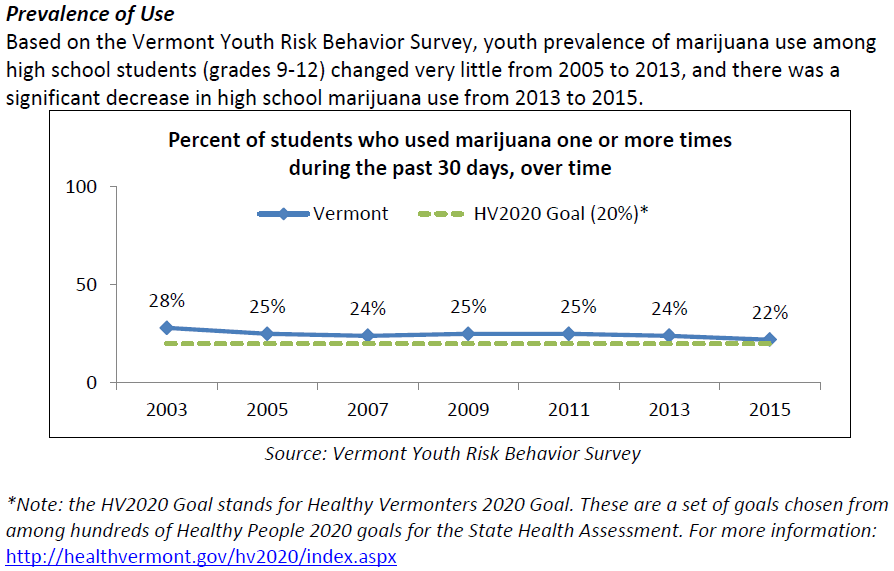
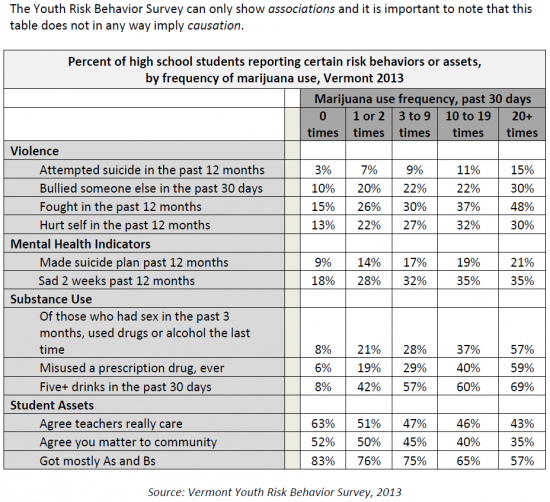
Marijuana use has gone down in recent years, according to the report, and is less prevalent in high schools than even high schoolers believe. However, marijuana use is related to riskier behaviors (the study warned against necessarily making a causal link) like suicide, drinking, smoking and other drug use, while users did not do as well in school. Marijuana use, the report states, also impairs driving.
The Vermont Cannabis Collaborative, a pro-legalization group which includes a wide-range of supporters, released a report in 2015 that indicated that sales of marijuana could increase tourism to Vermont 10-20 percent with sales of marijuana totaling $183 million to $365 million. A University of Vermont study suggested that marijuana would be taxed similar to cigarettes, or at one-third of its retail sale. At that rate, the tax revenues to the state would be in the $60-$120 million range.
 The largest single tax in Vermont in fiscal year 2015 was the Personal Income Tax, which generated $705.4 million; others included Sales ($364.6 million), Rooms & Meals ($150.8 million), Corporate ($120.3 million) and Gasoline ($77.6 million).
The UVM authors acknowledged that because of the low cost of production, lawmakers might find that marijuana could be too inexpensive in their view and therefore might raise the tax or regulate the price. The UVM study also suggested that a black market would likely still exist after legalization and control about 25 percent of the market.
Colorado legalized marijuana in 2014. Tax revenues were $52.6 million in 2014 and through October 2015, were $59.8 million, or 63.6 percent higher than through October 2014. There, total marijuana tax revenue includes the 2.9% retail and medical marijuana sales tax, 10% retail marijuana special sales tax, 15% marijuana excise tax, and retail/medical marijuana application and license fees.
The Health Department Report
COGNITION
"Frequent and persistent marijuana use appears to have a physical impact on the developing brain, and the brain develops rapidly until age 25. Research has now shown that frequent and persistent marijuana use during youth has negative cognitive and academic outcomes.
"Research over several years (prospective longitudinal studies) has shown that marijuana has negative health outcomes:
- decrease in cognitive function and memory loss
- increased risk of becoming addicted to marijuana and other illicit drugs
- decrease in educational/occupational attainment
- increased risk of serious mental health problems."
DRIIVING
"It is not safe to drive while under the influence of marijuana. Research has now clearly shown that motor vehicle crash risks – both fatal and nonfatal – increase significantly if the driver is under the influence of marijuana. We do not yet know the minimum blood level of THC that will result in an increased risk. This means that there is no currently identified safe blood level of THC for operating a motor vehicle."
BEHAVIOR
"While marijuana use does not normally lead to aggressive behavior, it is associated with higher levels of anxiety and depression for some people, and serious mental health symptoms for others. It can lead to a marijuana substance use disorder for one out of 10 users, and one out of six adolescent and young adult users. Use of marijuana is also associated with use of and dependence on other illicit drugs. Marijuana use poses significant health risks compared to not using marijuana."
Stakeholders & Participants
Facilitator: Shayla Livingston, Department of Health, Division of Health Surveillance
|
Stakeholders: The following individuals drove this Health Impact Assessment. While they do not all agree with every part of this document, their input was critical to developing the HIA. Name |
Organization |
|
John Searles, PhD |
Department of Health Alcohol and Drug Abuse Programs |
|
Jaskanwar Batra, MD |
Department of Mental Health |
|
Robert C. Uerz, MEd |
Agency of Education Student Health and Learning Team |
|
Rob Williams, PhD |
Vermont Cannabis Collaborative Steering Committee Member |
|
Lori Tatsapaugh Uerz, MPH |
Department of Health Alcohol and Drug Abuse Programs |
|
Eoana Sturges, MPH |
Department of Health Health Promotion and Disease Prevention |
|
Melanie Sheehan |
Mount Ascutney Prevention Partnership |
|
Ilisa Stalberg, MSS, MLSP |
Department of Health Maternal and Child Health |
|
Mark Depman, MD |
SBIRT Vermont; Central Vermont Medical Center Department of Emergency Medicine |
|
Amy Malinowski, RD |
Department of Health Burlington District Office |
|
Hilary Fannin, MPH |
SAMHSA/CSAP Prevention Fellow, Vermont |
|
Kim Hubbard, LADC |
The Howard Center |
|
Timothy Trevithick |
Chittenden South Supervisory Union |
|
Margo Austin, MEd, LADC |
Burlington High School Student Assistance Program Counselor |
|
Lori Augustyniak |
Prevention Works! VT |
|
Judy MacIsaac Robertson |
Vermont Cannabis Collaborative (VTCC) Steering Committee / Co-lead Industry |
|
Kayla Tatro, LICSW LADC |
Northwestern Counseling & Support Services Master Clinician, Adolescent Services |
|
Virginia Lyons |
Vermont Senate |
|
Jill Rinehart, MD, FAAP |
American Academy of Pediatrics Vermont Chapter |
|
Cindy Thomas |
Department of Health Alcohol and Drug Abuse Programs |
|
Tin Barton Caplin |
Department of Health Alcohol and Drug Abuse Programs |
|
Chris Bell |
Department of Health Emergency Medical Services |
|
Heidi Klein |
Department of Health Health Surveillance |
|
Mark Ames |
Recovery Network |
|
Kathy Hentcy |
Department of Mental Health |
|
Participants: These individuals took part in the process at one point or another. They may have come to some meetings, contributed data, or otherwise helped in developing the HIA. Name |
Organization |
|
Adam Frowine |
Department for Children and Families |
|
Jen Fisher |
Department of Liquor Control |
|
Genevieve Paul |
Department of Motor Vehicles Enforcement and Safety Division |
|
Jeannette White |
Vermont Senate |
|
Shayne Lynn |
Medical Marijuana Dispensary Representative |
|
Ann Pugh |
Vermont House |
|
Sarah Wylie |
Department of Health Tobacco Control Program |
|
Willa Ferrell |
Court Diversion/Reclaiming Futures |
|
Mary Gratton |
Addiction Treatment Specialist |
|
Joe Flynn |
Department of Public Safety |
|
Chauncey Liese |
Department of Motor Vehicles Chief of Driver Improvement |
Sources: 1.12.2016 http://healthvermont.gov/pubs/healthassessments/documents/HIA_marijuana_regulation_in_vermont_201601.pdf
http://www.uvm.edu/~vlrs/Agriculture/marijuanatax.pdf
http://vermontbiz.com/news/july/vermont-tax-revenues-end-fiscal-year-21-million