

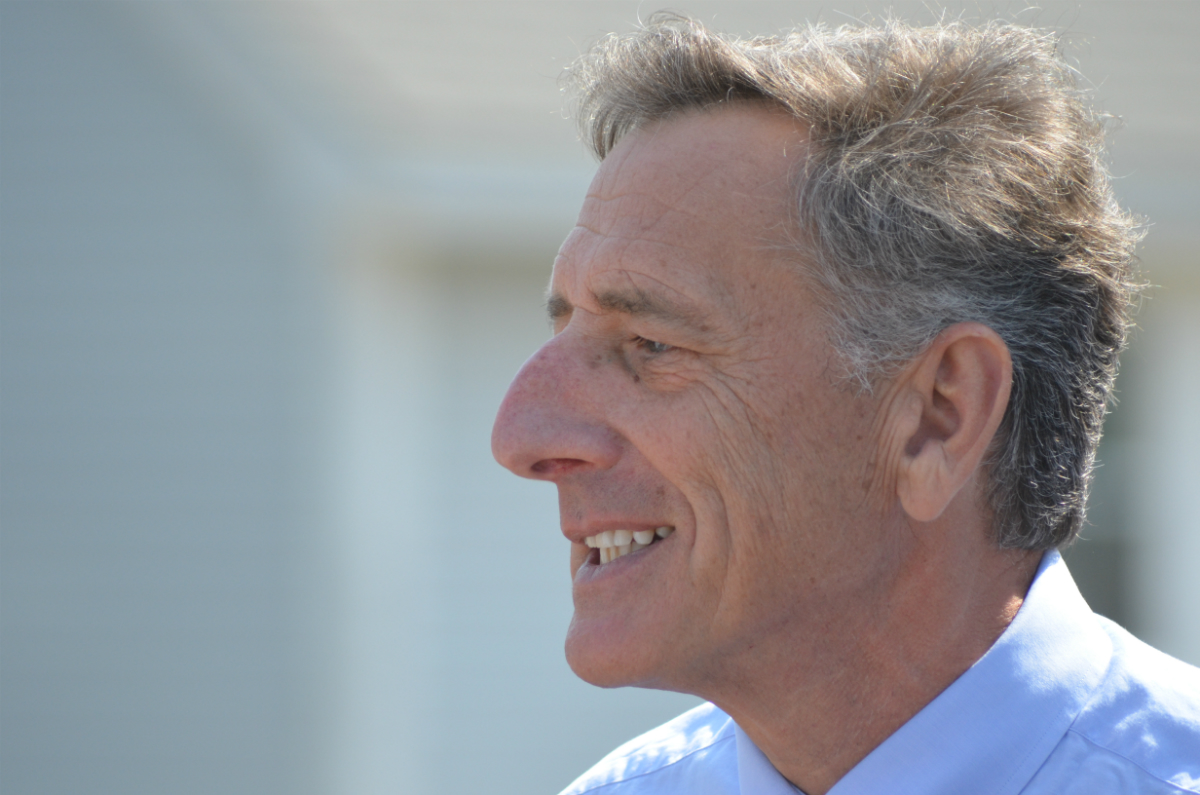
The governor talks about big wind, big health care, opiates, education, technology, successes, Hillary & Bernie and vows to never run for anything again
by James Dwinell Vermont Business MagazineGovernor Peter Shumlin enters his final year as governor and last session working with the Legislature, where he served in both the House and Senate. He offers his State of the State Address on January 7.He served as Senate leader on two occasions. Shumlin will once again have to cobble together a budget that to this point looks like it is tens of millions above projected revenues. Health care will also be a dominate theme. And as the governor well knows, there is always an issue that comes out of nowhere to send the entire session into chaos.James Dwinell has interviewed the governor for Vermont Business Magazine several times over the last five years, including shortly after he first took office in 2011. This article first appeared in the January 2016 issue of VBM.
VBM: The first time we interviewed you as governor, we asked: how long do you hope to serve? You answered, “Three terms."
SHUMLIN: You remember that? I wish that the rest of the press corps remembered.
VBM: We thought, perhaps, that you hoped that Senator Leahy would retire, Congressman Welch would run for Senate, and you for his House seat.
SHUMLIN: Not true. I go to Washington for a day and I can't wait to get home.
VBM: In 12 months, what will you do?
SHUMLIN: I will go back to work with my brother at Putney Student Travel. He has done a fantastic job running the business while I have been gone. We have programs all over the world. We have two entities now. We still send kids into amazing programs all over the world, the business my parents started. And we have new things going with National Geographic. We are their exclusive provider of their education programs. If you go to their website and inquire about their educational programs, the phone rings in our barn in Putney. We provide all the programming for them.
I have always said that six years is the perfect time to serve as governor. My time is up. Four terms is one term too many. I wanted to accomplish a great deal for Vermont, which I love. We have delivered on almost every promise that I made. I am very proud of that. Now, I will marry the woman whom I love and return home and join by brother (Shumlin and Katie Hunt were wed December 15). You will never see my name on a ballot again.
VBM: Not even for moderator of Putney’s town meeting?
SHUMLIN: If you ever see my name on the ballot again, I will give you $100 with interest, starting today! And you won’t see me wandering around the Capitol either.
VBM: Do you plan to grow the business?
SHUMLIN: Yes. My idea of public service is to get in and get out, to have a plan of accomplishment, work to achieve those goals, and go back to the private sector. It works for me, it works for Vermont.
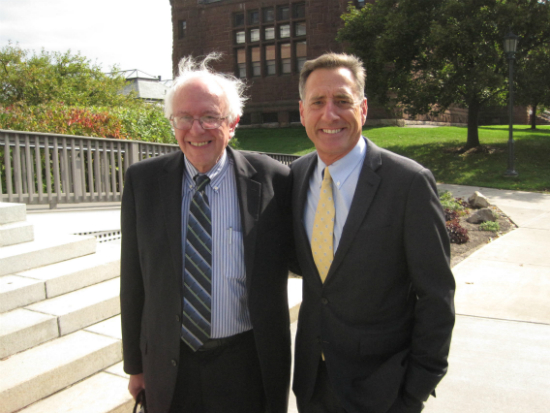 Bernie Sanders and Peter Shumlin at UVM in 2012. Shumlin is supporting Hillary Clinton for president over Sanders in the Democratic nomination for president. VBM photos.
VBM: Why are you supporting Secretary Clinton, instead of your local patron, Senator Sanders, who effectively pushed you over the top in 2012 by turning out his grassroots for you to just nip Lieutenant Governor Dubie?
SHUMLIN: I have a lot of respect for Senator Sanders as a friend, and he helped get me elected, that’s true. Bernie has made me proud in raising issues that I and many Vermonters support, but when you ask who is most qualified to do the most difficult job in the world, I say Hillary Clinton. She is a pragmatic progressive who gets things done. She can work in that cesspool we call Washington and get things done. I think that she is the person for the job.
VBM: Now that you will be gone in a year, what advice would you leave for the next governor, what three things?
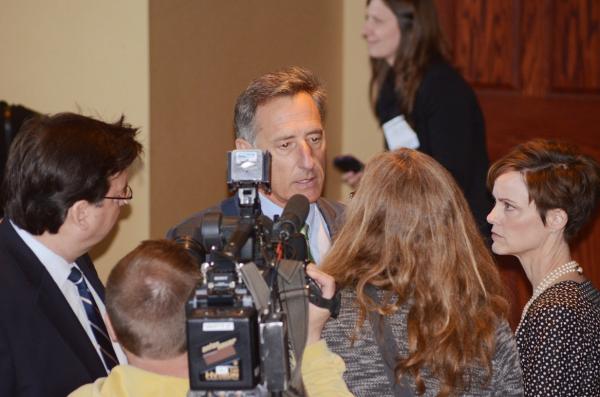 Governor Shumlin, with then-chief of staff Liz Miller, right, draws a crowd of reporters at the Vermont Chamber Business Expo last May. Vermont Business Magazine photos.
SHUMLIN: First, this is a very tough but interesting job. I went into it knowing that it was not going to be easy. I have not had any big surprises. Be prepared to make lots of big decisions quickly because you cannot do weeks and weeks of research. You have got to think on your feet and make the right decisions on your feet. Get your priorities and goals for what you want to accomplish and think that you can accomplish.
Second, worry less about being popular; worry more about getting the job(s) done. In a span of six years as Vermont’s governor, no matter what you do, people are going to tire of you. The difference between being a senator or state rep, in this position you have to make a thousand decisions a day, many are not popular decisions and everyday you will make some people unhappy. Regardless of what you do or how well you do it, your popularity will suffer every year. Delivering change requires getting it done and not obsessing about being popular.
Third and finally, have fun doing it. I have. if you are not at least having fun in this job, it is going to be one miserable ride.
VBM: What made it fun for you?
SHUMLIN: I love people, I love working with people. I have an incredible team here; we laugh a lot and have fun doing it. And I love being out there. If you don't love these things about life, you cannot govern.
VBM: In retrospect was Act 60, passed almost 20 years ago, a good thing? It seemed to transfer billions of dollars to teachers from the taxpayers, and yet it did not move the needle on outcomes as you frequently said.

The governor at the Academy School in Brattleboro last April. Courtesy photo.
SHUMLIN: Act 60 is not the cost challenge. We have exactly the same infrastructure that we had 30 years ago with 20,000 fewer students. We have never made the tough choices about the infrastructure that needed to be made. I think that Act 46 will do that. It will work in Essex, it will work in Bethel. As we look back on Act 46, we will see that Act 46 created the space for the conversation that that led to a more unified and quality system and infrastructure to deliver the quality education our kids needed.
VBM: Will the needle finally move, better outcomes, and lower costs?
SHUMLIN: Not in the first year, but it will as we develop a new system. The bottom line on Act 60 is that it solved another problem. Under the old system, a poor town's tax rate would go up 5 percent to raise $6,000, and a wealthy town's tax rate would go up 1 percent to raise $10,000. Not fair. Previous attempts like the Miller formula did not equalize. Act 60 did. And yes, Act 46 will eliminate some school boards and reduce the folks participating on them. But it will drive better results at a lower cost, just wait and see. I do not want to destroy local control; Act 46 enhances local control. It asks what are the parameters, and you decide what works for your town. If you don’t want to consolidate, come back to the state board, make your case, and maybe they will agree with you.
VBM: Is UVM serving Vermonters well?
SHUMLIN: I think that UVM is doing a great job; President Sullivan is doing a great job. He understands what UVM needs to do and where it has to go. We are blessed to have him. He understands UVM’s complex issues. He has developed positive relationships and trust with all the stakeholders. He is a huge asset for Vermont. Jeb Spaulding is another great asset to the state in running the state college system.
VBM: Trying to develop Vermont's own health insurance Web site ate up about $200 million. Wow! Is your system now working?
SHUMLIN: Vermont is doing better than many states. I want to thank Vermonters for their patience. The Web site is now working, working well for thousands of Vermonters. Our tax base has grown every year that I have been governor; our revenues are up year after year as we have over 15,000 new jobs. But we have 35 percent of our people on Medicaid, over 50 percent if you include Medicare. We used the federal money to build a system that responds to the needs of over 200,000 Medicaid clients, saving Vermont taxpayers that expense. I worried about the sustainability of our health care system as it was. We have universal access; we have the lowest cost of all 50 states.
The problem is not the quality; we provide the best in America. The problem is double digit increases in premiums and costs. Now, we are at about 3 percent increases annually, another mission accomplished. Universal access, cost containment, and a public financed system not a premium system, those were our goals. Public finance didn't work as the 16 percent payroll tax and a 10 percent income tax was too big a bite.
But we met our universal access and cost containment goals. I said going in that it was a three-legged stool: cost containment, universal access, and moving from a premium-based system to a single-payer system. We failed on the public payment system. We are the only state trying to move from a fee for services to an outcome-based system. If we pull that off, we will change how America delivers health care. I believe when I am done we will have two of the three legs completed. The tax increases were higher than we anticipated, so the public payment system is off the table for now.
VBM: The economy outside of Chittenden County really is not very good. Many folks can't even sell their homes as planned and retire to Florida.
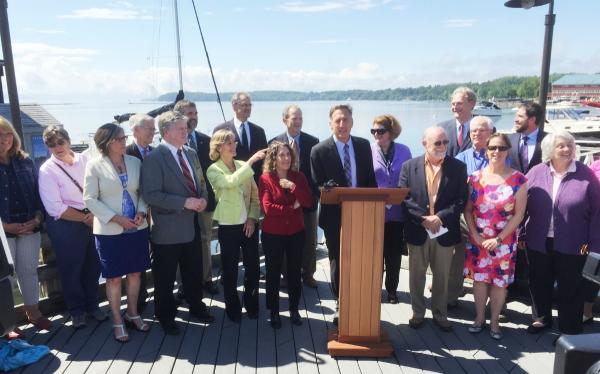 The governor,lawmakers and state, private and environmental officials at the bill signing for the Water Quality bill last June on the Waterfront in Burlington.VBM photos.
SHUMLIN: I am really proud what we have done in Vermont. We have a good story to tell to folks who want to do business in this state. Employers' biggest problem is finding qualified employees. We help with tax credits and low interest loans and in some cases grants. Our efforts led to GW Plastics making a huge investment in Vermont instead of in one their other locations where they manufacture.
IBM has been wanting out of the chip business; I am the governor who navigated those shoals: the sale to Global. Global has invested $50 million in order to keep making better and better chips to make smart phones smarter. We kept all those high quality, high pay, with great benefits jobs here in Vermont.
VBM: Which company ended up with the environmental issues from IBM which was using unseemly chemicals such as tetracycline in their production process in the 60’s and 70’s and which are still in the ground and/or ground water at that site?
SHUMLIN: I don't know which one has that responsibility, but the state of Vermont does not. We have saved companies such as GS Precision from moving out of state. We are confronted with the times where this generation of kids want to go to urban areas, not rural ones, want to be connected and in the middle of things. We now have Internet to all but a handful of addresses in Vermont. Cell service is less thorough, and we still drop too many phone calls. We have grown our localvore trade providing more and more quality cheese, vegetables, beer, cider, meats, coffee, breads, and so forth.
VBM: You take pride in your prison successes.
SHUMLIN: When I became governor I said that I wanted to change the way that we deal with non-violent offenders; this was controversial. It was projected that we would have 400 more inmates today costing us $55,000 a year. Instead we have 1,100 fewer. We have built treatment centers, and directed drugs offenders, not major dealers, to treatment. The prison population has fallen from 2,800 to 1,700. We saved millions of dollars. Opiate and drug addiction is no longer a crime. We reformed our criminal justice system
VBM: Many addicted people say that, for example, the methadone centers are too long a drive from home.
SHUMLIN: We have built treatment centers all over Vermont. Many more people signed up for treatment than we expected. The big question is how do we shut off the tap, stop people from getting into drug problems? Here is the problem. The FDA approved the pain pills and our medical community has been putting out OxyContin like it was candy. Here’s the truth. The first year that OxyContin was approved in the 90’s, we prescribed enough OxyContin to keep every adult in America high for a month. In 2010 we prescribed 250,000,000 OxyContin prescriptions, one for almost everyone in the country. Until we take on the pain discussion in America, we will not slow down the opiate addiction problem. It has become a huge problem. It is so overprescribed that there are too many pills lying around causing addictions and troubles. In 2010 more OxyContin was prescribed that there are people in America.
These are problems which we can't solve by ourselves.
VBM: Do you have regrets about the Vermont Yankee?
SHUMLIN: When it shut down, people said that rates would go up, lights would go out, and it would be terrible for business. I said build out renewable and increase efficiency and everyone said that I was crazy. Vermont is the only state in the Northeast which has seen electricity rates go down for three consecutive years. We built our renewable; we have ten times the solar panels; 4.7 percent workforce is now in green jobs.
The Green Mountain Power business model is not pulling power from northern Quebec but is providing online financing to put power in your home with new and better windows, new and better insulation, tightening the house, putting up solar panels, having storage in the basement, replacing the oil burner with a heat pump. Getting off oil and onto a green energy future. Amazing stuff.
We delivered on our promise of renewable energy and we are better off without that old nuke. I would like to see more big wind. I like the two big ones in the Northeast Kingdom. I support the Deerfield project in southern Vermont. Renewables are locally generated. We keep it in Vermont, we deliver it to our neighbors; we don’t lose a high percentage of the power in long transmission lines. We can’t build more wind in the Northeast Kingdom as we would waste too much of it in transmission outside the Kingdom. Big solar can’t be moved out from a hundred acre field efficiently.
We need smaller solar, local solar that can be used. I am for locally grown, home grown renewables delivered locally, not large corporate energy. Look at New Hampshire. Businesses there are paying 40 to 100 percent more for power while ours are paying less. So, is it so great to be in New Hampshire now?
VBM: There are still many complaints about the permit process, the length of it, and the uncertainty of it. Are the complaints valid?
SHUMLIN: Deb Markowitz has worked quietly for five years making the process more accountable, friendlier, and predictable. I get almost no complaints about the permit process.
VBM: Wal-Mart, for example, was over 20 years in the permit process in both Saint Albans and Derby. Which by the way, the New York Times found to be America’s best poverty program.
SHUMLIN: I just opened the new Wal-Mart in Derby. I endorsed that project a year and a half ago and it is now up and running.
VBM: Are you saying that it takes an activist governor to make the permit process work and those before failed to get the job done?
SHUMLIN: I think that the unwritten story in Vermont’s permit process is that Secretary Markowitz and her team have lived up to our promise to make permits more predictable, friendly, and accountable. If you don’t believe me, call up Wal-Mart and Mr. (Jeff) Davis and ask them. I feel very strongly about this. We have worked hard to make it better. I am hearing very few complaints now. It is taking less time now than it used to.
The only complainers are those which have lousy consultants who do not produce the required information in a timely and complete manner. And there are a few projects which really do deserve more scrutiny. We don’t want to look like New Hampshire.
VBM: Ah, come on.
SHUMLIN: You know that it's true.
VBM: The example of Irene is interesting to me, that without having to obtain permits, many a repair job was done in a quarter of the time at half the cost. Doesn’t this demonstrate the real costs in time and money of our permit system?
SHUMLIN: We learned from those experiences. One thing that I learned is that there were huge silos between the Agency of Transportation, the Agency of Natural Resources, and others, each with its own walls. We put them all up there in the National Life Building where they now work seamlessly and cooperatively. We are now delivering highway projects for less money with better outcomes.
I know that the press does not like good news. But we have cut the number of distressed bridges in half, cut the bad roads in half, and we built the bridge on I-91 in White River along side of the old one and rolled it over in place at night. We took those Irene lessons and turned them into more highway projects for less money.
VBM: Is this a systemic change or temporary?
SHUMLIN: Systemic. They are up there now having lunch together, collaborating together; putting them together was a brilliant move!!
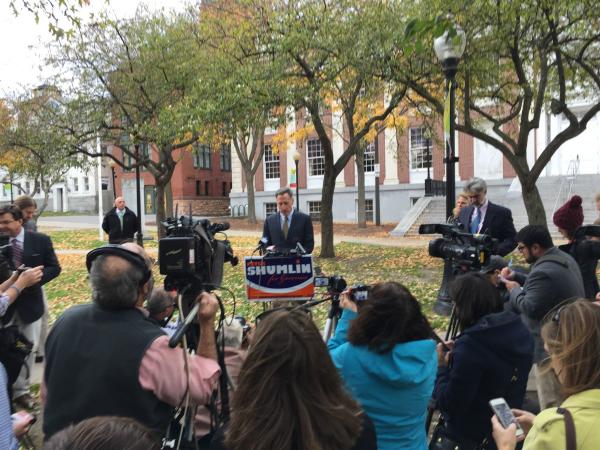 The mood was as gray as the November day that Shumlin "declared victory" in the 2014 election over Scott Milne. It was the Legislature that finally had to settle the contest in January 2015 because Shumlin did not receive 50 percent of the vote. VBM photos.