

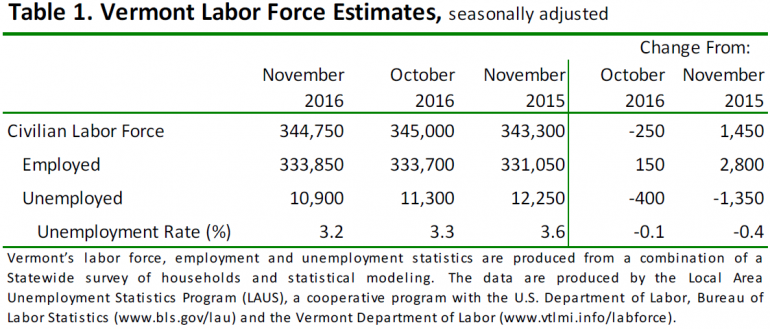
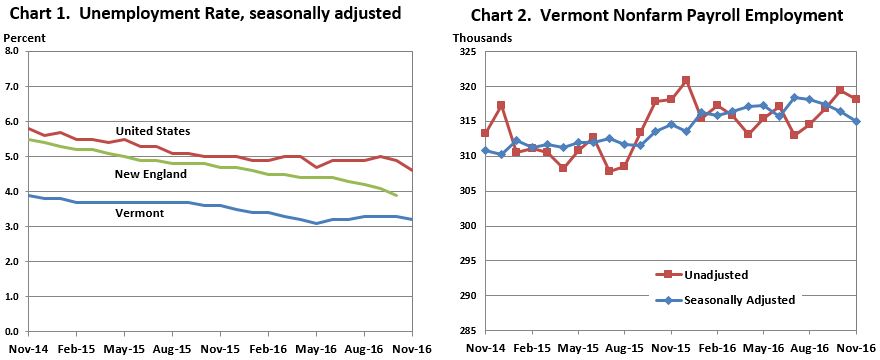
Vermont Business Magazine Vermont's unemployment rate dropped one-tenth in November to 3.2 percent, according to the US Bureau of Labor Statistics. The results were mixed, as the number of employed increased and the number of unemployed decreased, but the labor force decreased, which has been an ongoing trend. Both non-farm seasonally adjusted and not seasonally adjusted employment were down. Vermont remains tied for seventh lowest in the nation. New Hampshire held onto the top spot with South Dakota at 2.7 percent. The national unemployment rate was 4.6 percent in November, down from 4.9 percent in October, and 0.4 percentage point lower than in November 2015.
The seasonally-adjusted Vermont data for November show the Vermont civilian labor force decreased by 250 from the prior month’s revised estimate. The number of employed increased by 150 and the number of unemployed decreased by 400. The change to the number of unemployed and the change to the unemployment rate were statistically significant in the seasonally-adjusted series, according to the VTDOL.
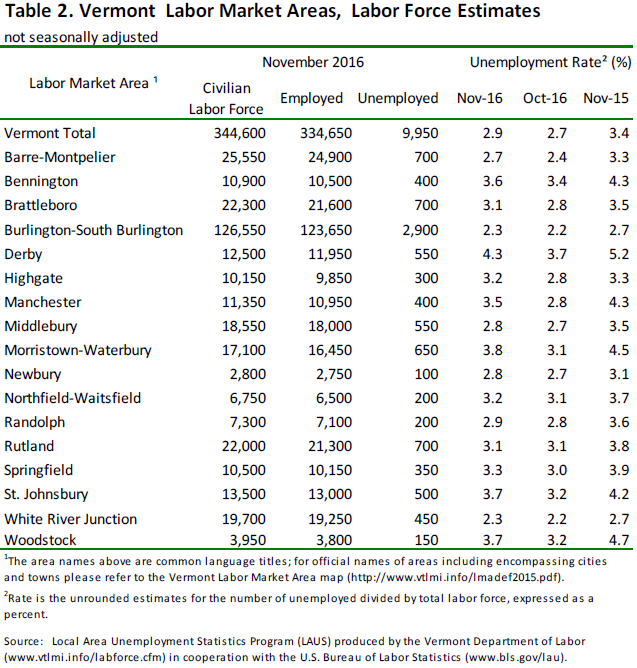
The November unemployment rates for Vermont’s 17 labor market areas ranged from 2.3 percent in White River Junction and Burlington-South Burlington to 4.3 percent in Derby (note: local labor market area unemployment rates are not seasonally-adjusted). For comparison, the November unadjusted unemployment rate for Vermont was 2.9 percent which reflects an increase of two-tenths of one percentage point from the revised unadjusted October level and a decrease of five-tenths of one percentage point from a year ago.
“The Vermont economy is more stable than the month-to-month data might suggest, as increases and declines are “ironed out” at the conclusion of the year,” said Labor Commissioner Annie Noonan in a statement. "What we can see is a slower rate of job gains this year than in recent years. Yet, with Vermont’s low unemployment rate, it’s still a tight labor market with recruitment and retention challenges for our employers; and a limited availability of workers can adversely impact economic expansion and growth.
"Based on the available data through November of this year, the number of unemployed persons in Vermont has declined about 10% compared to last year. As a state, Vermont needs to get more people – at all ages and skill levels – into the workforce, through increased education, job training, career counseling and placement, OJT and Apprenticeship programs, and effective mentoring.
"Vermont needs to effectively utilize every state and federal job-training dollar to get people into jobs, and we need to address issues that will help Vermont be more successful: promoting gender equity, workplace civility, bringing under-represented populations into the workforce, creating job training programs that guarantee employment at the conclusion, and resolving the “benefit cliff” so that anyone who wants to work can do so without suffering adverse economic impacts.
"The Vermont Department of Labor, through our12 local Career Resource Centers – and in conjunction with our many partner agencies – can collaborate to help job seekers become employed – or employed in a better job – and help employers market, recruit, train and hire good candidates. All of the services we offer at Labor are free of charge, and customized to the particular needs and interests of each person or employer."
Not-Seasonally-Adjusted
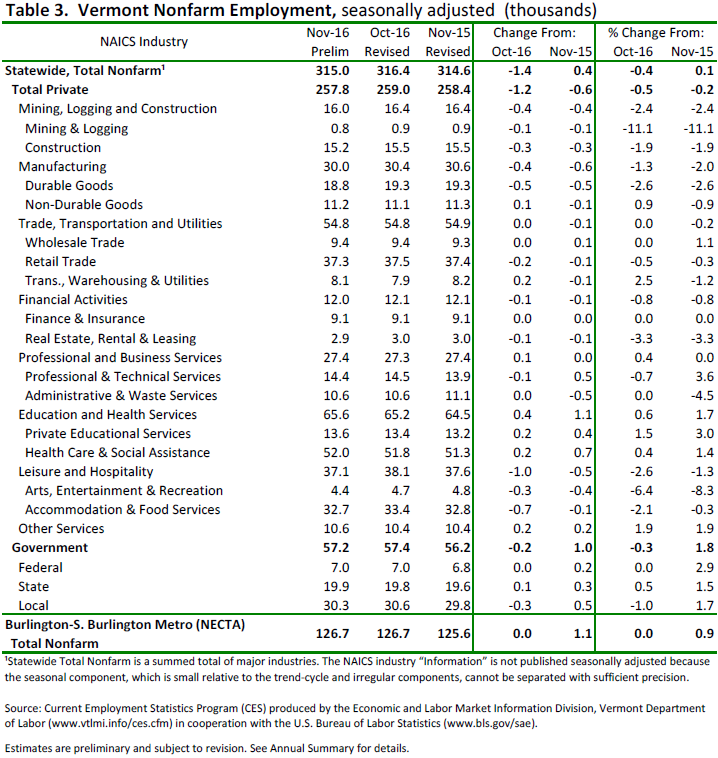
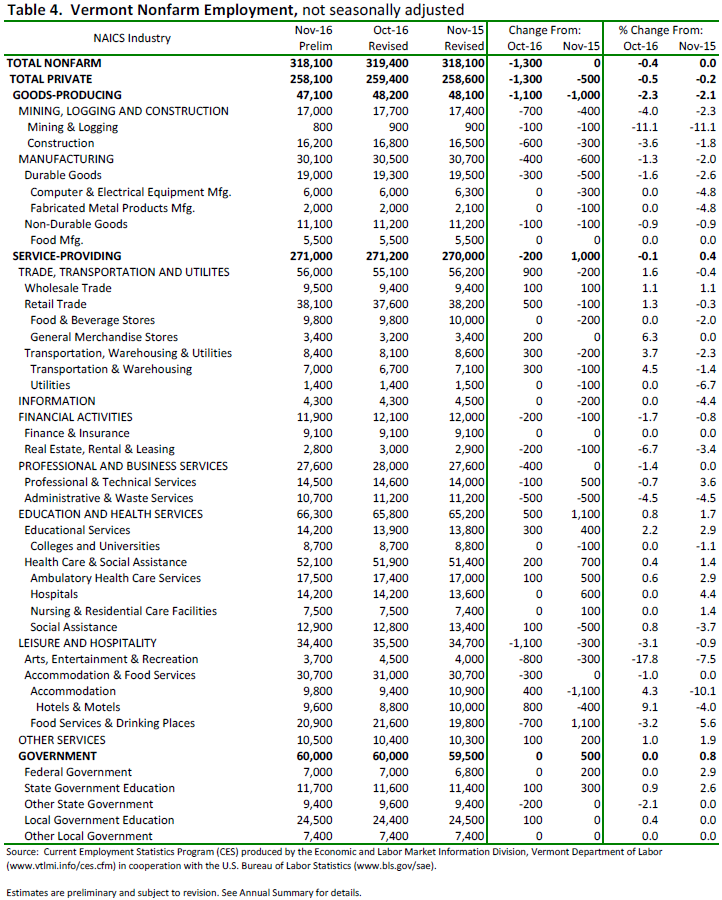
The preliminary ‘not-seasonally-adjusted’ jobs estimates for November show a decrease of 1,300 jobs when compared to the revised October numbers. There was an increase of 1,000 jobs between the preliminary and the revised October estimates due to the inclusion of more data. The monthly decrease seen in the November numbers was attributable to the seasonal nature of certain industries such as construction and landscaping. The broader economic trends can be detected by focusing on the over-the-year changes in this data series. As detailed in the preliminary ‘not-seasonally-adjusted’ November data, Total Private industries have decreased by 500 jobs (-0.2 percent) and Government (including public education) employment has increased by 500 jobs (0.8 percent) in the past year.
Seasonally-Adjusted
The seasonally-adjusted data for November reports a decrease of 1,400 jobs from the revised October data. As with the ‘not-seasonally-adjusted’ data, this over-the-month change is from the revised October numbers which also experienced an increase of 1,000 jobs from the preliminary estimates. The seasonally-adjusted over-the-month changes in November were varied at the industry level. Those with a notable percent increase include: Transportation, Warehousing & Utilities (+200 jobs or +2.5%), Other Services (+200 jobs or +1.9%), and Private Education Services (+200 jobs or +1.5%). Sectors with a notable percent decrease include: Leisure & Hospitality Services (-1,000 jobs or -2.6%), Mining, Logging & Construction (-400 jobs or -2.4%), and Manufacturing (-400 jobs or -1.3%).
Unemployment rates were significantly lower in November in 18 states and stable in 32 states and the District of Columbia, the US Bureau of Labor Statistics reported today. Nine states had notable jobless rate decreases from a year earlier, 2 states had increases, and 39 states and the District had no significant change.
Among the nine geographic divisions, New England had the lowest unemployment rate, 3.6 percent in November, followed by the West North Central, 4.1 percent. The highest rates were in the East South Central, Middle Atlantic, and Pacific, 5.3 percent each. Over the month, significant jobless rate changes occurred in three divisions: New England (-0.3 percentage point), Mountain (-0.2 point), and Pacific (-0.1 point). Five divisions had significant jobless rate declines from a year earlier, the largest of which was in New England (-1.1 percentage points). The only notable over-the-year rate increase was in the Middle Atlantic (+0.4 percentage point).
NOTE: Employment (nonfarm payroll) - A count of all persons who worked full- or part-time or received pay from a nonagricultural employer for any part of the pay period which included the 12th of the month. Because this count comes from a survey of employers, persons who work for two different companies would be counted twice. Therefore, nonfarm payroll employment is really a count of the number of jobs, rather than the number of persons employed. Persons may receive pay from a job if they are temporarily absent due to illness, bad weather, vacation, or labor-management dispute. This count is based on where the jobs are located, regardless of where the workers reside, and is therefore sometimes referred to as employment "by place of work." Nonfarm payroll employment data are collected and compiled based on the Current Employment Statistics (CES) survey, conducted by the Vermont Department of Labor. This count was formerly referred to as nonagricultural wage and salary employment.
|
||||||||||||||||||||||||||||||||||||||||||||||||||||||||||||||||||||||||||||||||||||||||||||||||||||||||||||||||||||||||||||||||||||||||||||||||||||||||||||||||||