Vermont Business Magazine The 20th annual Rabies Bait Drop begins August 9 in eight Vermont counties as part of a continued effort to stop the spread of rabies among wildlife. Rabies is a viral disease that is mainly found in raccoons, foxes, bats and skunks, and can infect domestic animals and people. Rabies vaccine, if given soon after a human is bitten by a rabid animal, is highly effective. However, rabies is almost always fatal without immediate medical treatment.
The Vermont Department of Health will work in collaboration with the U.S. Department of Agriculture’s Wildlife Services to drop approximately 450,000 baits containing ONRAB oral rabies vaccine. Baits will be dropped in parts of Addison, Caledonia, Chittenden, Essex, Franklin, Grand Isle, Lamoille and Orleans counties.
The bait drop will begin in August, weather permitting, in:
Addison
Ferrisburgh, Monkton, Starksboro
Caledonia County
Barnet, Burke, Concord, Danville, Groton, Hardwick, Lyndon,
Lyndonville, Newark, Peacham, Ryegate, St. Johnsbury
Sheffield, Sutton, Waterford, Wheelock
Chittenden County
Burlington, Charlotte, Colchester, Essex, Hinesburg,
Milton, St. George, Shelburne, South Burlington,
Underhill, Westford, Williston, Winooski
Essex County
Bloomfield, Brighton, Brunswick, Canaan, East Haven,
Ferdinand, Granby, Guildhall, Lemington, Lewis,
Maidstone, Norton, Warner’s, Warner’s Grant,
Warner’s Gore, Warren’s
Franklin County
all towns
Grand Isle County
all towns (aerial drops)
Lamoille County
Belvidere, Cambridge, Eden, Hyde Park, Jeffersonville, Johnson,
Morristown, Waterville, Wolcott
Orleans County
all towns
New Hampshire
several towns in Coos County
In rural parts of Vermont, bait will be dropped from low-flying airplanes. In more densely populated areas, teams of two people will place the bait by hand.
ONRAB, the vaccine being used this year in Vermont, New Hampshire and northern New York, has proven to be effective in eliminating raccoon rabies in Canada.
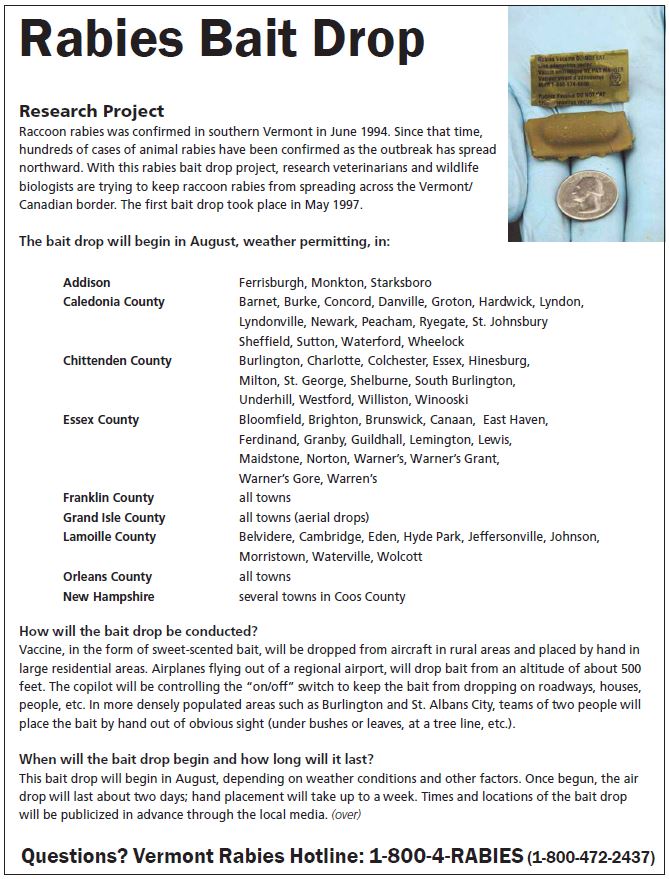
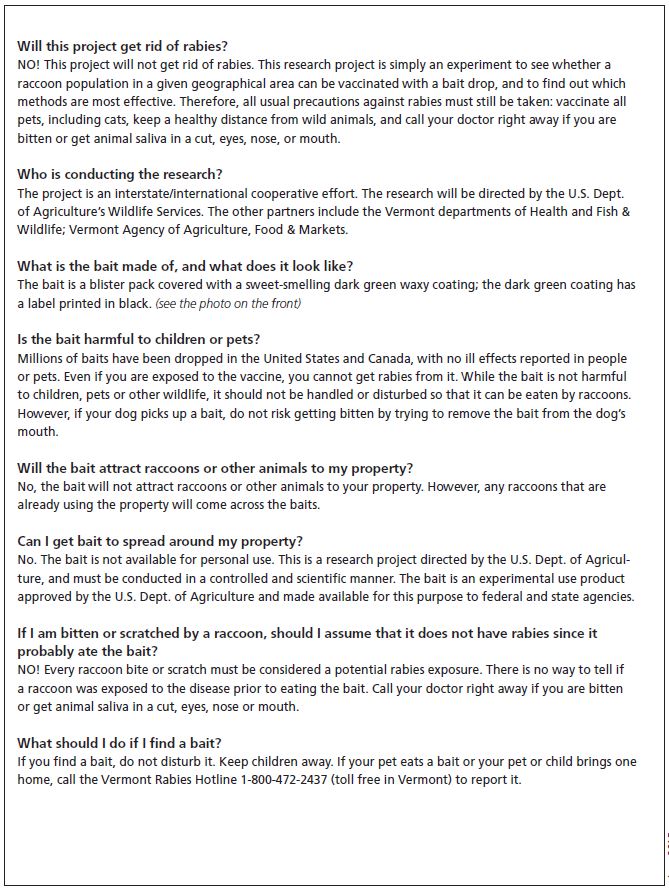
To make it attractive to animals, the bait is covered in a sweet coating that is made of vegetable-based fats, wax, icing sugar, vegetable oil, artificial marshmallow flavor, and dark-green food-grade dye.
There are no expected negative health effects for adults, children or pets who may come into contact with the bait and vaccine. There are, however, things to keep in mind if you do come in contact with bait:
- If possible, leave the bait where you found it.
- If you must move the bait, wear gloves, and move the bait to an area of thicker cover where animals are more likely to find it, like a wooded area.
- Wash your hands thoroughly with soap and water after contact with bait.
- Each bait has a U.S. toll-free number printed on it that anyone can call for more information.
Avoid any animal that shows strange behavior. Do not try to trap or capture the animal. Vermonters can help rabies control efforts by reporting strange acting animals to the state’s Rabies Hotline toll-free at 1-800-4-RABIES (1-800-472-2437), or in-state at 802-223-8697.