

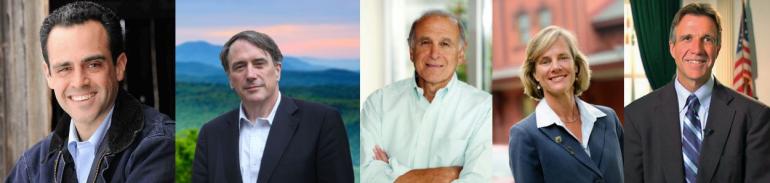
Left to right: Matt Dunne, Peter Galbraith, Bruce Lisman, Sue Minter and Phil Scott.
by Chris Graff Matt Dunne’s recent mailing – like the candidate himself – makes no bones about it: If you like Bernie Sanders you should vote for Dunne in the Democratic primary for governor. The front page of the glossy brochure shows Dunne standing at a podium at a Sanders’ rally. The title of the brochure is “Matt Dunne’s Step-by-Step Guide to Making Bernie Sanders’ Progressive Vision a Reality in Vermont.”
Not so fast, says Peter Galbraith, another of the three Democratic candidates for governor. Galbraith says he’s been espousing progressive ideas for more than 20 years. “People see a system that is rigged,” he said at a recent debate in Brattleboro.
Galbraith focuses his ire on what the calls “special interest tax breaks.”
“The system is rigged. There are $45 million in special interest tax breaks,” he says, listing examples in almost every answer he gives. “If you own a private jet, and you buy a new tire, no sales tax, but if you own a car and buy a new tire you pay a sales tax.”
While Dunne and Galbraith fashion themselves as the outsiders, Sue Minter touts her executive experience, saying, “I have the skills, the vision, and the experience to get things done.”
While Dunne and Galbraith see more similarities between the national scene and Vermont, Minter says, “Yes, people are frustrated. Yes, people are angry. I am a leader who wants to bring people together to get things done. And not talk about how bad it is to live and grow a business in Vermont, but to build for the future.”
On the Republican side, Bruce Lisman is unabashedly the outsider, saying if you like the way things are going in Vermont, vote for one of the others.
“There is a sense of unease, a concern about the cost of living here,” he said. “People think their government is not listening to them.”
Lieutenant Governor Phil Scott’s focus is on affordability and his ability to work across party lines.
“We have a lack of faith and trust in government,” he said. “Don’t overpromise and follow through on everything you say. We face a crisis of affordability in the state of Vermont.”
You can get a good sense of the candidates from their own 30-second appeals to voters in their closing statements at a recent debate in Brattleboro.
Here is what they said:
Phil Scott: “Twenty years ago I didn’t have a political bone in my body. I was in business and faced with a lot of obstacles, burdens in my way, and I thought they - them - in Montpelier didn’t get it. So I ran for the Legislature and that’s when I became more involved. I served in the minority my entire political life but I fully realized after getting in there that you have to work with others. You have to be a consensus builder. You have to have integrity. You have to follow through on your promises. And that’s the way you get ahead. You have to be a public servant, rather than someone who is there is satisfy your ego or satisfy the power.”
Bruce Lisman: “I never have run for anything before except for class president of 5th grade. I am an outsider. I am looking at it in an entirely different way. I am not the usual guy. I try not to say the usual things. I won’t do the usual things if I am elected your governor. I believe the state is headed in a bad direction. I believe the economy outside of Chittenden County is thin and fragile and older. Even Chittenden County has holes that look dangerous to me. And so I believe I am the right guy to take us in a different direction. I believe in inclusiveness and I believe in transparency. I believe in doing the right thing for the people and working like a dog for the people.”
Peter Galbraith: “Elections are about choices. You have five people with very different backgrounds but I would stipulate that every one of us would be a good governor. The choices, though, are about policy and I am running unabashedly on a liberal agenda - $15 minimum wage by 2021, free tuition at the Vermont state colleges, maintaining quality public services, and paying for it. I am the one guy here who is telling you how he is going to pay for it. By eliminating special interest tax breaks like the cloud tax and to make the tax code more fair but not raising taxes on working Vermonters.”
Sue Minter: “I have worked in the private sector, the non-profit sector but I have given most of my life to public service, my community, the Legislature, running a state agency and I am doing this because I see we have huge challenges and we need to work together to face those challenges. I am going to work on three things: addressing economic opportunity, supporting working families, and protecting our environment. I have the vision, the passion and most importantly the experience to get this done.”
Matt Dunne: “I am running for governor because like all of you I love this state. And I am concerned we are not in a sustainable place. We have been transitioning from large scale commodity manufacturing, large scale commodity dairy, to something else for 50 years. We just haven’t figured out what that something else is and we have not changed the way we approach government. I have the experience of helping to grow a Vermont-based company to over 100 employees, heading up the 6,000-person Americorps/VISTA program, and for the last eight and a half years having worked for Google, all from an office in White River Junction. I am committed and excited to bring a fresh approach, to build an economy that works for all Vermonters and all of Vermont.”
Chris Graff, a former Vermont bureau chief of The Associated Press and host of VPT's Vermont This Week, is now vice president for communications at National Life Group. He is author of, Dateline Vermont: Covering and uncovering the newsworthy stories that shaped a state - and influenced a nation.