

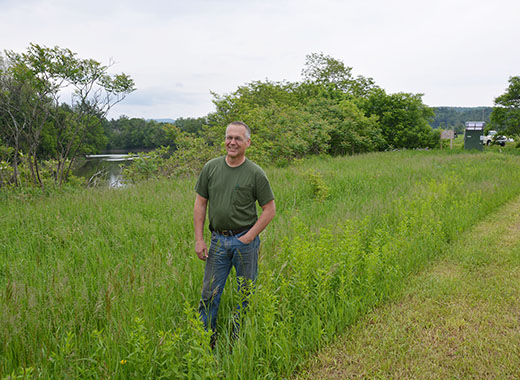
by Amy Overstreet Lorenzo Whitcomb manages North Williston Cattle Company in the Lake Champlain Basin of Vermont with his brother and nephew. The 800-acre, 224-head cattle operation is a sixth-generation family farm that incorporates conservation stewardship with cutting edge technology, including solar energy and robotic milkers. Whitcomb is a firm believer in stewardship and is dedicated to ensuring that his farming activities have a minimal impact on water quality. He’s been recognized for his conservation ethic, and he and his family received honors including Vermont Dairy Farm of the Year, Vermont Conservation Farm of the year, and classification as a Dairy of Distinction by the Northeast Dairy Farm Beautification Program. Now, he’s taking soil and water conservation to the next level with a unique edge-of-field monitoring system. This enables water to be analyzed which helps determine the amount of nutrients and soil lost from agricultural fields during runoff events.
Working with the USDA Natural Resources Conservation Service (NRCS), Whitcomb applied for funding through theEnvironmental Quality Incentives Program (EQIP) to have a pair of monitoring stations installed in adjacent corn fields. Danny Peet is a soil conservationist in the Williston NRCS office who has worked with him to protect the natural resources on and around his farm with a diversified EQIP conservation plan.
“These monitoring stations are helping him see that there are certain times of the year and specific storm events that impact water runoff from his cropland fields,” he explained. “His fields, for the most part, have well-drained soils. This study is helping illustrate that during heavy rain events, contaminants find their way directly to the Winooski River.” The Winooski River is the largest tributary watershed to Lake Champlain. It includes almost ten percent of the land area of Vermont. By measuring and recording what is in the water that drains off his fields, Whitcomb can alter his farming practices to ensure he is not negatively impacting water quality.
This technology is helping farmers better understand their soils and how they behave. Different soils have different degrees of permeability, a characteristic that determines how water flows through the soil, and specifically, the rate at which a measured quantity of water drains away through the soil. Conservation practices can help protect and improve soil health, and in turn, minimize impacts to water quality. Some of these practices include conservation crop rotation, cover-cropping, filterstrips, manure injection, and field borders, all of which are part of Whitcomb’s EQIP conservation plan.
This project will get a boost thanks to a four-year University of Vermont (UVM) study, funded by USDA-NIFA’s Agriculture and Food Research Initiative (AFRI). Whitcomb’s monitoring stations will help researchers focus in on what leaches down through the soil, and will also consider the financial and social aspects of implementing best management practices. Farming and Climate Change Program Coordinator with UVM Extension, Joshua Faulkner, is the project lead. “These stations are an incredible asset, and we wanted to see them used to their full extent, collecting data on real Vermont farms, and continuing to inform both the scientific and agricultural communities,” he said.

The two edge-of-field monitoring stations were placed in cornfields that are bordered by the Winooski River. Whitcomb learned about the technology during a meeting of farmers. He is an active member of the Lake Champlain Valley Farmer’s Coalition, a cooperative of Vermont farmers in the Lake Champlain Basin who are concerned about their impact on the lake. He says the edge-of-field monitoring has been an eye opener.
“This helps me understand what’s going on out in the field, even when I can’t be out there,” he said.
Peet explained, “We are comparing the impacts to water quality on a field that is conventionally farmed, and another field which is using manure injection, cover crops, and reduced tillage.” Water quality specialist Kip Potter said this technology is also helping to sell conservation. “The results from this study will illustrate to farmers more precisely the real benefits that conservation practices have on water quality,” he explained.
The data being collected is part of an Agricultural Practice Monitoring and Evaluation Program currently underway on six farms throughout Vermont. The cooperative conservation study is a partnership between the Vermont Agency of Agriculture, Food & Markets, USDA-NRCS, the Vermont Agency of Natural Resources, and the Lake Champlain Basin Program. These entities contracted with Stone Environmental, Inc., to collect data through the end of the 2015 growing season with updated findings to be developed in early 2016. Stone Environmental Water Resources Engineer Julie Moore has worked with the farmers since the stations were installed to study agricultural runoff and the impacts to water quality.
“The study is divided into two phases,” she said. The control phase is helping to understand the relationship between the two fields that are being studied on each farm. The treatment phase, which started last fall, involves application of conservation practices to one of the fields and an assessment of the impact the conservation practice has on water quality. “Even during the control phase, we learned a lot,” Moore said.
The data collected during the study looked at phosphorus and nitrogen measurements, as well as sediment loss and the total amount of runoff, or flow, from the fields. Moore said that findings indicated a majority of phosphorus leaving the study sites, including on Whitcomb’s farm, is in the dissolved form. “It’s rocket fuel for algae,” she says.
Phosphorus is essential for plant growth, but too much of it can have negative impacts. When phosphorus enters water, eutrophication results. Eutrophication is when a body of water becomes enriched in dissolved nutrients, like phosphorus, which then stimulates the growth of aquatic plants. An example of this is the blue-green algae blooms that plagues Lake Champlain during the summer. The algae growth can cause fluctuations in dissolved oxygen, which adversely impacts aquatic life.
Vermont NRCS State Conservationist Vicky Drew said the findings of the edge-of-field study could have big impacts on the way conservation plans are written.
“This study is groundbreaking because it’s helping farmers, and conservationists, to think about conservation planning in a new way,” she said. Moore agreed. “Our data shows that even when farmers plant cover crops, they were still losing phosphorus, meaning erosion is not the only pathway we need to be concerned about.” She said that during the control phase of the study, they recorded high phosphorus concentrations when farmers applied manure right before a rain event. “This information is helping emphasize just how important management decisions are, including the rate and timing of manure applications,” she said. For instance, application of manure just before rainfall can lead to incredibly high nutrient concentrations, which has damaging impacts on water quality,” she explained.
Whitcomb concludes, “Farms can be looked at as filters.” And, edge-of-field technology is providing him with a closer look at how his farm is impacting soil and water quality, and what he can do to ensure he’s protecting and improving natural resources.
Amy Overstreet is the Public Affairs Officer for the USDA Natural Resources Conservation Service, Vermont