

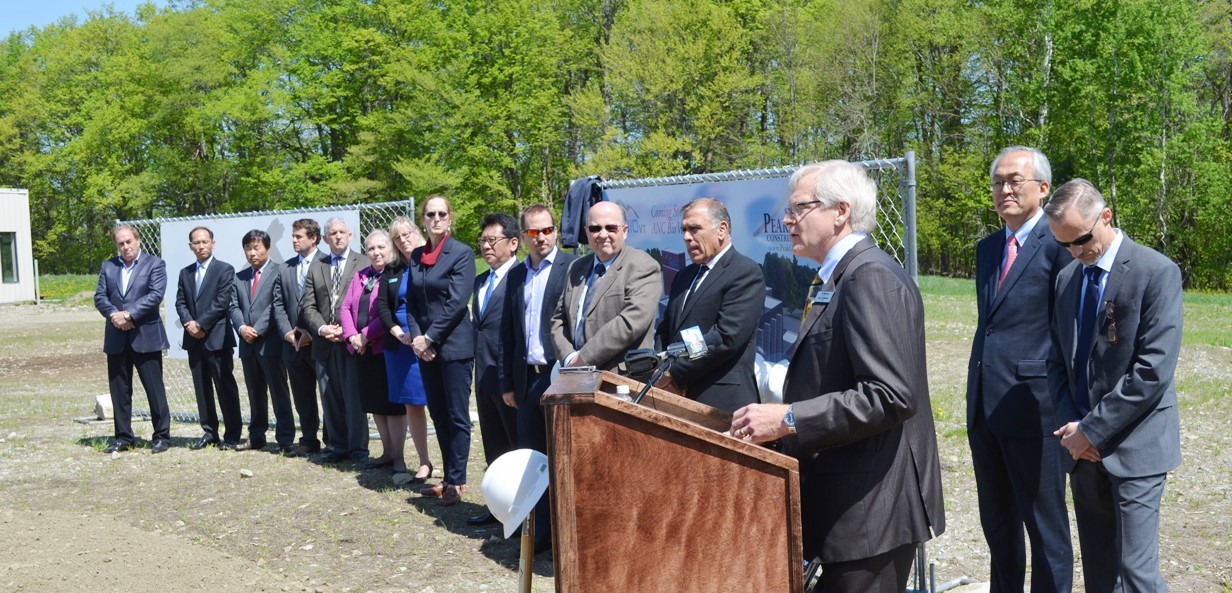
Bill Stenger speaks during groundbreaking ceremonies for the AnC Bio facility in Newport in May 2015. VBM photo.
by Mike Smith I must admit, before reading the federal complaint against Bill Stenger and Ariel Quiros — the two principals in the EB-5 fraud scandal that has rocked the state — I convinced myself these types of schemes, rooted in massive greed and deception, had state borders; that Vermont was somehow immune to this kind of behavior. So when I finally sat down and began to read the 82-page federal complaint, I was looking for a reason to believe it wasn’t true. Perhaps the fact that Bill Stenger is a Vermonter and Quiros is not gave me hope that somehow the Vermonter was duped — just a pawn in an illegal scheme he had no knowledge of.
Certainly, that is Stenger’s contention.
 Bill Stenger, May 2015.
I know Bill Stenger, not well, but in my dealings with him he seemed pleasant and honest and committed to revitalizing the Northeast Kingdom. His grand vision of creating hundreds of jobs in the most economically depressed part of our state was appealing. But as I read deeper into the complaint, it became increasingly difficult to conclude that Stenger was somehow an innocent bystander to a scheme that adversely impacted so many.
Some investors, hoping for a chance to get a green card that would allow them to live in the United States, are likely to lose millions, and on top of that will not get the benefits of living and working here. Of course, there is pain close to home, too. The city of Newport has a massive hole in the ground in its downtown because buildings were torn down to make room for facilities that are likely never going to be built. And contractors, in some cases local Vermont companies, are unlikely to be fully paid. Finally, the jobs that were promised will probably never materialize. If Stenger wasn’t fully aware of what was happening, then the complaint draws you to the conclusion he conveniently made the decision to look the other way and avoided asking the obvious questions when all the warning signs were fully illuminated.
The U.S. Securities and Exchange Commission contends that Quiros used money diverted from investor accounts for his own personal benefit, (buying a Trump Tower condo, for example). Quiros, in his SEC deposition, sees things differently. To him, he stepped in and helped to save the Northeast Kingdom by buying Jay Peak ski resort and investing in projects that would otherwise never have been built. He claims he cleaned up mismanagement of projects, and he only took money that was due to him.
Some contend Stenger did not appear to personally benefit from the alleged diversion of money; therefore, he is less at fault than Quiros. Stenger may not have taken money for his own benefit, but according to the federal complaint he did allow investor money to be used in a deceptive and unauthorized manner that now has the potential to crush the lives, hopes and dreams of many.
Vermonters are now faced with some challenging questions.
First, should Vermont scrap the EB-5 program? The EB-5 program is designed to bring foreign investment to Vermont and elsewhere where capital is desperately needed and access is limited. In Vermont, the way it works is that foreigners seeking to live and work in the U.S. can invest $500,000 in projects and then receive a conditional green card (a temporary visa). If the project is successful and produces the jobs it has promised — and reaching that threshold is not difficult — then they will receive a return on their investment plus a permanent green card that allows them to stay in the country. But this program in Vermont and elsewhere has been plagued by abuse and fraud.
To many it is a program that is designed to allow rich foreign nationals to buy their way into the U.S. However, to others, it’s a vital economic development tool, and absent the EB-5 program, it’s unlikely that hundreds of millions of dollars would have been invested in the Northeast Kingdom.
Second, should we have an independent investigation of the actions of state government and the principals of this alleged fraud? Some are calling for an independent investigation in order to take any state investigation out of the hands of Vermont politicians who may have a vested interest in its outcome.
Third, should the Legislature establish an ethics commission? Although I have advocated for such a commission and still think it’s needed, it’s uncertain whether a state ethics commission — which looks into ethics violation of state officials — would have prevented this particular fraud.
And fourth, should the role of financial institutions, especially the investment firm Raymond James, and to a lesser extent People’s United Bank, be investigated to understand what role they played and what oversight may have been needed to prevent this from happening? This is a part of the scandal that has gone under-reported, but state and federal governments have the power to investigate and in some instances demanded restitution.
A disturbing aspect of this event is the realization that Vermonters are not immune from scandals that grip the residents of other states. Unscrupulous human behavior has no geographic boundaries.
This fraud case combined with other recent revelations: a state senator who has been accused of sexual misconduct, and state government trying to downplay — some say hide — problems with a health care exchange where costs are approaching $300 million, has resulted in the erosion of confidence and trust in government and state leaders.
We will now scrutinize our government and our leaders through a different lens, perhaps even a similar lens, as residents of cities and states that are notorious for fraud. This EB-5 scandal seems like the final straw in a culmination of events that has had an impact on our collective psyche. And the impact of this scandal will not dissipate quickly because it touches so many: The Vermonters who were promised so much; the investors who lost so much; and the people wrapped up in this scandal.
What is perhaps the greatest tragedy of this entire episode is the discovery that the confidence we had in our state’s immunity from the greed and deceit common elsewhere — and has slipped from us as a result of this scandal — was probably never legitimate in the first place. It was just an illusion — a wish for how we would like Vermont to be.
RELATED STORY: State files suit alleging investor fraud at Jay Peak, Inc EB-5 Projects
Mike Smith was the secretary of administration and secretary of human services under former Gov. Jim Douglas. He is the host of the radio program, “Open Mike with Mike Smith,” on WDEV 550 AM and 96.1, 96.5 and 101.9 FM. He is also a political analyst for WCAX-TV and WVMT radio and a regular contributor to The Times Argus, Rutland Herald and Vermont Business Magazine.