

Vermont Business Magazine A new study from New York financial technology company SmartAsset shows where people can get the most out of their money thanks to a favorable cost of living. Residents of Addison County get the most bang for their buck in Vermont, while those in Essex County get the least. Chittenden County, which is the overall wealthiest, has the second best buying power. The study compares median income and cost of living data nationwide to find the counties where people hold the most purchasing power. The study aims to find the places where average living expenses are most affordable to the people who live there. The study looked at the cost of living relative to income to determine purchasing power.
| Rank | County, State | Cost of Living | Median Income | Purchasing Power Index |
|---|---|---|---|---|
| 1 | Addison, VT | $38,731 | $59,274 | 73.67 |
| 2 | Chittenden, VT | $42,612 | $64,243 | 72.57 |
| 3 | Orange, VT | $35,236 | $53,114 | 72.56 |
| 4 | Bennington, VT | $33,102 | $49,303 | 71.69 |
| 5 | Washington, VT | $39,152 | $58,293 | 71.67 |
| 6 | Grand Isle, VT | $42,049 | $61,338 | 70.22 |
| 7 | Rutland, VT | $33,835 | $48,308 | 68.73 |
| 8 | Windsor, VT | $37,845 | $53,610 | 68.19 |
| 9 | Windham, VT | $36,109 | $50,526 | 67.36 |
| 10 | Franklin, VT | $41,304 | $57,159 | 66.61 |
Addison County ranked 488th nationally, Chittenden 571st and Franklin 1319th. The other four counties in Vermont were: Lamoille 11th, Caledonia 12th, Orleans 13th and Essex 14th, ranked 2624th in the US.
SmartAsset calculated two different cost of living numbers for a household with one adult and no dependents. One reflected the baseline cost of living in each area and the other was based on expenditures typical to someone making the county’s median income.
It then combined the two cost of living numbers using a weighted average based on how close each county’s median income was to the minimal livable income in that area. We then subtracted income taxes paid in that area. Finally, SmartAsset calculated purchasing power by determining the weighted cost of living as a percentage of median income.
A household budget will be more sustainable if they can spend less than 30 percent of your income on housing. If they pay more than that they're considered "burdened" by housing costs. Depending on where they live and how much they make, paying less than 30 percent of income to keep a roof over their head may or may not be possible. So, moving to an area with lower housing costs can make a serious difference to their overall cost of living.
Food

Another big expense category is food. While you can make changes to your lifestyle to cut back on the cost of food - changes like wasting less and eating less meat - you're still affected by food costs in your area. That's why our cost of living calculator takes local food prices into account. Even basics like a pound of pasta or a bag of apples can vary in cost from place to place. Most cities exempt grocery items from sales taxes but a few do not. That's the kind of thing that can make a big difference to your bottom line. If you never cook you won't be as affected by a change in food prices if you move. But if you're on a tight budget you're probably cooking most - if not all - of your meals at home. That means you want to keep a close eye on grocery costs.
Taxes
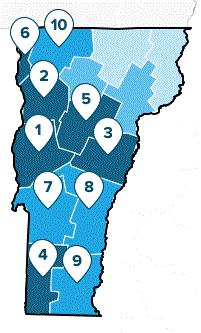
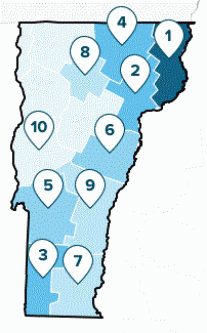
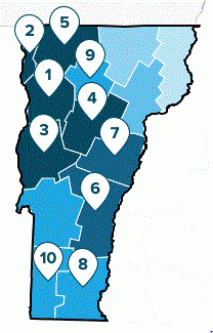 Purchasing Power, Cost of Living and Median Income
What about taxes? State and local taxes can combine with your federal income taxes to take a serious bite out of your income. When you consider that some cities have zero sales tax while others have sales taxes in excess of 9%, it's easy to see why taxes need to be included in any cost of living comparison. While every state has property taxes, these vary considerably from place to place. There's even greater variation in income taxes. Some states don't have any state-level income tax. Others (I'm looking at you, California) have high income taxes.
Education and Childcare
Depending on your circumstances there are several other large expenses that may shape your cost of living. There's the cost of education and whether you'll need to take out student loans to get (or complete) a college education. There's the cost of childcare if you need it. This could mean the cost of a caregiver who comes to your house, of pre-kindergarten or of after-school daycare. If you or your partner is a stay-at-home parent or if you have extended family helping you out you won't need to shell out for these expenses. Anyone else will need to budget accordingly.
Transportation
Transportation costs are a major expense for many Americans. Only about one in 20 American workers commute by public transit. The rest take a car. That means paying for repairs, gas and possibly tolls and parking permits. Carpooling can help you cut these costs by sharing them with others. Still, most American commuters ride alone. Transportation is a big factor in the cost of living because it's so closely related to job security. Unreliable transportation can mean a lost job.
Healthcare

Next up is healthcare. Healthcare premiums go from the affordable to the astronomical. Then, there's the cost of the care itself. The same medical procedure can be several times more expensive in some locations than in others. If you have employer-sponsored healthcare you might not have to pay anything for medical insurance. But if you're self-insuring by purchasing a health plan on the health insurance marketplace you could be looking at monthly costs in excess of $400 depending on where you live. Despite a decrease in the number of uninsured Americans, medical costs still account for a significant portion of the bankruptcies in this country. That's why it's important to look for insurance you can afford and have an emergency fund to cover unexpected expenses.
The Extras
Many Americans have nothing left in their budget after paying for the necessities mentioned above. But there are other necessities that aren't captured by food, childcare, medical costs, taxes, transportation and housing. These "extras" include clothing, personal care items and household cleaning products. You could go without some of them for a little while, but they're still necessities.
We're talking about things like toothpaste, the clothes you wear to work and the sponge and dish soap you use to clean your dishes. The good news is that these tangibles have gotten less expensive even as the costs of childcare, housing and medical care have gone up. Items including clothing, cell phones and computers have become relatively more affordable. That may not entirely take the sting out of your rising rent or your high healthcare premiums, but it can help.
Cost of Living Comparison
Economists consider mobility to be a good thing. If people are willing and able to move they can relocate to take the jobs that are best suited to their skill sets. Understanding the cost of living in a given place helps you make an informed decision about the salary you'll need to maintain the same standard of living. For example, if you're offered a job in a more expensive city you'll know that you need to hold out for more money if you don't want to experience a dip in your purchasing power. A cost of living calculator can make the research much easier.