

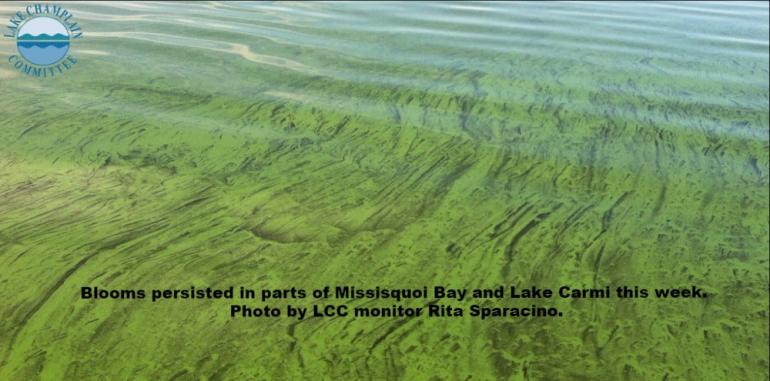
 Lake Champlain Committee (LCC) Fall is in the air, but water temperatures remain high. The reading at the King Street Ferry Dock Friday morning was over 70 °F. Blue-green algae blooms can still occur so please keep a watchful eye. While conditions seem to be improving in St Albans Bay, algae blooms continue to persist in some areas of Missisquoi Bay and Lake Carmi. Lake Memphremagog also had some visible cyanobacteria this week. Most other areas reported good conditions but we have fewer monitors reporting at this time of year.
See the weekly report section below for details along with useful resources and more background on LCC's monitoring program.
It's waterfowl season. Any hunters using dogs near waterbodies should know how to recognize blue-green algae and keep their dogs away from blooms. Also of interest to pet owners is that xylitol, a sugar substitute being used in some peanut butters, is toxic to dogs. (Pet owners sometimes wrap dog medication in peanut butter to make pills more palatable.) The symptoms of xylitol poisoning are very similar to those of cyanobacteria poisoning. Click here for more information.
If you're in the area in the next few weeks, please join us for our annual meeting on Thursday October 15 from 6:00 - 8:00 PM at the Flynndog Gallery and Chef's Corners South End space right outside our office in Burlington. Dr. William Howland will give a presentation on the state of Lake Champlain. There will be light fare of locally sourced food and drink, updates on lake issues and LCC's work, cool sculptures in the gallery, and conversation with other lake lovers. Click here for more information and to register. There are prizes for early RSVPs!
WEEK OF SEPTEMBER 20 BLUE-GREEN ALGAE MONITORING RESULTS
The information below represents the results from the latest reporting. Be aware that conditions can change rapidly and be watchful of the water and avoid blooms. This week we received over 70 reports from Lake Champlain Committee volunteers, government personnel and watershed groups outside the Lake Champlain Basin.
Lake Champlain Monitoring Sites
Missisquoi Bay – 8 reports. Conditions were mixed and changed throughout the week. The Highgate area reported high alert conditions as did the Route 78/Larry Green Fish and Wildlife Access Area. Everyone active on the water and shoreline of Missisquoi Bay should watch for changing conditions and keep people and pets away from blooms.
St. Albans Bay – 7 reports. Conditions were mixed in this area earlier in the but have improved since. Low alert conditions were reported from St. Albans Bay Park on 9/21 but had cleared by 9/22. No blooms have been reported since then. While conditions at other sites were generally safe small amounts of algae do remain. Anyone recreating in this area should watch for changing conditions and keep people and pets away from blooms.
Inland Sea – 9 reports. This area also had mixed conditions. Pelots Bay had a low alert on 9/19. No further reports have been provided for this location. All other locations reported good conditions and are considered generally safe.
Malletts Bay – 2 reports. No reports of blooms, this area is considered generally safe.
23 reports overall for the Main Lake
Main Lake North – All stations reported generally safe conditions.
Main Lake Central – All stations reported generally safe conditions.
Main Lake South – All stations reported generally safe conditions.
South Lake – 1 report. There have been no reports of blooms and this area is considered generally safe.
Other VT Lakes
Lake Carmi – 9 reports. Mixed conditions were reported again this week. Dewing Road, Hammond Road and North Beach sites all reported high alert conditions. All other locations reported good conditions. Everyone recreating in this area should watch for changing conditions and keep people and pets away from blooms.
Lake Iroquois – 1 report from 1 site of generally safe conditions.
Lake Memphremagog – 2 reports. Conditions were mixed this week with one low alert at Derby Bay. Everyone on the lake should watch for changing conditions and keep people and pets away from blooms.
Other Bloom Reports
Lower Poultney River, VT - A bloom was confirmed on the lower Poultney in West Haven. Anyone active in this area should watch for and avoid contact with algae blooms.
WHAT TO DO IF YOU SEE OR SUSPECT A BLOOM
- Report it to the Lake Champlain Committee using our online form. Click here for how to assess conditions.
- Avoid contact with the water in the area of the bloom.
- If you've been in contact with a bloom, rinse and shower thoroughly as soon as possible.
- Keep people (especially children) and pets out of the water.
- Do not drink untreated lake water. If you suspect a bloom near your intake, don't drink, cook or shower with the water. Boiling water does not destroy toxins.
- See a doctor if someone gets ill after exposure to an algae bloom and report algae-related illnesses to the health department.
- LCC GUIDANCE FOR TAKING BLOOM PHOTOGRAPHS
Please take digital photographs of the water whencategory 2 or 3 bloom conditionsare observed:
1. A close-up of the water surface
2. A broad view of water in the vicinity, and
3. A close-up of a water sample in a clear container placed against a background that provides contrast such as a sheet of paper of a wall. Darker colors provide more contrast.
All photographs should include the time, date, and location. This information can be added by using the date stamp in your camera or by holding a piece of paper with the relevant information in the picture. Name the photograph file using the year, month, day-photographer's name-location-photo type.
Example file name: 2015-07-10_LFisher_Hathaway Point_Category 2 Bloom Close-up
BLUE-GREEN ALGAE DATA TRACKER
You can check out water conditions on the blue-green algae data tracking map. LCC staff review and vet reports on a daily basis and make them available for viewing. All you need is an internet connection to keep apprised of conditions monitors are reporting. Once you get to the data tracking site, select a lake or section of Lake Champlain and then click on the inner circle in the dot. The date of the last monitoring report and status of conditions will appear in a table on the right. Green dots indicate generally safe conditions, yellow dots note low alerts, and red dots highlight high alerts. The low and high alert ratings don't change until the next report is filed.
INFORMATION RESOURCES
- Blue-green Algae in Lake Champlain
- Blue-green Algae Fact Sheet
- Blue-green Algae Fact Sheet for Veterinarians
- LCC flier on how to differentiate blooms from other lake phenomena
TAKE ACTION
Raise Awareness About Blue-green Algae
As people interested in water quality, please help spread the word about the risks of blue-green algae and actions to take. Blooms are caused by a combination of warm water temperatures and high concentrations of nutrients in the water, particularly phosphorus. Reducing the supply of phosphorus is key to reducing blooms. So please continue to take actions around your home and workplace and advocate for stringent controls to reduce nutrients flowing into the lake.
BACKGROUND ON LCC's MONITORING PROGRAM
The Lake Champlain Committee (LCC) developed a blue-green algae monitoring program for Lake Champlain in 2003/2004 and has overseen the citizen-based program ever since. The focus of the program is to raise awareness of the issue, build a database of information on bloom frequency, and identify and publicize any potential health hazards. The information gathered will help us better understand the triggers for blooms and aid in the work to reduce their frequency.
LCC coordinates our monitoring program closely with Vermont and New York health and environmental agencies. We annually train hundreds of citizens in methods to assess and report on water conditions. We also conduct trainings for state and municipal park staff, town health officers, and public water supply operators. LCC monitors provide important data on lake health from more than 80 Lake Champlain locations and five on Lake Carmi and one on Lake Iroquois.
FUNDERS & PARTNERS
The Lake Champlain Committee's blue-green algae monitoring program is funded byLCC members, the Lake Champlain Basin Program and the Vermont Department of Health. Key program partners include the Vermont Department of Environmental Conservation, Vermont Department of Forests, Parks, and Recreation, Vermont Department of Health, New York Department of Environmental Conservation, New York Department of Health, and the Lake Champlain Basin Program.
LCC 9.25.2015