

by Timothy McQuiston Vermont Business Magazine Deputy Housing Commissioner Jennifer Hollar is leaving her position in state government to work for the Vermont Housing & Conservation Board in Montpelier. Already experienced in community housing efforts, Hollar was among the first appointments of the Shumlin Administration and an important member of the team dedicated to the recovery efforts after Tropical Storm Irene hit in late August 2011. Hollar is stepping down at the end of September and will join VHCB November 1.
Governor Peter Shumlin said in a statement: “Jen has been a great asset to the state of Vermont. Her efforts to expand affordable housing options for Vermonters have strengthened our downtowns and economy. She is a tireless advocate for affordable housing and has magically moved the levers of government to make things happen. Jen is bright, dedicated, and results-oriented. She will be missed but I know she’ll continue to do great things for Vermont at VHCB.”
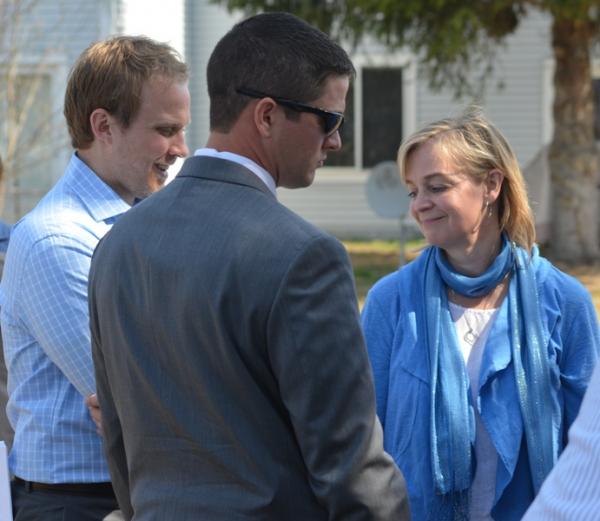 Jennifer Hollar at an affordable housing event in Colchester in May 2015, SEE STORY. VBM photo
Similar to how the Vermont Economic Development Authority and the Vermont Student Assistance Corp are organized, VHCB is a quasi-public entity whose board is appointed by members of both the administration and the Legislature. Its mission statement, in part, says, "The dual goals of creating affordable housing for Vermonters, and conserving and protecting Vermont's agricultural land, forestland, historic properties, important natural areas, and recreational lands are of primary importance to the economic vitality and quality of life of the State."
VHCB Executive Director Gus Seelig said of hiring Hollar: "During her time in state government she's been known as a super administrator." Seelig said previous to her position as deputy housing commissioner she had done some grant writing and been involved in other projects with the VHCB.
"She knows our work and our mission," Seelig said. "She can help us in any number of ways."
Hollar said in an email: "For five years I’ve had the great privilege of working for Governor Shumlin on behalf of Vermonters – creating housing, supporting community development and making sure those with lower incomes were not left behind in the recovery from Tropical Storm Irene.While we have made tremendous progress, more work lies ahead. The Vermont Housing and Conservation Board is unique in the nation for its ability to both provide for housing and community development while preserving and protecting our historic and natural resources. It is also uniquely positioned to help meet challenges such as water quality, climate change, disaster resilience and forest fragmentation. Working towards the state’s goals in these areas as part of the VHCB leadership team is an opportunity I had to take."
Seelig said Hollar will be a member of the VHCB (www.vhcb.org) management team and will be working on many of the same issues as she did in the administration. Among those is the tight and expensive housing market found nearly everywhere in Vermont.
"Housing is really strained," Seelig said. "The rental market is really tight."
He cited the state study released in 2014 that found that there is less than a 1 percent vacancy rate in multi-family housing in Vermont.
The Burlington, Montpelier and White River Junction areas are particularly difficult for workers, he said, as rents of $1,700 a month are beyond the means of someone making $10-$12 an hour. With younger workers putting off trying to buy a home, it puts more pressure on the rental market, he said.
"We need workforce housing," Seelig said.
He anticipates Hollar being able to help find new funding resources while she "strengthens our mission."
Hollar is on the board of the Vermont Housing Finance Agency. She also has been a commissioner with the Montpelier Housing Authority and has been on the board of the Central Vermont Community Land Trust. And prior to her Shumlin Administration appointment she was a member of the Government and Public Affairs Group at Burlington law firm Downs, Rachlin, Martin.
Shumlin's Deputy Chief of Staff Scott Coriell said they are in the process of finding Hollar's successor.
VHCB is funded in part by the Property Transfer Tax. According to its Website, since its inception in 1987 the VHCB has awarded nearly $260 million to nonprofit housing and conservation organizations, towns, municipalities and state agencies to develop nearly 1,500 projects in 220 towns. This investment has directly leveraged approximately $860 million from other private and public sources and resulted in the creation of more than 10,500 affordable homes, the conservation of 390,740 acres of agricultural and recreational lands and natural areas, and the restoration of 56 historic community buildings for public use. Many VHCB housing awards have supported housing in buildings eligible, nominated or listed on the State or National Register of Historic Places. Historic barns and farmhouses and archeological sites are located on many farms conserved with VHCB funding.