

Vermont Business Magazine The IRS has ruled that an owner of solar panels in a community-shared array is eligible for the 30 percent federal residential income tax credit known as the "residential ITC." The IRS ruling applies only to a specific solar panel owner inVermont, but it is a positive development for community-shared solar participants and project developers.Community-shared solar allows electric customers to buy an interest in an offsite solar array and to receive credit on their electricity bills for their ownership interest. While the IRS’s ruling is only legally applicable to the individual taxpayer in question — a solar panel owner in Boardman Hill Solar Farm, a member-managed 150 kW off-site solar array in Vermont — the ruling may open up project opportunities for direct ownership of community-shared solar systems by multiple individuals.
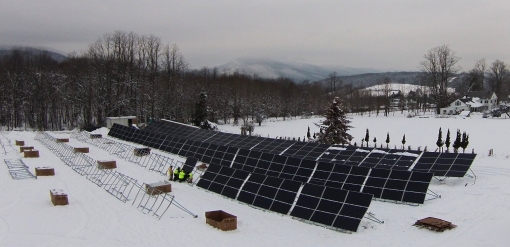 Community-shared solar allows electric customers to buy an interest in an offsite solar array and receive credit on their electricity bills. Stakeholders inMassachusettsandVermont, and attorneys withBostonlaw firm Foley Hoag, LLP and the Clean Energy States Alliance (CESA) arranged the Private Letter Ruling request to the Internal Revenue Service to help clarify shared solar owners' eligibility for the residential ITC.Foley HoagattorneysNicola LemayandAdam Wadeprovided legal services and facilitated discussions with the IRS.
"On behalf of the many Vermonters who participate in community solar, as well as those who work in the field to realize community solar, Renewable Energy Vermont celebrates the recent IRS ruling finding that the Federal tax credit can be used by Vermonters who opt in to community solar. Many Vermonters simply don't have the right roof or property -- and community solar makes it possible for them to go solar.This ruling sets a precedent for others to follow -- and makes tax policy fair for those who can't go solar on their own properties," saidGabrielle Stebbins, Executive Director, Renewable Energy Vermont.
"This new Private Letter Ruling represents the first instance in which the IRS has publicly weighed in on the applicability of the residential ITC to an owner of solar panels in a shared, offsite array," saidWarren Leon, the Executive Director of CESA. "The ruling suggests that the IRS may be receptive to claims for the residential ITC when a project mirrors the structure used in this case."
The Private Letter Ruling is available HERE.
CESA and Foley Hoag will be hosting a free webinar onTuesday, September 22ndfrom1 pm - 2 pm EST. Details and registration information are available HERE.
AboutFoley Hoag, LLP:Foley Hoagprovides innovative, strategic legal services to public, private and government clients across the globe. It has premier capabilities in the life sciences, healthcare, technology, energy, professional services and investment management fields, and in cross-border disputes. Its professionals possess the skills and experience to provide exceptional senior-level service to clients ranging from startups to multinational companies to sovereign states. For more information, visitwww.foleyhoag.comor follow @FoleyHoag on Twitter.
About the Clean Energy States Alliance:The Clean Energy States Alliance (CESA) is a national nonprofit coalition of public agencies and organizations working together to advance clean energy. CESA members—mostly state agencies—include many of the most innovative, successful, and influential public funders of clean energy initiatives in the country. CESA works with state leaders, federal agencies, industry representatives, and other stakeholders to develop and promote clean energy technologies and markets. CESA facilitates information sharing, provides technical assistance, coordinates multi-state collaborative projects, and communicates the positions and achievements of its members. For more information, visitwww.cesa.org.
MONTPELIER, Vt.,Sept. 1, 2015/PRNewswire/ --Foley Hoag, LLP