

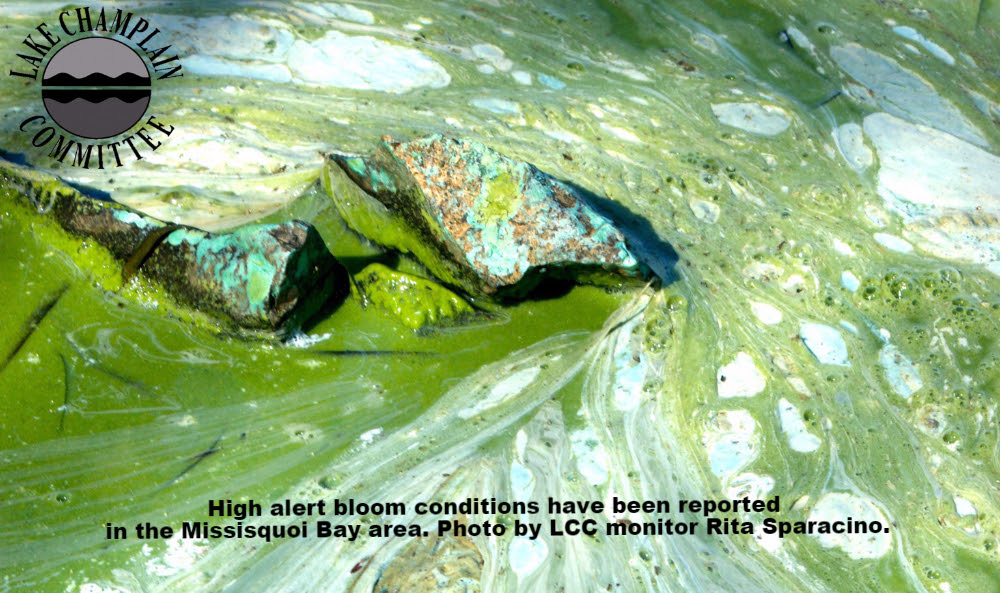
Algae bloom in Lake Champlain in August. Photo courtesy Lake Champlain Committee (LCC)
Vermont Business Magazine Today the Clean Water Fund Board recommended spending a projected $10.4 million to reduce nutrient pollution in Vermont’s waterways. The funds will be administered by state agencies in 2016 and 2017, once the legislature approves the plan next session. Nutrient pollution carried in runoff can fuel excessive plant and algae growth in Vermont’s waters, such as blue green algae blooms in Lake Champlain.
“Clean water has been a top priority of the Shumlin administration for the last five years,” said Agency of Administration Secretary Justin Johnson. “I am pleased that the resources are now allocated to expand important clean water work.”
|
Recommendation by Administering Agency |
FY16 |
FY17 |
Total Administered By Agency |
|
Agency of Agriculture, Food and Markets |
$675,000 |
$1,975,000 |
$2,650,000 |
|
Agency of Natural Resources |
$900,000 |
$4,955,000 |
$5,855,000 |
|
Agency of Commerce and Community Development |
$430,000 |
-- |
$430,000 |
|
Vermont Transportation Agency |
-- |
$1,465,000 |
$1,465,000 |
|
Total Need |
$2,005,000 |
$8,395,000 |
$10,400,000 |
|
Summary of Adjustment to the Proposed Allocations |
9/8/15 Proposal |
11/9/15 Proposal |
||
|
FY16 |
FY17 |
FY16 |
FY17 |
|
|
Farm capital improvements/USDA match |
$ 0 |
$ 600,000 |
$ 0 |
$ 600,000 |
|
Farm incentives/USDA match possible |
$ 225,000 |
$ 925,000 |
$ 225,000 |
$ 925,000 |
|
AAFM oversight & compliance |
$ 450,000 |
$ 450,000 |
$ 450,000 |
$ 450,000 |
|
ERP: partner support in technical, outreach assistance |
$ 200,000 |
$ 885,000 |
$ 100,000 |
$ 885,000 |
|
ERP: Advanced monitoring, partner organizations, LaRosa Lab |
$ 200,000 |
$ 200,000 |
||
|
ERP: Technical Assistance in field based practices (Agronomy) |
$ 485,000 |
$ 485,000 |
||
|
ERP: Municipal SW project identification & prioritization |
$ 500,000 |
$ 400,000 |
$ 400,000 |
$ 500,000 |
|
ERP: Municipal stormwater control implementation |
$ 500,000 |
$ 740,000 |
$ 400,000 |
$ 840,000 |
|
ERP: Municipal Capital Equipment Assistance |
$ 410,000 |
$ 395,000 |
||
|
ERP: NR -- Flood resilience, stream channel stability, forestry water quality projects |
$1,150,000 |
$1,150,000 |
||
|
FED: WWTF revolving loan funds |
$ 500,000 |
$ 500,000 |
||
|
LiDAR mapping |
$ 100,000 |
$ 430,000 |
||
|
Municipal gravel roads: inventory, planning, implementation |
$ 200,000 |
$ 470,000 |
$ 570,000 |
|
|
Municipal paved roads: inventory, planning, implementation |
$1,010,000 |
$ 895,000 |
||
|
Total by Year |
$2,075,000 |
$8,325,000 |
$2,005,000 |
$ 8,395,000 |
|
Total: Proposed Allocation |
$10,400,000 |
10,400,000 |
||
Vermont Clean Water Fund Board includes the Agency of Administration, Agency of Agriculture, Food and Markets, Agency of Commerce and Community Development, Agency of Natural Resources, and Agencyof Transportation. The Clean Water Fund Board was created by Act 64, also known as the Vermont Clean Water Act, which was passed by the legislature during the 2015 session and signed by Governor Shumlin on June 16, 2015. As stipulated in the new law, the Clean Water Fund Board develops on an annual basis a proposal for investingrevenues from the Clean Water Fund in programs that will make a significant contribution towards improving Vermont's water quality.
Over the past few decades, water pollution from runoff and erosion has increased in significance in Vermont and nationwide, and is now a critical concern. The signing of clean water legislation, Act 64 – the Vermont Clean Water Act, in June 2015 by Governor Shumlin signified a growing public recognition of the state’s water quality problems.
“We know that cleaning up the lake will take time and will require the participation of all Vermonters. The clean water fund money is being deployed carefully to help jumpstart that work,” said Agency of Natural Resources Secretary Deb Markowitz.
The Vermont Clean Water Act (Act 64) created the Clean Water Fund, a dedicated source of clean water funding, from an increase in the property transfer tax. These funds will be used to target priority activities that restore or protect clean water. The Clean Water Fund Board directs the fund’s use and is comprised of the secretaries of Administration; Agriculture, Food and Markets; Commerce and Community Development; Natural Resources; and Transportation.
Spending recommendations for the Fund’s first two years include (partial list):
· $2,140,000 for municipal stormwater support;
· $1,465,000 for municipal road inventories and improvements;
· $985,000 for grassroots partner support to aid municipalities and farmers;
· $1,750,000 for direct grants to farmers;
· $900,000 for compliance and enforcement of water quality standards on farms by the Agency of Agriculture; and
· $1,150,000 for river channel and floodplain restoration activities to reduce soil erosion and enhance flood resiliency.
Chris Cole, Secretary of the Agency of Transportation noted that, “Support from the Clean Water Fund will help cities and towns conduct inventories of their roads to identify water quality problem areas. Corrective actions they then implement will make great strides to keep our streams, rivers, and lakes clean.”
Vermont’s farmers will also be working to put management practices in place to reduce runoff. These investments are the most cost-effective investments that can be made to reduce nutrient pollution, like excessive phosphorus. “These funds will provide farms, of all sizes, with the resources needed to implement best management practices, many of which provide benefits to the farms, such as planting cover crops and implementing conservation tillage practices,” noted Chuck Ross, Secretary of the Agency of Agriculture, Food, and Markets. “Investing in these practices will benefit the environment for years to come.”
Agency of Commerce and Community Development Secretary Pat Moulton was also pleased with the Clean Water Fund Board’s vote. “Vermont’s economy is directly linked to clean water and a clean environment,” she noted. “These additional resources provide much-needed support to our municipalities, farmers and partners to get the job done.”


 For a copy of the recommended Clean Water Fund spending proposal visit: http://cleanwater.vermont.gov/.