

by Elizabeth Hewitt vtdigger.org The budget bill won preliminary approval from the House Thursday with a vote of 96 in favor and 46 opposed. The roll call vote came hours after an accompanying bill that raises $35 million in new income taxes passed the House by a slim margin. Legislators faced an unusual challenge with the budget bill this session. One week after Governor Peter Shumlin presented his budget proposal in January, a revenue forecast found an additional $18.6 million gap between the state’s projected revenue and projected spending in fiscal year 2016.
That left lawmakers scrambling to close a $113 million hole.
The budget bill, which passed out of the House Appropriations Committee with a unanimous 11 to 0 vote on Monday, makes $53 million in reductions to projected spending in FY 2016. New revenue and $24 million in one-time funds fill the remainder of the gap.
RELATED: House approves $33.2 million tax package after political deal-making
The House bill retains $10.8 million in labor savings proposed by the governor, as well as another controversial $6 million reduction to heating assistance. The bill contains a reduction of $5 million to Vermont Health Connect.
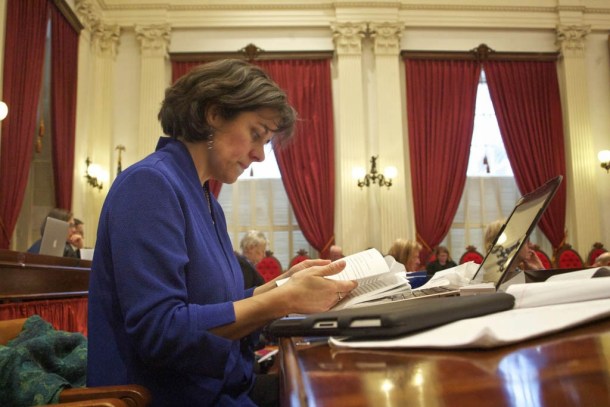
Rep. Mitzi Johnson, D-South Hero, chair of the House Appropriations Committee, prepares for a vote on the budget Thursday. Photo by John Herrick/VTDigger
During the three-hour report on the floor, Rep. Mitzi Johnson, D-South Hero, introduced the budget as the beginning of a “multi-year framework” for Vermont’s fiscal sustainability.
“It’s our job to wrestle that alligator mouth closed,” Johnson said, referring to the trend in recent years for lawmakers to reconcile a gap between revenue and spending.
The budget for Vermont’s general fund in FY 2016 as passed by the House Appropriations Committee totals $1.46 billion, a 4.8 percent increase over current year spending. The budget is a $7.4 million increase over the governor’s budget, in part because the Legislature needed to fill a larger budget gap than the governor did.
Members of the House Appropriations Committee read out the budget in full over the course of several hours.
There was one proposed amendment to the appropriations bill, which Rep. Chris Pearson, P-Burlington, withdrew.
Earlier in the day, Pearson told the House Appropriations Committee that his amendment would have used an additional $12 million in revenue for programs and expenses that support jobs and economic development.
The amendment to the appropriations bill would spend the bulk of the new revenue, a total of $6 million, on restoring the state workforce, which he said would save between 150 and 350 jobs. It also would have supported a state weatherization program, a working lands initiative and heating assistance — three areas that will see significant reductions under the appropriations bill.
“I do not intend this to be a critique of your work at all. This is simply trying to reflect a desire of many of our colleagues to take a modest step in a different direction,” Pearson told the committee.
But after both of the Workers’ Caucus amendments to raise additional funds under the revenue bill failed on the House floor, Pearson decided to withdraw the appropriations amendment.
“Our point has been communicated,” Pearson said before the House vote on the budget bill.
The budget received support from across the political spectrum, including the four Republican members of the House Appropriations Committee, although the big bill had many critics from within the majority party.
Rep. Cynthia Browning, D-Arlington, said after the vote that she did not support the budget because she felt that it did not go far enough in making long-term changes to Vermont’s finances.
“I don’t see a sign of either structural budget reform or structural tax reform that’s going to resolve our problems,” Browning said.
Browning noted that the gap was closed in part by drawing from the capital bill, a two-year budget that uses bonds to fund infrastructure projects.
After the vote, Johnson applauded the “bipartisan” work of her committee.
“I’m really pleased that for all the difficult reasons there are to vote against the budget, 96 people thought that there were more reasons to vote for it,” Johnson said.
House Speaker Shap Smith also said that he was pleased, though not surprised with the result of the vote on the appropriations bill.
“I thought the budget vote was a really strong vote, and was happy with the support for the appropriations committee,” Smith said.
Along with the revenue bill, the appropriations bill will face a second floor vote Friday.
Rep. Paul Poirier, I-Barre, questioned members of the committee on the House floor Thursday about the proposed elimination of $6 million in state funds to low income home energy assistance (LIHEAP). The cut would leave the state entirely reliant on federal funds for heating assistance.
Poirier said Thursday that he intends to propose an amendment on the third reading of the appropriations bill that would restore $3 million to LIHEAP.
Rep. Thomas Burditt, R-West Rutland, said that he plans to introduce an amendment to the appropriations bill that would put “teeth” on an introductory section of the bill that lays out five long-term goals for the budget.
The “intent” section of the bill, which has drawn mixed reactions, says that the Legislature will make an effort to create a sustainable budget by reducing reliance on one-time funds, attempting to bring revenue and spending in line, and considering a two-year budget cycle.
Republicans also plan to introduce two amendments to the tax bill that could mean the loss of between $2 million and $13 million in projected revenue.