

by Timothy McQuiston Vermont Business Magazine The patent on the silicon-based integrated circuit was barely five years old when an IBM manager called into his office in East Fishkill, NY, a small group of his best young engineers. This was 50 years ago almost exactly, in the spring of 1965, and he wanted them to try and use ICs for memory. To that point they’d only been used for logic. IBM was developing an important computer for the National Security Agency and VP of Engineering Eric Bloch asked his engineers to see if ICs could be used for one small component. If not, he told them, he’d use something else for the system protect.
RELATED STORY: GlobalFoundries completes acquisition of IBM Microelectronics business, July 1, 2015
 As Paul Castrucci tells it, he and Bob Henley “rolled up our sleeves” and invented IC Memory. By Christmas the 16 bit wafers were tested and in 1966 the computer was shipped to the NSA.
The IBM engineers were astounded by the performance of the memory chips.
“The circuits were flipping and flopping at speeds that we never anticipated,” Castrucci wrote for Vermont Business Magazine in 2007, for a special VBM issue celebrating IBM’s 50th anniversary in Vermont.
Immediately after this IBM developed a 64 bit Buffer IC Memory and a 128 bit Main Store IC Memory and shipped them its outpost in Essex Junction, Vermont, for manufacturing.
And then something momentous happened. On October 21, 1970, the Digital Age was born when IBM announced, with much fanfare, the first computer with 100 percent IC electronics, the Model 145.
“IBM Vermont became the capital for IBM Memory,” Castrucci recalled. “Essex Junction became the Plant of Control for IBM Memory plants in Essones, France, Singdelfigen, Germany, and Yasue, Japan. Many scientists, engineers and operation professionals from these countries came to Vermont to manage the technology transfer activities associated with moving the memory technology from Vermont to their countries.”
Castrucci went on to become the plant manager of IBM Vermont, or BTV as the plant became known. In the 1980s he “wrote the check” ($350 million) to build the 200 millimeter wafer manufacturing line. It was not only state-of-the-art, it was the first of its kind. All the memory developments at the time were done in Vermont. Vermont, as Castrucci said, became the Memory Capital of the World. Employment here peaked at about 8,500 in the 1990s.
Paul Castrucci died in June 2013, but his enthusiasm for IBM and for the technological advances achieved in Vermont never waned.
Governor Shumlin and a grim-faced group of state and local officials conducted a press conference at GBIC in Burlington on October 20, 2014. With the governor, among others (from left), were Development Commissioner Lisa Gosselin, Commerce Secretary Pat Moulton, Max Levy from Essex, George Tyler from Essex Junction, GMP CEO Mary Powell, Burlington Mayor Miro Weinberger, Lieutenant Governor Phil Scott, Speaker Shap Smith, GBIC President Frank Cioffi, LCRCC President Tom Torti, State Senator Ginny Lyons, Labor Secretary Annie Noonan and State Senator Dick Mazza. VBM Video.
The mood among Vermonters was decidedly different, however, on October 20, 2014, the day IBM announced that it was giving California-based GlobalFoundries $2 billion to take its technology division off its hands, including its chip manufacturing plants in Essex Junction and the larger Fab 2000, 300 millimeter plant down in East Fishkill.
It’s not only a complicated deal between the technology companies, it left Governor Peter Shumlin, local development officials, employees and everyone else in Northwestern Vermont wondering what would happen next. Closure?
The governor and others squeezed into a conference room that dayat the GBIC headquarters in Burlington to hold a packed press conference and put on a brave face. The officials were nervously optimistic, is one way of putting it.
While IBM is a vast technology company that does many things, including making chips almost as a money-losing aside to its legacy (that bygone legacy includes typewriters, personal computers, laptops and desktop operating systems). But GlobalFoundries aspires to be one thing, the world’s largest chip manufacturer.
Today, nearly every cell phone in the world carries a chip made in Vermont.
The nervousness for the future of the plant, its now 4,000 employees and the entirety of the Vermont economy has subsided. IBM has bolstered the manufacturing line of late. Chips are made day and night. GlobalFoundries plans to rehire almost everyone there. Even IBM plans to keep about 200 employees in Vermont.
IBM, parsimonious with a division that, at least on paper, was losing millions of dollars a year, had been reluctant to invest in the plant. Now, managers have been told by GlobalFoundries they can start upgrading systems. There is an undeniably positive feeling among workers, which has not been the case for many years.
The planned cutover is July 1. Given the complicated nature of the deal and the requirement for federal approval, it could be delayed slightly, but no one thinks it would be for very long.
STORY: IBM sells chip business, Vermont plant to GlobalFoundries
Vermont Business Magazine asked several local government, business development and business leaders for their memory of IBM in Vermont and what their hopes and expectations were for GlobalFoundries.
IBM Memories (SEE HISTORIC PHOTOS BELOW)
“We always quote the late Stuart "Red" Martin the founder of WCAX who summarized IBM's impact on Vermont this way,” said Greater Burlington Industrial Corp President Frank Cioffi. "IBM opened Vermont to the world and the world to Vermont."
“IBM made such a positive impact on our state and also made truly significant contributions to our communities and to Vermonters,” Cioffi said.
GBIC’s role in this all along has been significant, as well. GBIC built a modest spec building in Essex Junction more than 50 years ago and helped talk IBM CEO Tom Watson Jr, a Vermontophile already, into occupying it.
 What was once thought as impossible as a moon landing, IBM invented the 1 meg chip in 1987 in Vermont. IBM photos.
“Without IBM, Vermont would not be what it is today,” Governor Peter Shumlin said. “From the moment Tom Watson decided to build a plant in Vermont, IBM transformed our state from a small rural state into an innovative, research and technologically based economy.”
“It’s a pretty remarkable story,” Shumlin said. “You cannot underestimate the influence of IBM on the Green Mountain State.”
“IBM has been the backbone of a tremendous amount of Vermont's socio-economic success,” said Green Mountain Power CEO Mary Powell. “IBM employs Vermonters from every corner of Vermont and has an incredible number of Vermont companies that are in the business of supplying IBM with goods and services. IBM has also been a stellar contributor to the community through donations, participation in community activities and investments. The intellectual horsepower employed at IBM has supplied our economy with many new ideas and businesses and has contributed in so many measurable, and immeasurable ways to the greater good of Vermont.”
IBM has been GMP’s largest customer.
Tom Torti is the president of the Lake Champlain Chamber of Commerce, based in Burlington.
“The arrival of IBM brought with it not just thousands of jobs over the years but it brought engineers, visionaries, technology manufacturers and their families to the state. Many of these employees and families became deeply entrenched in the community and became community leaders who advocated for top quality academic programs; for social, athletic, arts and entertainment opportunities that mirrored what they were accustomed to in other IBM areas; they demanded community services and were most importantly willing to pay for these attributes. In a very real sense, IBM created the intellectual density that we see today at the University and Colleges; at the Medical Center and similar centers around the state and a culture that gave rise to the growing technology and entrepreneur ecosystem we see across Vermont. People wanted to come to the state/region to be part of or near to what IBM was creating. That is not to say that Vermont or this region would have remained corn fields and cow pastures, but the arrival and growth of IBM drove the demographic and social change that was slowly underway during the 60’s at a much more rapid pace.
“In other ways not related to technology, IBM drove the expansion of our private sector economy. Every kind of business from restaurants to movie theatres, to small retail shops to IBM related manufacturing and the service sectors (law, advertising; financial services; cleaning; etc…) expanded exponentially due to the influx of the thousands of well paid and committed employees. Those committed employees, some of whom turned down promotions to stay at IBM-Essex, gave tremendously to their communities by financially contributing to the United Way and other social programs, by serving on town boards, charitable organizations and the like.”
Jeff Couture is the Executive Director of the Vermont Technology Alliance. He’s also been on the frontlines with IBM as its communications manager until 2013.
 Manufacturing in 1960, before the semiconductors arrived.
“IBM put Vermont on the map as a place where advanced technology could be successfully developed and produced,” Couture said. “Over the 50 years since the semiconductor chip was first invented, the Vermont IBM plant has been a worldwide leader in the development, design and manufacture of semiconductor technology and products, delivering many innovations and firsts to the industry. Technologies from IBM in Vermont have helped make computers and electronic products smaller, faster, cheaper and more reliable. Nearly every Vermonter has come in contact with chips from the facility – through the Internet, computer systems used by banks, hotels, airlines and more, to cell phones and consumer products.
“For Vermont IBM has meant good paying jobs, tax revenue, support for charitable organizations and the contributions of thousands of IBM employees to their communities, including thousands of hours of volunteer service and the development of new businesses by former employees.
“Despite the concerns and criticisms over the years about layoffs, its size and its future, IBM has remained an important anchor business for the state’s economy, much as an anchor tenant is critical to a shopping mall’s success. The company provides a high profile example of the possibilities and potential of Vermont as a home to technology businesses.”
“IBM has been one of our cornerstone customers for many decades," said Don Rendall, President and CEO of Vermont Gas Systems, Inc. "They’ve been a great business partner to Vermont Gas and an extraordinary contributor to the regional and State economy. We look forward to the same close, customer-focused relationship with the Global Foundries team, providing them with affordable, clean, reliable energy service.”
Richard McGuire is the town manager of Williston. When IBM was expanding like gangbusters in the 1980s, it built a bridge across the Winooski River and built a new building on the Williston side.
“It is difficult to imagine what Williston, Chittenden County or Vermont for that matter would look like had IBM not decided to locate in Essex Junction in the late 1950s and early 1960s. The economic impact was huge. Many, many Williston residents over the years either worked directly for IBM or in a business that benefitted from IBM. In short, Williston would likely be a smaller community and possibly less prosperous had IBM not come to Vermont.”
GlobalFoundries Hopes and Expectations
“It appears to be an extraordinary win for our state,” said Governor Peter Shumlin. “We’re hiring every one of them. It couldn’t be a better story for us.”
“It’s been every governor’s fear since the second Snelling Administration that IBM could move out of state,” Shumlin said.
“This could have been the kind of thing that keeps governors up at night,” Shumlin said.
“The simple answer is that they commit to Vermont for the long term,” said Tom Torti, “so that the employees and families have stability and continuity. For too long, the fear of the “other shoe dropping” has affected the morale of folks who do the great work that IBM is known for. Stability will have positive repercussions throughout the community and the region.
“Second, my hope is that Global understands, appreciates and continues the commitment of being a true community partner. We all realize that some things will be different. The technology world is constantly changing; we all get that. What doesn’t have to change are some of the simple things: the charitable giving campaigns; the support for local youth activities; supporting employees that serve on local boards; engagement of business issues at all levels of the public process… these are the qualities that made IBM a model of good community corporate citizenship and will serve Global well as this exciting transition occurs.”
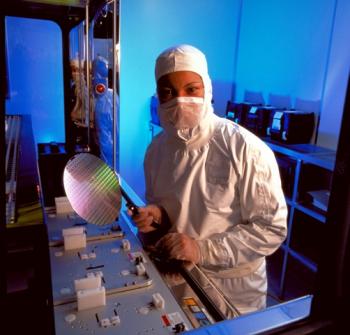 The 200 mm (8 inch) wafer.
“We are very optimistic and hopeful that GlobalFoundries represents a VERY significant opportunity for bringing new investment in technology/equipment/facilities and excellent prospects for solid job retention and possible job growth at our Vermont campus,” Frank Cioffi said.
“While GF is a relatively new company, their commitment to growth and innovation in the industry is very strong. GF intends to be the global leader in the industry.
“Vermont looks forward to developing a strong relationship with GlobalFoundries.”
“GMP is very excited about working with Global Foundries,” said Mary Powell. “It has been known for quite a long time that the majority of the IBM business in Vermont wasn't aligned with the new strategic direction of the company. This created anxiety that can now be put to rest as ownership changes to a company focused on growth in the areas well aligned with the capabilities at the Essex plant. Global Foundries is also very interested in energy and moving to a future that utilizes data and renewable energy generation in a new and different way. This will undoubtedly create opportunities for deeper partnership work with Green Mountain Power and is consistent with the policy goals of our state.”
Jeff Couture said, “GlobalFoundries is taking on a business that is successfully producing chip technology targeted at fast growing mobile consumer electronics and communications markets, particularly smart phones. Most cell phone manufacturers use and depend on chips from the Vermont facility.
“Chip technology and the external chip market was not a core business focus for IBM – it is for GlobalFoundries. GlobalFoundries has worked with IBM and is familiar with its chip technology. They are acquiring skilled and experienced employees and a strong portfolio of products and technology. For the employees, it removes some of the uncertainties and impacts from the ups and downs of IBM’s business that were out of their direct control. At the same time, IBM is not completely leaving Vermont, since a large number of IBM employees will still be based at the Vermont facility.
“The hope is that GlobalFoundries will succeed, find new opportunities and continue to grow in Vermont. With the IBM acquisition, GlobalFoundries is now one of the largest players in the chip industry and it becomes an important part of Vermont’s overall technology business sector, which represents an economic growth opportunity for the state.”
“The hope moving forward,” Rick McGuire said, “is that GlobalFoundries will continue to maintain a major employment presence in the region for many years to come. In the alternative, if their long term presence as an employer does decline, my hope would be that it be gradual to allow other businesses to replace the employment losses. However, given the quality of workers we have in this region and the good infrastructure in place, I am very optimistic about the long-term future of both Williston and the region.”
Shumlin said in the conversations he’s had with GlobalFoundries executives, it’s clear that they want to expand, invest and grow their chip business in Vermont.
“They want to be number one in that market,” Shumlin said. He said they’re just waiting for federal government approval to take possession of the Vermont plant.
“We’ll celebrate when it happens,” he said.
“You can imagine the concern we had when we heard that IBM wanted out of this business,” he said.
Now, “I’m really excited about our future.”
When C Harry Behney of GBIC and other local leaders convinced IBM CEO and local ski enthusiast Tom Watson to put a small manufacturing facility in a spec building in Essex Junction in 1957, they hoped to renew the economy following the collapse of the woolen factories in Winooski.
In its review of the most important economic events of the 20th century, VBM called the opening of IBM as the most significant economic development in Vermont’s history.
The facility grew, evolved, suffered and now it enters its next phase. For at least the time being, the governor of Vermont can sleep at night.
Timothy McQuiston is editor of Vermont Business Magazine.
IBM’s ImpactBy Frank Cioffi, President, GBIC GBIC prepared this economic and community assessment of IBM in 2014. IBM Vermont Over the past six decades, the most significant contributor to the expansion, diversification, and enrichment of our state’s economy has been IBM Vermont. No company has made a more prolific contribution towards enhancing the lives of generations of Vermont families and expanding our state’s capacity to innovate and grow. IBM opened Vermont to the world and opened the world to Vermont. IBM is Vermont’s largest for-profit employer, providing quality jobs to approximately 4,000 Vermonters. We estimate that over 10,000 Vermont families are supported directly and indirectly by IBM. The company’s $200 to $250 million annual payroll and economic activity annually injects approximately $1 billion dollars into our state’s economy making IBM Vermont’s most significant and vital economic engine. Whenever Vermont is recognized for its technological innovation, that distinction is likely to be attributable to IBM’s generation of knowledge and skills among its Vermont workers. IBM Vermont is a world leader in supplying complex electronic components to a wide range of global companies. Vermont’s high per capita state rankings for the creativity index, patent innovations, exports, and state rankings of workforce with higher education degrees are all substantially attributable to the contributions of IBM. Inventors at IBM are credited with 10 % of the company’s total U.S. patents issued each year, and IBM has led the world in patents issued for more than a decade. Since coming to Vermont, IBM and its employees have set an unparalleled standard of excellence by their significant contribution towards enhancing our communities. The relationship between IBM, its employees and the Vermont community is grounded in IBM’s long-standing commitment to civic, social, and environmental responsibility. Since its establishment in Vermont, IBM’s impact on our state has been truly unrivaled. However, its touch in the world has been just as remarkable. Semiconductors made at IBM, Vermont are used by leading global electronics companies. Across the world in 2014, virtually anyone using a smart phone, hand held and mobile device is using a product run on semiconductors made at IBM Vermont. Sixty years after they came to Vermont, the innovation and creativity of the company and its employees remain as rugged, strong, and vibrant as our Green Mountains. IBM Vermont: Economic and Community Significance Economics:
o GBIC estimates that approximately 4,000 Vermonters are employed directly by IBM. o GBIC estimates that IBM Vermont employees live in 190 towns across all 14 counties in Vermont. o GBIC estimates that payroll for the IBM Vermont campus workforce is between $250 – $300 million annually
o $ 6,668.90 (Essex Town) o $ 2,226,256.50 (Combined Village and Town total) § Williston: One assessed parcel with a real value of $ 31, 627,060 • Taxes (combined municipal and state assessment): $ 557,015.76 Utilities and Municipal Infrastructure:
o The entire site use is approximated at 65 megawatts, translating to more electric usage than the City of Burlington. Removing this portion of the GMP portfolio would require increasing rates to cover transmission and distribution costs on capital assets. o The estimated purchase value of the IBM electric power usage is approximately $35,000,000 annually
o IBM has been a consistent and large VT Gas customer due to the high demand for baseload energy. IBM’s gas bill is approximately $4.5 million annually and their year round usage stabilizes the Vermont Gas distribution system.
o IBM has consistently been 34.2% of CWD’s daily usage (3.18 MGD out of a total 9.3 MGD). Their consistent usage and non-seasonal demand allows for price stabilization across the entire CWD supply portfolio. o Without IBM usage, wholesale rates would increase 40%, from $1.84/1,000 gallons to more than $2.50/1,000 gallons.
o IBM Owned Treatment Facility Value: § GBIC estimates the combined capital value of the IBM owned waste water treatment facilities and infrastructure, as constructed, at $200 million. o Capacity: § Industrial waste treatment facility (4.4 million gallons per day). § Sanitary waste treatment facility (350,000 gallons per day). Future Industrial Potential:
o Their conclusion was that more than 34 acres of developable land remained on the site, enough to house 387,500 sq. ft. of light industrial development potential. o If development on IBM land could access the IBM waste water treatment facilities then there would potentially be very significant more square feet of new space, either of industrial, commercial or residential depending upon local zoning.
o IBM accounts for 70% of these patents. If removed from the equation, Vermont would rank #28. o The Brookings Institution lauded the Burlington-South Burlington MSA as the second most innovative metro area in the United States due in large part to our per capita patent figures. o In the past 10 years, IBM of Vermont employees have generated more than 1,200 patents, far and away the most of any organization in the state. o IBM technology developed in Vermont is globally innovative and present in products like hand held and mobile devices used virtually everywhere in the world today.
o These positions are strictly those counted within IBM Vermont; further benefits to the state and our communities occur because of their choosing to make personal investments from living in Vermont.
o IDX, Asic North, and ipCapital were all founded with former IBM employees. Exports:
o Many of these exports are incorporated into higher level subassemblies in Asia, where they must be able to compete on price as well as performance. Technical Expertise: - IBM has utilized its expertise in water and wastewater management to support other Vermont employers to make technical and business decisions, free of charge. o Additionally, IBM has shared their phosphorous reduction chemistry and techniques with wastewater treatment plants across the State at no cost to the plants.
o This includes providing land for the project free of charge. o Also free of charge, IBM has provided the technical work for the project: § Power engineering § Permit expertise § Construction management § Site design § Government contracting
o These IBM employees help with energy management support, technical issues, and Smart Grid data analytics to help these Vermont employers run more effective and efficient operations Charitable Contributions in the Community:
o Greater than $780,000 pledged o 4 Tons of Food delivered to 13 different food shelf locations across the state o Greater than $2M in total contribution (includes pledges, volunteer hrs, grants.)
o >140 volunteers o >4000 students reached o >40 schools across 6 Vermont Counties
o 14th Consecutive Year o >40 volunteers o 30 Seventh grade girls in attendance
o 39 non-profits/schools o 19 different communities o 85 IBM Volunteers |
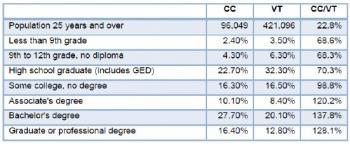
 Educational Attainment – Chittenden County:
  Innovation and Patents:
  Community involvement has always been a big part of IBM's presence in Vermont.
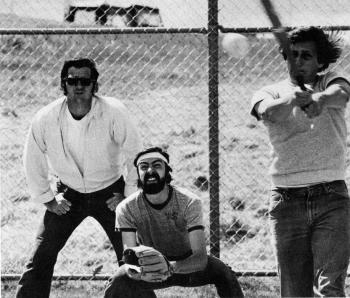 And they had some fun along the way, baseball 1973.
 The 64 bit chip in 1968 with the old magnetic "cheerios" memory system, which the IC memory replaced.

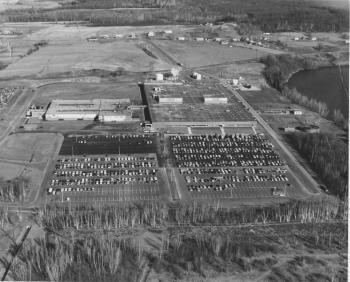
 The plant: 1957 (appears the slide is reversed); 1965 and 2003.
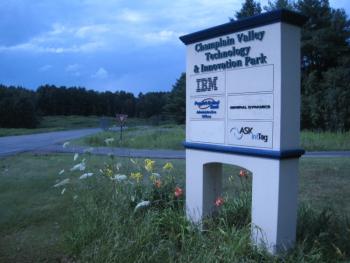 A new sign (seen from the Williston side in 2014) will soon go up.