

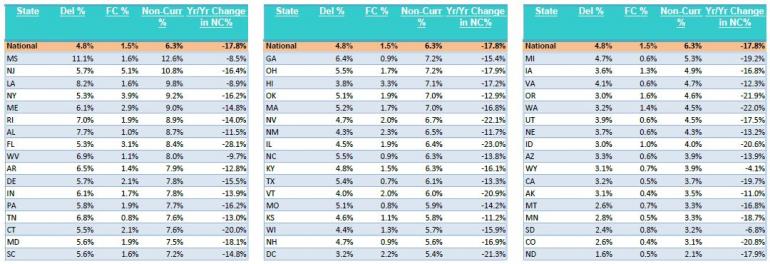
Vermont Business Magazine While there was not a drop in bad mortgages in Vermont from March to April, as there was from February to March, the annual decline in non-current mortgages continues in Vermont and in the US. For April, total non-current mortgages in Vermont were 6.0 percent (delinquent, 4.0 percent; foreclosures, 2.0 percent; down 20.9 percent from April 2014). These are nearly identical to the March numbers, which in turn were better than in February (non-current 6.9 percent, down 15.4 percent).
The Data and Analytics division of Black Knight Financial Services (NYSE: BKFS) reports Vermont is fairing slightly better in delinquent loans, slightly worse in foreclosures and overall is reducing its number of non-current mortgages faster than the national average, while still in the middle of the pack.
For the US as a whole:
-
Foreclosure starts drop by 22 percent in April; down 7 percent from one year ago
-
Slight seasonal increase in April delinquencies pushes national rate up to 4.77 percent
-
Prepayment rates up 60 percent from the same time last year
-
Florida leads nation with 17.4 percent reduction in non-current inventory over the past six months
 Black Knight also in April examined the most recent data on home retention actions-- i.e., loan modifications and repayment plans-- and found that of the approximately 952,000 US borrowers who are 90 or more days past due but not yet in foreclosure, 62 percent have been through some form of home retention program. As Black Knight Data & Analytics Senior Vice President Ben Graboske explained, while overall retention actions have decreased over the past two years, they are making up a greater share of that seriously delinquent inventory.
"In analyzing the data around home retention initiatives, we found that nearly one in five seriously delinquent borrowers are currently taking part in an active trial modification or payment plan," said Graboske. "With 62 percent of loans 90 or more days delinquent but not yet in foreclosure having been through some form of home retention action, we're currently seeing the highest level of saturation yet, but that's only marginally up from last year – in other words, that saturation level is beginning to flatten. Overall, home retention actions have declined 42 percent over the past two years, but at the same time have increased nine percent as a share of that seriously delinquent inventory. We're also starting to see some redundancy in this activity – 70 percent of all new trial modifications and repayment plans have already been through one or more home retention actions previously."
Drilling down into the home retention data on a geographic level, Black Knight found that Washington, D.C., led the nation with 67 percent of its seriously delinquent inventory having gone through some sort of home retention activity; of these, 26 percent are currently in an active trial modification or repayment plan. Maryland, Georgia, Texas and Connecticut followed; all having seen 66 percent of their 90+ day delinquent inventory participate in some form of home retention action. Additionally, at the national level, some 53 percent of loans in active foreclosure had taken part in home retention initiatives.
As Graboske went on to explain further, though there has been great improvement in both seriously delinquent and active foreclosure inventories, they still remain two and three times their pre-crisis norms, respectively, with 28 percent of the remaining inventory located in just three states: Florida, New York and New Jersey.
"Of these three states, Florida has seen the most improvement, with a 37 percent decline in inventory over the last year, and a 63 percent drop over the last two years," Graboske said. "On the other hand, low foreclosure completion rates in New York and New Jersey have contributed to lingering inventory in those states. Looking at pipeline ratios-- the length of time it would take to work through the backlog at the current rate of foreclosure completions-- we see New York and New Jersey with nearly 13 and nine years of inventory, respectively. Even though Florida peaked with 20 percent of the entire state being 90 or more days past due, its pipeline ratio was never longer than 10 years and is currently the lowest among all the judicial foreclosure states at just under three years. Compare that to Washington, D.C., which uses a non-judicial foreclosure process and a comparatively very small backlog inventory, yet still has a pipeline of over 43 years, primarily due to extremely low foreclosure sales volume there."
As was reported in Black Knight's most recent First Look release, other key results include:
|
Total U.S. loan delinquency rate: |
4.77% |
|
Month-over-month change in delinquency rate: |
1.46% |
|
Total U.S. foreclosure pre-sale inventory rate: |
1.51% |
|
Month-over-month change in foreclosure pre-sale inventory rate: |
- 2.43 % |
|
States with highest percentage of non-current* loans: |
MS, NJ, LA, NY, ME |
|
States with the lowest percentage of non-current* loans: |
MN, MT, SD, CO, ND |
|
States with highest percentage of seriously delinquent** loans: |
MS, RI, LA, AL, NJ |
*Non-current totals combine foreclosures and delinquencies as a percent of active loans in that state.
**Seriously delinquent loans are those past-due 90 days or more.
Totals are extrapolated based on Black Knight Financial Services' loan-level database of mortgage assets.
About the Mortgage Monitor
The Data and Analytics division of Black Knight Financial Services manages the nation's leading repository of loan-level residential mortgage data and performance information on approximately two-thirds of the overall market, including tens of millions of loans across the spectrum of credit products and more than 140 million historical records. The company's research experts carefully analyze this data to produce a summary supplemented by dozens of charts and graphs that reflect trend and point-in-time observations for the monthly Mortgage Monitor Report. To review the full report, visit: http://www.BKFS.com/
JACKSONVILLE, Fla. –Black Knight Financial Services