

Vermont is below the US average in the percentage of women-owned businesses and near the bottom in the growth of such businesses since 1997. Vermont has an estimated 23,300 women-owned firms, employing 13,200 and attributing to roughly $2,062,300 in revenues according to the fifth annual State of Women-Owned Businesses Report, commissioned by American Express OPEN, a comprehensive report released today analyzing the 1997, 2002, and 2007 data from the US Census Bureau’s quinquennial business census, the Survey of Business Owners. Vermont is ranked 46th (36.8%) in growth of number of firms over the past 18 years and 42nd (57.1%) in growth of firm revenue between 1997 and 2015.
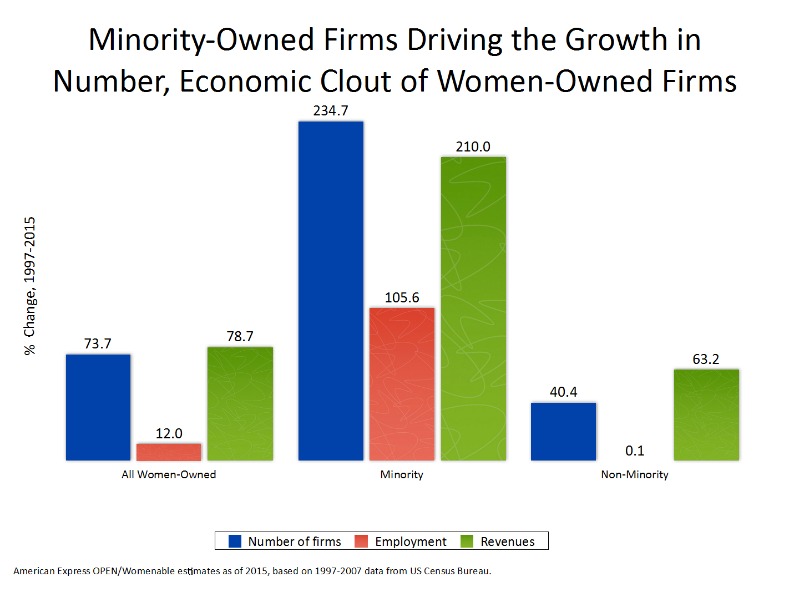
Nationally, the number of women-owned businesses has increased 74% since 1997. Much of that growth has been driven by multicultural enterprises.
Similar to previous annual reports released this time last year, the unique analysis, reported by industry, revenue and employment size at the national and state levels, shares a new and nuanced investigation into the growth trends among the 9.4 million women-owned enterprises over the past 18 years.
Vermont
1997: 25.2% of VT firms are women-owned
2002: 26.3%
2007: 26.0%
2015: 26.4% (compared to 30% nationally)
|
||||||||||||||||||||||||||||||||||||||||||||||||||||||||||||||||
The start-up rate among women-owned firms shows that business creation has recovered from the recession. The number of women-owned firms has increased by 21% since 2007, close to the 20% increase in the 2002 - 2007 period and up from only 7% between 2007 and 2012. Over the entire 18-year period from 1997 to 2015 women-owned businesses have:
- increased in number by 74%,
- grown revenues by 79%, and
- added nearly 1 million (847,000) more jobs.
As of 2015, it is estimated that there are just over 9.4 million women-owned businesses in the United States, generating nearly $1.5 trillion in revenues and employing more than 7.9 million people.
“Women-owned businesses are key contributors to the post-recession recovery,” said Lisette Bernstein, Vice President at American Express OPEN. “With this report, we hope to draw attention to the growing diversity of women-owned enterprises and inspire even more women entrepreneurs to reach their full potential.”
Significant Growth Driver is Multicultural Women-Owned Firms
Within the population of women-owned firms, a major driver of growth and diversity is multicultural enterprises. In fact, in 1997 there were 929,445 multicultural women-owned firms, accounting for one in six (17%) women-owned firms. That number has skyrocketed to an estimated 3,111,300 as of 2015, now comprising one in three (33%) women-owned firms. These 3.1 million firms employ 1.6 million workers in addition to the owner and generate an estimated $268 billion in revenues. And, looking at just the past year, nearly 500 of the 887 net new women-owned firms started each day were started by minority women – for a 55% majority of net new women-owned firms.
Some additional findings from the 2015 State of Women-Owned Businesses analysis include:
Industry Trends
The industries with the highest concentration of women-owned firms are health care and social assistance (53% of firms in this sector are women-owned, compared to a 30% share overall), educational services (45%), other services (42%), and administrative support and waste management services (37%).
Geographic Trends
The states with the fastest growth in the number of women-owned firms between 1997 and 2015 are:
1. Georgia (132%)
2. Texas (116%)
3. North Carolina (98%)
4. North Dakota (89%)
5. New York (89%)
The states with the slowest growth in the number of women-owned businesses between 1997 and 2015 are:
51. Alaska (14%)
50. West Virginia (26%)
49. Iowa (27%)
48. Kansas (32%)
47. Maine (36%)
Combining growth in the number of women-owned firms as well as revenue and employment growth over the 1997-2015 period finds that the states with the highest combined economic clout for women-owned firms are:
1. North Dakota
2. Wyoming
3. District of Columbia
4. Arizona (tied for fourth)
4. Georgia (tied for fourth)
4. Nevada (tied for fourth)
Among the 25 most populous metropolitan areas, the cities with the highest combined economic clout for women-owned firms over the 2002-2015 period are:
1. San Antonio, TX
2. Portland, OR
3. Houston, TX
4. Atlanta, GA
5. Riverside, CA
Study Methodology
The State of Women-Owned Business Report, commissioned by American Express OPEN, is based on data from the United States Census Bureau, specifically their business census, the Survey of Business Owners (SBO), which is conducted every five years in years ending in 2 and 7. Data from the past three censuses – 1997, 2002 and 2007 – were collated, analyzed and projected forward to 2015 factoring in relative changes in Gross Domestic Product (GDP) not only nationally but also at industry and state levels. State-level GDP changes over the period of analysis are applied to our estimates of change at the metropolitan level. Please note the metropolitan area trends can only be analyzed back as far as the 2002 Economic Census because the boundaries of metropolitan areas were changed after the 2000 Census. Also note that prior to 1997, women-owned firms were defined differently by the U.S. Census Bureau, and the trend analysis cannot be compared to data earlier than 1997.
The report was prepared for American Express OPEN by Womenable, a research, program and policy development consultancy whose mission is to improve the environment for women-owned businesses worldwide. Womenable pursues this mission by working with the stewards of women's entrepreneurship around the world – policy makers, multilateral organizations, corporate decision makers, entrepreneurial support organizations and the women's business community – to evaluate, implement and improve policies and programs to support women's enterprise development.
The report was published in May of 2015. The report along with the data included in this press release is provided solely for informational purposes and is not to be construed as providing advice, recommendations, endorsements, representations or warranties of any kind whatsoever. Opinions and analysis contained in the report represent the opinions and analysis of Womenable, and do not necessarily represent the opinions or analysis of American Express Company or any of its affiliates, subsidiaries or divisions (including, without limitation, American Express OPEN).
Source: American Express OPEN. 5.18.2015. www.womenable.com. For detailed information on the 1997, 2002 and 2007 economic censuses, visit: www.census.gov/econ/census07/www/get_data.html. (The 1997 economic census is no longer available electronically). A preview of upcoming changes for the 2012 economic census may be found at:www.census.gov/program