

The Vermont Agency of Natural Resources recently added nine species to the list of state threatened and endangered species. The listing included four plants, three bumble bees, one amphibian, and one bird. Three pollinators were listed - the rusty-patched bumble bee, yellow-banded bumble bee, and Ashton cuckoo bumble bee. Pollinators such as bees, moths, and butterflies are critically important to Vermont’s agriculture, but many are in decline nationwide. According to a survey by the U.S. Department of Agriculture, beekeepers reported losing 42 percent of their honeybee colonies between April 2014 and April 2015.
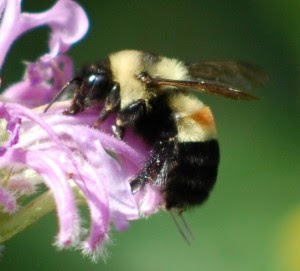 The rusty-patched bumble bee was one of three pollinators recently listed under Vermont’s Endangered Species Act, along with six other species. Photo by Johanna James Heinz, courtesy of the Xerces Society.
Vermont’s bumble bee species appear to be in decline due to a parasite infestation. Another concern for pollinator conservation is the widespread use of a group of systemic insecticides referred to as ‘neonicotinoids.’ These pesticides are used on agricultural crops, and are also used in concentrated doses on home gardens, lawns, and ornamental trees. Several types of neonicotinoids are highly toxic to bees, in addition to making them more susceptible to parasites and pathogens. The federal Environmental Protection Agency is currently considering legislation that would limit the use of these chemicals.
“Pollinators are essential to our farms and also to our meadows and wild orchards,” said Deb Markowitz, Secretary of the Vermont Agency of Natural Resources. “Adding them to the endangered species list is only one of many steps we can take to help protect them. Additional techniques, such as integrated pest management and planting more native flowering plants, are others.”
The bumble bee listings do not come with restrictions against currently legal activities such as applying pesticides in accordance with state and federal regulations, although the Secretary may notify a landowner that a permit is required in cases where one of these bumble bee species is likely present. More information on pollinators, including a list of pesticides for homeowners to avoid, is available on The Xerces Society’s website at www.xerces.org.
In addition to pollinators, the Fowler’s toad and rusty blackbird were listed as endangered in Vermont.
The Fowler’s toad is dependent on scoured sand banks along the Connecticut River, a limited habitat type in Vermont, and has always been extremely rare in Vermont. However, the toad had been detected in the state with infrequent regularity until 2007 when the toad was last heard.
Rusty blackbird populations have declined regionally by more than 90 percent during the past five decades, according to the North American Breeding Bird Survey. Vermont is at the southern edge of the bird’s boreal forest breeding habitat.
Four plant species were also listed as endangered in Vermont. These include the dwarf birch, tulip tree, whorled milkweed, and green mountain quillwort. These plants were previously not thought to exist in the wild in Vermont, but single specimens or single populations of all four species were found recently in the state.
“While we are delighted to have located these rare species, their endangered status reminds us that many of these plants can only survive where there is habitat to support them,” said Markowitz. “We are fortunate in our state that Vermonters value the bees, birds, and plants that enrich our experience of nature and have worked to conserve lands so that future generations might enjoy them as well. It is critical that we continue to protect not only endangered species but the places where they thrive.”
Vermont currently has 51 state threatened and endangered animals, and 163 state threatened and endangered plants. Three well-known birds were removed from the list in 2005 –the peregrine falcon, osprey, and common loon –following the birds’ recovery as a result of conservation efforts.
Monarch Butterflies Decline to Dangerously Low Levels
Monarch butterflies are in decline nationwide, and may be approaching dangerously low levels.
Monarchs have declined nearly 80% in the 21 years researchers have been monitoring their wintering populations, from a high of up to one billion butterflies in the 1990s to roughly 56 million today, according to a recent report from the Xerces Society.
But according to Mark Ferguson, a biologist for the Vermont Fish & Wildlife Department, Vermont may play an important role in the continued efforts at monarch conservation.
“Vermont’s meadows and old fields provide habitat for milkweed, which is a critical food source for monarchs,” said Ferguson. “In contrast, increasing levels of herbicide use in large-scale agriculture in the Midwest appear to have greatly reduced the abundance of milkweed in that part of the country, which historically produced half of the monarchs in eastern North America.”
Monarchs lay eggs on milkweed and feed on milkweed as caterpillars. Most eastern monarchs overwinter at a single site in the mountains of central Mexico. According to Ferguson, monarchs need to reproduce several times during their north-bound migration, and require milkweed at each of these sites.
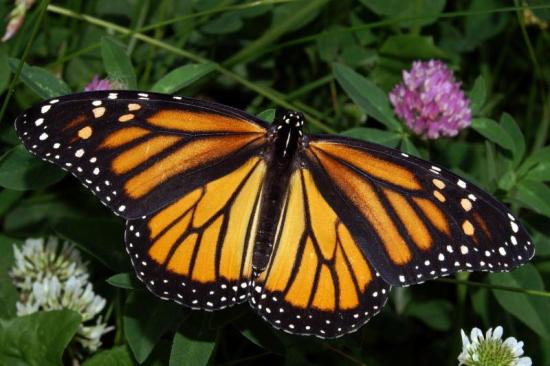 Monarchs are in decline nationwide, but Vermont Fish & Wildlife’s Mark Ferguson says that Vermont contains essential monarch habitat that may play an important role in the butterfly’s conservation. Photo by Kenneth Dwain Harrelson, Wikimedia Commons.
“A monarch that leaves its wintering grounds in Mexico will never make it to Vermont,” said Ferguson. “Instead, several generations are born and die along the way, meaning that the grandchildren or great-grandchildren of the monarchs leaving Mexico eventually arrive in Vermont each summer. Because monarchs need milkweed to reproduce, anything we can do in Vermont to promote this vitally important species will help monarchs thrive.”
In addition to declines in milkweed, the widespread use of a group of insecticides referred to as neonicotinoids may threaten monarch conservation. These pesticides are used on agricultural crops, and are also used in concentrated doses on home gardens, lawns, and ornamental trees.
Ferguson says that there are several things that Vermonters can do to help foster healthy monarch populations. “One of the best things people can do for monarchs is to provide milkweed for caterpillars and nectar plants for adults,” said Ferguson. “Many of the best nectar plants are actually wildflowers that grow naturally and will provide monarchs with a good source of food if left uncut during the growing season.”
Ferguson also recommends that people limit the use of insecticides and herbicides in order to allow Vermont’s residential yards, meadows, old fields and pastures to support monarchs and their habitat.
According to a recent White House report, pollinators such as monarchs contribute more than 24 billion dollars to the U.S. economy, by promoting fruits and vegetables as well as agricultural crops like alfalfa. Pollinators also keep forests healthy by pollinating many species of trees.
Source: Vermont Fish & Wildlife. 7.1.2015.