

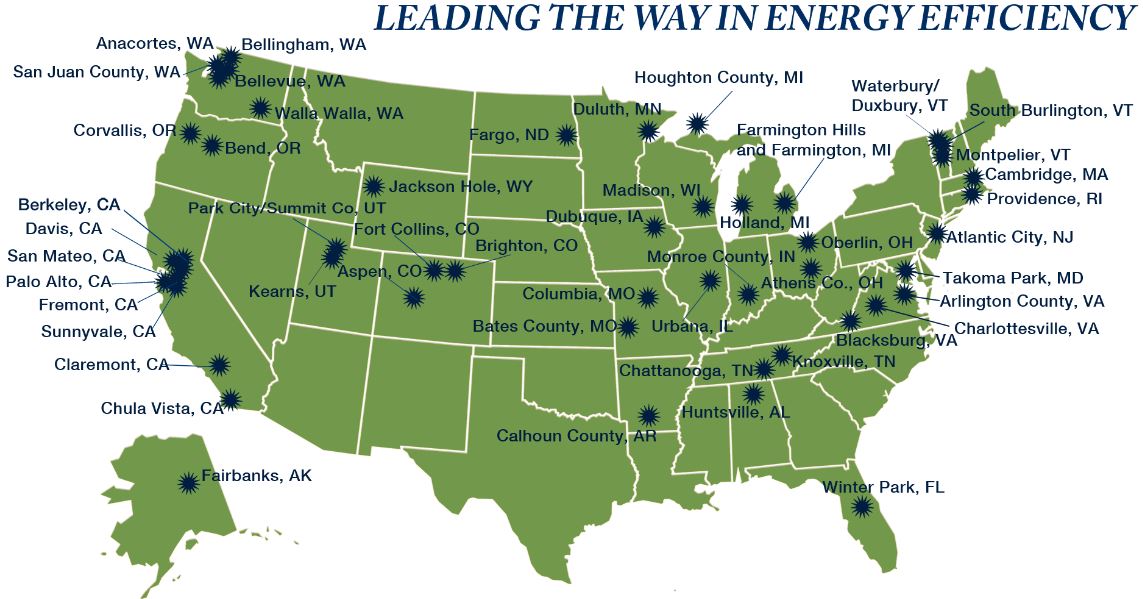
Three Vermont communities advanced to the semifinal round of the Georgetown University Energy Prize (GUEP), a national competition that is challenging communities across the U.S. to rethink their energy use. At a press event in Washington, DC. today, Montpelier, South Burlington and Waterbury/Duxbury (a joint application) were among the 50 communities acknowledged for leading the way on energy efficiency. Each of the 50 towns from around the country will compete for a $5 million purse, which can be used to support community energy efficiency initiatives, education or energy innovation.
Under the leadership of the local energy committee, each of the three communities plans to use this significant prize to build off of – and considerably strengthen – their work to help their municipalities and neighbors reduce their fossil fuel use.
Waterbury/Duxbury outlined their plans to continue to improve energy efficiency in schools, town buildings and residences through education and public awareness activities, as well as to further promote rooftop and small-scale backyard solar arrays for private residences.
Jamison Ervin, a member of the board of directors of Waterbury LEAP, noted that, “It’s nice to be recognized for the energy leadership that Waterbury and Duxbury have already shown, and this prize gives Waterbury LEAP a real boost in advancing energy literacy throughout our community. Our actual chances of winning the prize are probably slim, but if we go all in, our community will end up saving a surprising large amount of money anyway.”
South Burlington and Montpelier join Waterbury/Duxbury in vying for one of 10 finalist spots to be announced in early 2017. The ultimate goal of the competition is to reduce the impacts of energy use on the environment and on the economy by spurring the creation of innovative and replicable programs.
“The two year competition is a winwinwin proposition,” said South Burlington Committee co-coordinators Keith Epstein and Don Cummings. “The City, its schools, and its residents will all save a tremendous amount of money on energy use, and that money will stay in the local economy. The competition will also be a great way to build community spirit and connections. We think everyone will not only see concrete benefits but also have a lot of fun.”
Rounding out the trio of qualifiers is Vermont’s capital City of Montpelier, which is in the midst of an effort to become “Net-Zero” in its fossil fuel use by 2030.
“Montpelier has set a tremendously ambitious goal to eliminate or offset fossil fuel use in the Capital City completely in 15 years,” said Montpelier Mayor John Hollar. “This initiative not only provides even more motivation to act but an opportunity to collaborate with two other Vermont communities to achieve our goals. We look forward to rolling up our sleeves and moving ahead.”
Vermont also has ambitious state goals regarding renewable energy and climate change. The state aims to meet 90 percent of Vermont’s energy needs in 2050 with renewable supplies and reduce its carbon pollution 75 percent by 2050.
“The growing grassroots network of local energy committees is key to helping Vermont realize a clean energy future,” said Johanna Miller, coordinator of the Vermont Community Energy and Climate Action Network (VECAN), which is the state’s network of over 100 energy committees. “The Georgetown University Energy Prize will help these dedicated communities further foster needed innovation, collaboration and motivation.”
“At a time when many members of Congress are denying the reality of science in the climate change discussion, leadership on efficiency, renewables and climate change in Vermont is more important than ever,” said U.S. Senator Bernie Sanders. “Vermonters understand that saving energy not only keeps more money in their pockets but is good for planet. I congratulate the excellent work of South Burlington, Montpelier and Waterbury/Duxbury and look forward to seeing them become a model of energy efficiency and renewable energy for this nation.”
To learn more about the Georgetown University Energy Prize, visit www.guep.org, or follow the Prize on Twitter (@GUEnergyPrize) or Facebook (www.facebook.com/guenergyprize).
About the Vermont Energy and Climate Action Network
VECAN is a network of over 100 town energy committees and statewide Vermont organizations helping communities across the Green Mountain State reduce energy costs and climate impacts through conservation, increased energy efficiency and conversion to renewable energy sources. The Vermont Natural Resources Council serves as the VECAN coordinator.
About the Georgetown University Energy Prize
The $5 million Georgetown University Energy Prize challenges small- to medium-size towns, cities, and counties to rethink their energy use, and implement creative strategies to increase efficiency. To compete for the Prize, local governments, residents, utilities, and others will need to work together to demonstrate success in sustainably reducing energy consumption over a two-year period. For more information, visit www.guep.org.
Source: VNRC 1.14.2015