

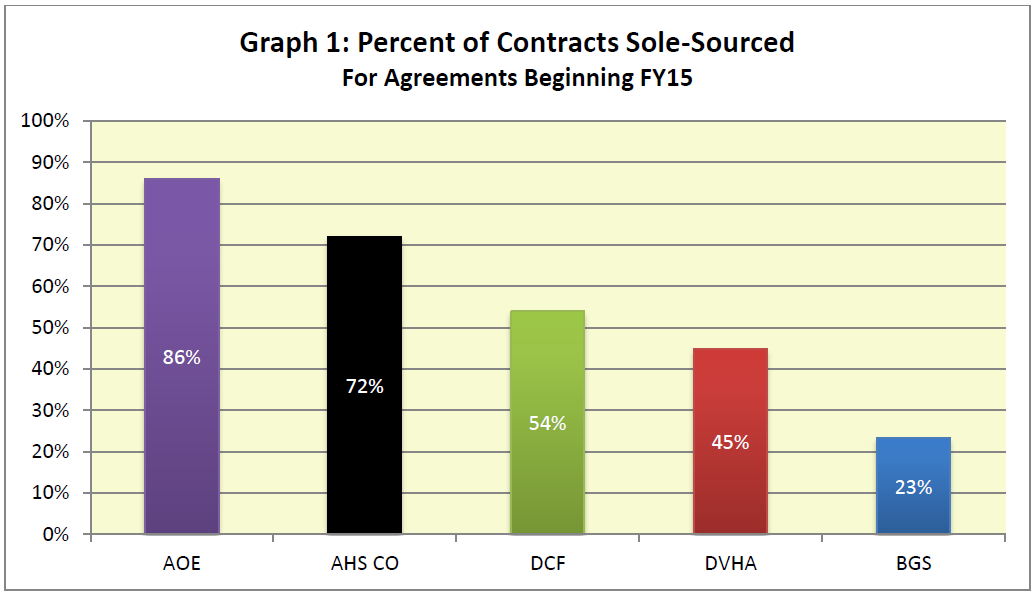
by Timothy McQuiston Vermont Business Magazine Saying that sole-source state contracts should be used rarely, but are instead used for more than 40 percent of all contracts he reviewed,Vermont State Auditor Doug Hoffer today released the findings of an investigation into the prevalence of noncompetitive state contracting practices.For more than two decades, the State of Vermont has had a policy of contracting for services and materials “in a cost effective manner through the use of an open and competitive contract solicitation process.” According to the policy, sole source contracts awarded to a vendor without a competitive bid ought to be reserved for “extraordinary circumstances.” He also identified legislative practices used to sometimes get around the bidding process.
The report released today quantifies the frequency and dollar value of sole source contracts at five selected departments and agencies. It also points to trends that the Auditor’s Office identified, as well as concerns about particular contracts and practices.
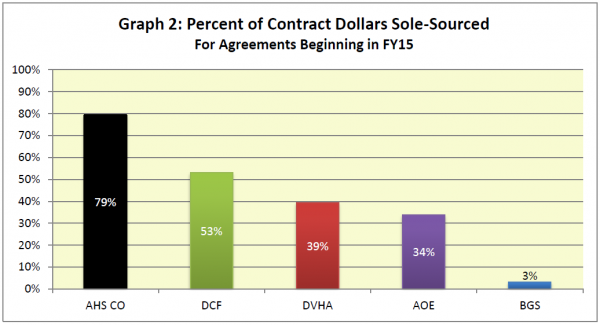
A review of nearly 1,000 contracts across five agencies and departments found that while sole source contracts are intended for extraordinary circumstances, this selection method is commonplace for some departments and agencies. In fiscal year 2015, sole source agreements accounted for 41% of all contracts awarded and amounted to $68 million, or 27 percent of the total dollar value. This value is for sole source contracts awarded in one year by the five agencies and departments examined in our report reflects only a portion of state government.
“The high frequency of sole source contracts reviewed for this analysis raises questions about the effectiveness of the State’s contract management,” Auditor Hoffer said. “The State’s longstanding policy to competitively bid for contracts is meant to ensure taxpayers receive the highest values for their contracted dollars and Vermont businesses are afforded an equal opportunity to obtain contracts.”
Included in this review were: the Agency of Education, the Agency of Human Services Central Office, the Department of Buildings and General Services, the Department for Children and Families, and the Department
of Vermont Health Access.
While some sole source selections were justified, many were not. Numerous memos lacked a justification for using a sole source selection, and others lacked evidence to substantiate claims. The Auditor identified sole source memos based on erroneous information, and highlighted legislative directives that were used to sidestep the State’s contracting policy. In addition, familiarity with contractors often took precedence over an open and competitive process.
 Hoffer cited several examples, included among them are:
The Phantom Ruling
For instance, the DCF contracts roughly $20 million annually to providers for Medicaid services under the Private Non-Medical Institutions Medicaid option.20 DCF is contracting with 11 providers this fiscal year. Contracts forthese services are sole-sourced, and these arrangements appear to stretch back to the mid-1990s.
A common justification for these contracts has been that the federal government prohibits DCF fromcompetitively bidding these services.
“A ruling issued by the Health Care Finance Administration in 1996 prevents the department fromsecuring Medicaid services by competitive bid,” DCF’s Deputy Commissioner wrote in memos from2009-2015. “Therefore it is my intention to enter into sole source contracts with the existing providersfor a period up to four years.”
A search of past rulings of the federal administration yielded no results that would prevent the Statefrom competitively bidding for these services. Hoffer asked DCF for documentation associated with said1996 ruling, and the department was unable to provide it.Hoffer also contacted the Centers for Medicare and Medicaid Services (CMS), which was formerly calledthe Health Care Financing Administration. Officials at CMS reviewed their files and could find nodocumentation that would substantiate the ruling referenced by DCF. Furthermore, a CMSrepresentative wrote: “Typically, to assure economy and efficiency of provider rates, we allow states touse competitive bidding to subject rates to market forces.”
It is unclear why the department has relied upon this erroneous justification for sole-sourcing theseservices. But the repeated approval by administrations over the years raises questions about the level ofscrutiny and verification employed when reviewing and approving sole source contracts.
Amending Up
The audittor also found that contracts are sometimes sole-sourced and then amended up to significantly highervalues. A BGS contract with Architecture Plus, for example, grew by 1,775%, from $150,000 in 2008 to$2,812,350 in 2015. The vendor received a sole source contract to continue work that began in 2005 todevelop site plans for residential psychiatric facilities. The contract was amended upwards several times,which the department said was caused by new legislative mandates and Tropical Storm Irene. Althoughone of these circumstances might be extraordinary, the lack of competitive bidding over a seven-yearperiod is not best practice, especially considering the significant changes to the project’s scope and thecontract’s value.
Another example of this practice is when DVHA contracted with Bailit Health Purchasing as part of theSIM Grant to provide technical assistance for the initiative’s sub-grant program. DVHA said that it sole-sourcedthis contract due to the contractor’s familiarity with Vermont, the content, and because “DVHAfeels it is in the best interest of the State at this time to seek sole source approval for these technicalassistance services for (an amount) not to exceed … $190,000.” That initial contract was for one year. Itsscope was then enlarged, and its period was expanded to three years. The value of the contract wasincreased 550 percent to $1.23 million.
Legislative Direction: BGS Example
In those instances when BGS does not operate state visitor centers, the department contractsexclusively to Chambers of Commerce. The Lake Champlain Regional Chamber of Commerce received asole source contract for $1.2 million to operate the Williston North and South Visitor Centers from July2012 to June 2015. It received another sole source contract for $207,149 to operate the Georgia SouthInformation Center and manage advertising at Georgia’s north and south centers from July 2014 to June2016.In both cases, the chamber is able to generate revenue from advertising and other means thatthe State would otherwise receive.
BGS cites the legislative authority to enter into agreements with local or regional chambers ofcommerce as the main reason for exclusively contracting to them for these services.The empoweringlanguage stems from 1997 legislation, which says: “The Commissioner of the Department of Buildingsand General Services is authorized to enter into agreements with, and grant funds to, local or regionalchambers of commerce, or both, to provide staffing and operations of state-owned welcome centers,rest areas and information centers under guidelines established and enforced by the commissioner.”
A1999 bill states that the department “is authorized to operate rest areas, information and welcomecenters as state or private facilities.”
While this language gives BGS the authority to contract to chambers of commerce, it does not mandatethat the department only contract to the chambers. The department, however, interprets this languageas a directive to only contract to chambers when it privatizes these services. Absent competitive bids,there is no way to know whether the State is getting the best deal.BGS also sole-sourced a $514,000 agreement with the Bennington Chamber of Commerce to run theBennington Welcome Center for nearly two years. In addition to the above language, 2009 legislationinstructed BGS to build the Bennington Welcome Center and made clear: “It is the expectation of thehouse and senate committees on transportation that the site will be operated by the Bennington areachamber of commerce.”
Although this language did not mandate contracting to the Bennington Chamber of Commerce, thislegislative action told BGS that it was the expectation of two committees to effectively sidestep theofficial contracting policy of the State, which is to competitively bid for contracted services wheneverpossible.
BGS did conduct cost-benefit analyses to project savings compared to using state workers, but BGS doesnot know whether it could have obtained a better value for these services by soliciting proposals fromother vendors.It also appears that the cost-benefit analyses do not account for lost revenue fromforegone advertising and other opportunities. Furthermore, cost-benefit analyses should be re-run aftercontractors have a history with the State to ensure that the assumptions used for the anticipated stateruncosts correspond with the actual performance of the contractor. In other words, what would it costfor the state to run the welcome center with the same number of workers working the same hours asthose actually worked by the contractor?
Contractor Familiarity:DVHA Example
When DVHA requested a sole source contract with the Pacific Health Policy Group (PHPG) in May 2014,the Agency of Administration denied the department’s request. DVHA sought to work with PHPGbecause its commissioner said the firm provided a “unique” knowledge base and skill set, as PHPGemployed a former Vermont commissioner and deputy commissioner. The firm also employedindividuals with a history working on Vermont health care reform initiatives.
The Secretary of Administration responded: “I am not inclined to support this waiver request. The factmultiple PHPG principals were high level State officials leads me to believe a competitive bid iswarranted.”
Nonetheless, two months prior, the administration allowed DVHA to sole-source contracts with PHPG ata value of $600,000 for 1.5 years and one at $90,000 for one year. Roughly two months after the solesource denial, DVHA was also allowed to execute a $100,000 sole-source contract with PHPG for oneyear.
The $600,000 contract with PHPG was an extension of services from a previous two-year contract, whichhad expired and was valued at roughly $1.4 million. This previous contract was also sole-sourced.DVHA’s contract with Bailit Health Purchasing for $1.2 million over nearly three years is for some similarservices as those provided in the PHPG contract for $90,000. The justification of contractor familiarityfor this sole source request is very similar to those for the PHPG contracts.
Additionally, DVHA has contracted with the University of Vermont (UVM) for at least seven years toprovide the State with a Chief Medical Officer and Medical Director, as well as program evaluations.The current contract was sole-sourced for $1,792,437 over nearly 2.5 years.According to DVHA, thiscontract provides an added bonus in that UVM can use these positions as faculty at its medical school,and the medical school can quickly respond to program evaluation needs. “For these reasons, puttingthis work out to bid would be a fruitless process,” the department’s commissioner wrote.
While UVM can use the Chief Medical Officer and Medical Director as faculty, this is not the purpose ofthe contract, and other institutions might also be able to provide the State with qualified physicians tofill these roles.
Without a competitive process, it would be difficult to verify the value of this contract.While the contract does offer a partnership with the only academic medical center in the state, relianceon UVM for program evaluations may present conflicts of interest if the university is charged withevaluating state health care programs in which the University of Vermont Medical Center (UVMMC)participates.
“State officials owe it to Vermonters to make every effort to achieve the highest value contracts for services and materials,"Hoffer said. “The only reliable way to do that is through an open and competitive process.”
In light of the findings in this report, the administration has pledged to work with agencies and departments to strengthen contracting practices.
“I am encouraged by the Secretary of Administration’s response to these findings and his agency’s commitment to improve contract procedures,” Hoffer said. “It is critical for the State to identify structural deficiencies and solutions to enhance contract oversight.”
Secretary Justin Johnson said in a letter appearing in the report that, "I generally agree with the observations outlined in the report." He said he will work with department heads "to strengthen the oversight and review of the contracting process to ensure full compliance with the spirit and intent" of the rules governing state contracting.
Johnson said the state is working toward a centralized procurement system.
(SEE FULL REPORT with responses from all the departments and further queries from the auditor).
Source: Vermont Auditor 12.14.2015. SEE FULL REPORT