

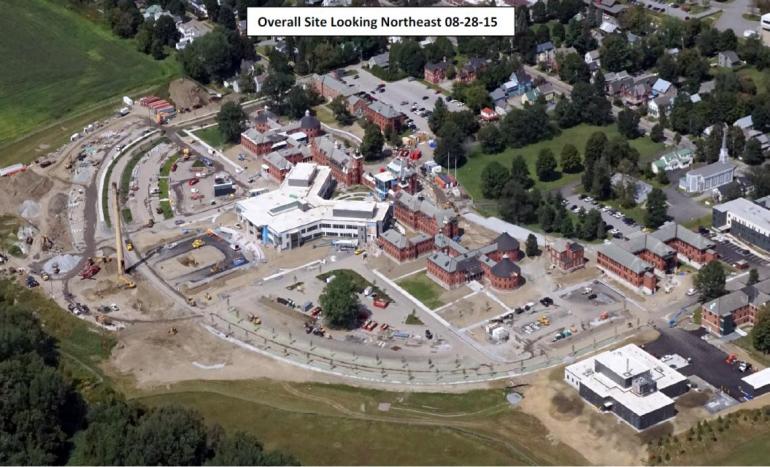
 by Erin Mansfield vtdigger.org The renovation of the Waterbury State Office Complex is almost complete, and state employees are on track to move back at the end of 2015. The facility will house about 850 state employees, most of whom work for the Agency of Human Services, the largest agency of state government, and the Department of Public Safety. The project has been in the works since Tropical Storm Irene in August 2011 damaged the complex. Heavy rainfall led to severe flooding and the evacuation of psychiatric patients at the Vermont State Hospital. About 1,500 state employees worked at the Waterbury complex at the time.
The facility served as an insane asylum in the 1800s. Now a modern granite building peeks out from behind rust-colored cylindrical buildings. The rusty buildings are the historical core, whose round rooms once had beds lined up in rows for psychiatric patients; the rooms are being turned into true office space. A new building, with white granite siding and a secure entrance, sits behind the historic core.
“We specifically chose that the new buildings stand out from the old buildings,” said Mike Stevens, the project manager, who works for the Department of Buildings and General Services.
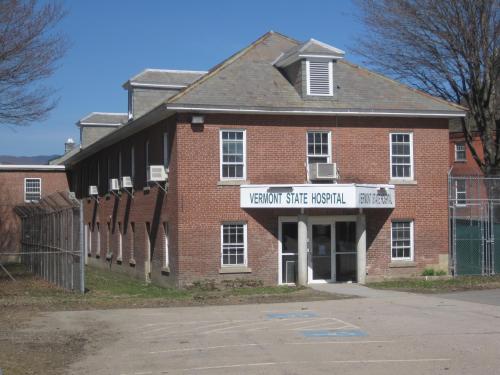 After the flood, the state hospital was closed at the Waterbury State Office complex and subsequently relocated. Vermont Business Magazine photo. Top photo courtesy State of Vermont of the construction nearing completion in August 2015.
Stevens gave Gov. Peter Shumlin’s administration and members of the news media a tour of the construction site on Thursday. Beth Pearce, the state treasurer, Jeb Spaulding, the chancellor of the Vermont State Colleges, and members of the Agency of Administration also attended.
Stevens said the construction process is 89 percent complete. Shumlin said state employees will begin occupying the facility on Dec. 19.
The project cost is in the $130 million range. The state is responsible for two-thirds of the cost, and Pearce said her office secured a low-rate bond for the project. The Federal Emergency Management Agency will pay about $36 million, and the state’s insurance company will pay about $15 million.
“The productivity of an employee is often reflected by the space they work in,” Shumlin said. The new building would make state employees “productive, safe, and able to focus,” he said.
Shumlin said the old building had single-pane windows that rattled, with warm hallways and freezing offices. “This is gonna be the nicest state office building of any state in the nation when we’re done with it,” he said.
In the new building, there will be a secure public entrance, a 100-person conference room and two 40-person conference rooms. There are skylights in some of the office spaces, and an artist is completing a mural in the foyer.
The historical buildings are being brightened up, including in the old stairwells, which have an eerie quality during construction. Modernized windows have replaced single-pane windows that didn’t hold heat, and there will be air conditioning.
The buildings are built with a blue, envelope-like wrap for weatherization. A central plant to the west of the main building complex will control heating and cooling, and a driveway surrounds the main campus. The complex will use 40 percent of the energy the building used back in 2011, according to Stevens.
The former Vermont State Hospital was taken down over a year ago in favor of a decentralized mental health system. A new hospital, the Vermont Psychiatric Care Center, is up and running in Berlin, and each county has a designated agency for community mental health care.
The Waterbury campus’ crematorium in the back, marked with the letters VSH, will stay, and state employees will be able to see it from floor-to-ceiling windows in all of the three conference rooms. Stevens said the community gathered enough support to stop the crematorium’s destruction.
Rep. Tom Stevens, D-Waterbury, said he’s “very impressed by the progress of the project.” He was one of the more than one dozen people who attended Thursday’s media tour.
“This whole space has been re-designed,” Rep. Stevens said. “Before, we made do with just a lot of existing space. People worked in hallways. People worked in closets. They had offices in bedrooms.”
Rep. Stevens said completing the project would end the need for the state to pour money into maintaining old buildings and “bring stability to our village for another several generations.”