

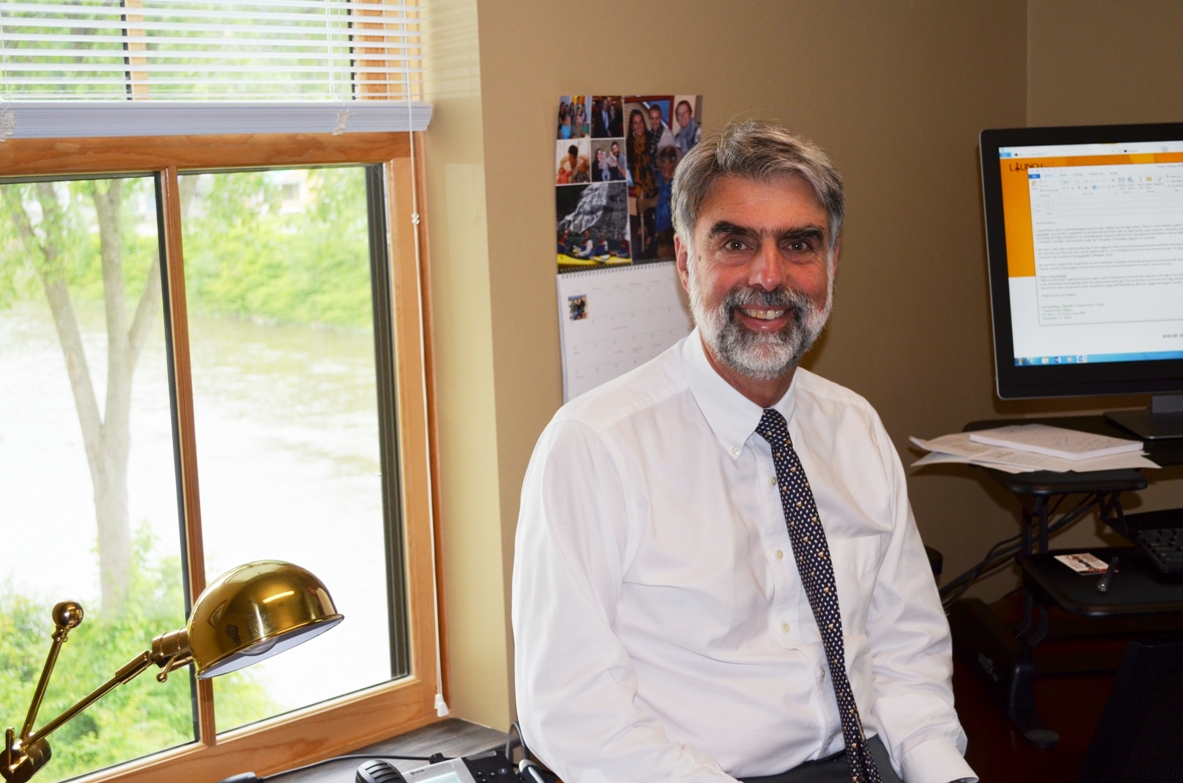
by Timothy McQuiston Vermont Business Magazine The Vermont State Colleges Board of Trustees approved at its meeting in July its support for a focused and ongoing effort that will allow the Vermont State Colleges to become a more “comprehensive, cohesive, and interconnected” system, with multiple distinct institutions within it. The goal is to provide students access not only to the resources of their particular college or university, but to the resources of the system as a whole, and enabling the most cost effective operation of the individual institutions and system.
The Board also approved the name change of Castleton State College to Castleton University.
In an interview just prior to that vote, VSC Chancellor Jeb Spaulding spoke about these changes and what the state college system might look like going forward. The name of the new system has not been decided on yet, but it likely will not be “Vermont State University at Lyndon,” say. The new name will be decided in the fall and will reflect the more comprehensive system and the vital re-branding that goes with it.
VSC will start by having a more unified Website for its five institutions (Castleton, CCV, Johnson, Lyndon, and Vermont Tech). Eighty percent of VSC students are Vermonters; 50 percent of VSC students are first in their family to go to college.
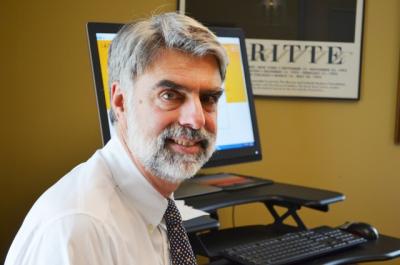
George B “Jeb” Spaulding is 62 and most recently was Governor Shumlin’s Administration Secretary. He’s also been State Treasurer and was one of the founders of WNCS radio, now known as The Point. Spaulding has also had experience in academia as an administrator and adjunct professor. He lives in Montpelier with his wife.
Spaulding, who took over in January, has hit the ground running fast and has had to. Not only has he undertaken the major re-branding noted above, he’s had to deal with a shrinking demographic of high school students, while trying to help the cash-strapped colleges balance their books.
Spaulding was interviewed in late June by VBM Publisher John Boutin and Editor Timothy McQuiston, shortly after announcing a new program that would allow veterans to pay in-state tuition at any of the VSC college regardless of where they live.
Spaulding: This allows veterans (and current military) even if they’re not residents, to qualify for in-state tuition. And it’s the right thing to do.
Another thing we’re trying to get the word out about was an initiative that all the political leaders signed off on in 2010, everyone from Jim Douglas, the governor at the time; Peter Shumlin, Senate President; Shap Smith (House Speaker), your top level people. They made a commitment that we were going to take action steps to increase the number of Vermonters with a post-secondary credential. There have been shown, you know, that many of the jobs are going to require some level of post-secondary education. So, by 2020 that’s going to be 60 percent of the jobs. I use “post-secondary” purposely because it doesn’t mean they all need a bachelor’s degree. Some level of post-secondary education. We’re doing everything we can to achieve that, including helping veterans.
VBM: How do your in-state rates compare to other states?
Spaulding: High. Definitely. No question about it. I can’t tell you right now if they’re the highest. But I can tell you they’re definitely high. It’s a pretty simple equation here. Funding has to come from basically two sources. Traditionally, public higher education was supported significantly by state appropriations. So, we were never high, but back in the mid-80s, roughly half the revenues for the university and state colleges came from the state appropriation. Now we’re down to, like, 17 percent overall for the state colleges. And the way the appropriation works, it’s split five ways. So for the larger colleges, like a Castleton or CCV, they’re down to 8 or 9 percent coming from state appropriations. UVM’s down in that area too.
So that’s one source of revenues that doesn’t exist. The only other one of significance is the tuition paid by students. If you’re not getting money from the state, you’re relying heavily on students. Basically we’re 85 percent-plus reliant on tuition for the revenues to run higher education in this state. Similar to New Hampshire.
Meanwhile, the same demographic trends that are affecting K-12 as a whole mean that the number of students graduating from high school in the Northeast is getting smaller.
So there’s the problem. The state appropriation is stagnant, same in 2016 as it was in 2008. We’re already pretty high in tuition. And the natural pool is getting smaller. So that’s our challenge. New Hampshire and Vermont are the two lowest states for higher education appropriation.
I would say New Hampshire puts a little higher emphasis on two-year colleges. We get almost half as much state support for community college and technical college as they do. (CCV only has associate’s degrees and Vermont Tech is about 75 percent associate’s degrees, while the other state schools are mostly bachelor’s or master’s degrees).
One way to look at this is that it’s depressing. The number of high school students is getting smaller. The state doesn’t have any money, and we’re probably no different than any other state that I can tell. And what’re we going to do?
Well, there are a number of things we can do. I think we have a very bright future for the state college system if we play our cards right.
The first thing I’d like to say is that we’re lucky in Vermont to have more post-secondary institutions per capita than any other state in the country. I’m counting every college in Vermont.
The Vermont State College system, the five state colleges, enroll more Vermonters than all those other colleges and universities put together. When you count associates degrees through PhDs, even MDs, the state colleges confer almost twice as many degrees on an annual basis as any other institution in the state to Vermonters.
So when it comes to our future workers and our future entrepreneurs? We’re it. That’s the message.
Let me pick on a really great school, Champlain College, wonderful. Seventy-five or 80 percent of their students are from out-of-state. Seventy-five to 80 percent of ours are in-state.
Most of ours are staying. In the other colleges, some of their out-of-staters are staying, and we want them to stay. As an economic development strategy we ought to be working to make sure that we keep as many as we have. We want as many Rich Tarrants (originally from New Jersey) as we can get, coming to St Michael's and doing good things here.
But in raw numbers the state colleges are what provide our future startups and the employees of those startups. So we're an important piece.
As a state we're very lucky to have one of the highest graduation rates from high school in the country, but our continuation rate from high school into post-secondary education is run-of-the-mill. Mediocre.
There are thousands, thousands of graduates from Vermont high schools this year that will not be going into post-secondary education this fall.
One of the efforts we're providing leadership on is to convince more Vermonters that they can succeed, that they can afford it, and that they are actually much better off in their life if they pursue post-secondary education (credential, two-year degree, four-year degree, graduate studies).
So, even though the total number of high school graduates is getting smaller, if we can convert more of the high school graduates to continue on to post-secondary education, then most of those students are probably going to go onto one of the state colleges.
That's one thing we can do.
Another thing we can do is help them complete. A lot of kids who come to the door in August – we used to think of it as September, now it starts in August – don't make it over the finish line.
Our colleges are working very hard on this. We're very proud of the fact that our colleges are an access point for Vermonters who might not otherwise go on to college. That doesn't mean we don't have a high quality educational experience for all Vermonters, but we all know kids who didn't get into the University of Vermont. We're proud of taking all Vermonters. Half on opening day aren't going to make it to the end. So if we keep moving the needle, that's going to make a difference.
What we also want Vermonters to know is that we can compete. We're not Harvard. We're not Yale. But most people who are going out-of-state are going to places that aren't Harvard and Yale. And I think, if they saw what we have to offer, they might decide to stay here.
I know these are factoids here, but we have the highest percentage of high school graduates who are going on to college who are going to college out of state.
Know you can say, 'We're a small, rural state, you want to go somewhere.' And a lot of them do. But, hey, New Hampshire and Maine, they're not exactly New York City either.
We're trying to let people know that we're allowing four and a half million dollars in student grants to go anywhere in the country. New Hampshire doesn't do it for students there. New York doesn't do it for students there. But I don't really want to get into that one now.
But if we can convert a few more percentage points of students that are going out of state to say, ‘I think we should look at one of the state colleges first’ then we can increase our numbers here.
So those are the three big points (One, get a higher percentage of high school graduates to go to college; two, get more to complete their education, and three, get more to go to college in Vermont).
How are we going to do it?
 Our Board, we have a great Board (there is only one board that governs all the colleges), Martha O'Connor is the chair of our Board. She's chaired a lot of boards over time, and we've got a number of really great people on it.
They're committed to moving forward from one system with five strong colleges in it, to one comprehensive, interconnected and cohesive system of education with multiple distinct institutions that provide the resources of all five colleges to any student anywhere. If you go to any one of our colleges, you can take courses and gain experiential opportunities from any of the other colleges for no extra money. (Spaulding noted that one Johnson State College student is in Russia getting six credits through a Lyndon State course.)
So we're going to be pushing that concept. Now how you do that is often through online courses. CCV has hundreds of them. If you're at Castleton and you can't fit in your statistics course because you're on the football team, or whatever, then you can take it online from CCV for no extra money. Our credits are totally transferrable within the system.
So what if a student at Johnson State College wants to spend a semester or even a whole year at one of the other colleges? We'd like to let them do that.
So we're really looking for ways to expand student opportunities, so that they're not going to just one strong college, they're going to a strong system that has opportunities throughout that are much greater than the sum of the individual parts.
And we're working through this. We have unanimity in knowing we have to become this more cohesive, comprehensive system. The question is, how do you do that?
And one way you do that is, simplified, is sort of a Penn State model. There's not five different accredited colleges, there's one college or one university with several campuses. That's one.
Another would be like U Maine, where they're independently accredited colleges. Or what you do, which is closer to expanding what we already are, which is uniquely, individually branded colleges (with Castleton University) that are part of the system. And that would be more like SUNY, to tell you the truth.
If you look at the SUNY system now, they're individually accredited, they've got their own brands within a single system. It seems like our long-range planning committee has come to the conclusion that that's the direction we're going.
Whatever we evolve into, one of the first things we've got to do is re-do our Website. Each one of our colleges has a program, say, to support veterans. So if you're a veteran, why should you have go to five Websites to find out what they have to offer for veterans, instead of going to the Vermont State Colleges Website, or whatever the successor name is?
VBM: So what might the name be, State University of Vermont?
Spaulding: UVM is an ally of ours, but they're not part of the Vermont State College system. But in a state of 620,000, do you need two universities? And that was one thing we had to work through. One or two of our board members felt strongly that other states did this. You have, say, The University of Florida and Florida State University. University of North Carolina. North Carolina State University. Why not here?
And I think the answer is two-fold.
One, Community College of Vermont, Lyndon, Castleton, they've spend decades building their own brand and they don't want to lose it and they'd be fighting hard. Believe me, the alumni would be fighting hard. And I think it would be a mistake in such a small state to have two “universities.”
I think we'll find a name that we're trying to evolve into, which is this comprehensive, cohesive, interconnected system. I think a small public university is perfect. We haven't crossed that bridge yet on a name.
We want to create a Website that makes it easy for our customers and increases what we offer to our customers, who are our students.
And we've already started to decrease our operational costs, like group purchasing. Stuff like that. We have a common IT system for all. We want to meet some of the headwinds we have financially.
I'm optimistic, because, the one thing we know, and you know, is that the biggest thing we have to fear is our inability to make changes. The status quo is our enemy.
We have 25 graduates of Lyndon working at ESPN right now. When I was up there at graduation there was one whole page of students getting degrees in outdoor recreation management and every last one of them was from out-of-state. And they're basically paying out-of-state tuition to come there for the quality of those professional programs. So we've got that too.
Castleton is the only public college in the state that has a football team. They’ve football, they’ve got baseball, they’ve got skiing, they’ve got hockey, they've got everything. They have international film festivals. They have the polling institute. They've got the downtown center.
So to me, Castleton is still going to be part of the Vermont State Colleges, so they're not going anywhere. So that's what we want to be known as, a place that's comprehensive. (While they offer an education PhD, they don't aspire to competing with UVM in doctoral programs).
VBM: How much of this is going to be online education?
Spaulding: Where are bricks and mortar colleges are going to be in 20 years, who knows? A lot of people say, and I think they're right, that there is value to a place where people come and they learn to work with people that are different than they are and they experience failure and have people to support them. They get an array of extracurricular experiences that they otherwise would not get with an online course in an apartment somewhere.
There are people that make a pretty strong argument that there will be a place for residential colleges. But I think we're probably going to see an effort to reduce the cost of education. That's going to continue to be a pressure point for us and a challenge. Distance learning will probably be more and more intertwined with our residential colleges.
We think they're all going to have their own individual brands, probably critical to the survivability of any college or university. If people don't know what you offer, if it's generic, you're going to have a hard time.
Lyndon is a small professional college. It has been developing its brand. It has the highest percentage of out-of-state students of any of our colleges.
CCV and Vermont Tech have their niches. I think we're lucky to have the energy of Dan Smith at Vermont Tech to help us recover from some of the loss of brand identity at VTC in the last number of years. And I think we've made a lot of progress there.
In all cases, it will continue to be important to provide access to college in any part of the state. Some students need to live and work at home and go to college at the same time. The colleges will have their own niche, but it's important they provide access to Vermonters in an affordable way.
VBM: How are they doing financially?
Spaulding: They're all struggling with the same 30,000-foot problem of competition. Whether it’s Massachusetts or New Hampshire. They're trying to get our students and we're trying to get their students.
I wouldn't say any of them are not struggling or not working hard. They all have a different plan.Castleton and Lyndon both have had operational cuts in the past year, not just VTC.
VBM: Many colleges and universities have a separate board responsible for just fundraising. Do you have such a board?
Spaulding: No.
VBM: Why not?
Spaulding: We should. And the Board is going to get more involved. I've been here like six months and that's the direction we're going. But traditionally, public higher educational institutions have been significantly supported by state appropriations. So they just haven't done as much fundraising.
What people will argue, as opposed to the University of Vermont, is that our alumni base is very different than there’s. If 50 percent of our people coming in as a first-in-their-family going to college, it's probably a good bet that they're also of modest means.
However, with the financial reality facing us – and we're continuing to advocate for the state to support us at a more appropriate fashion from our perspective – the reality is we're not going to see huge new investments. They do fundraise at the individual college level. But the Board has not been that involved.
Also, the college presidents, they've scraped and clawed and they've gotten everything they've got by their own hard work and cunning and they're nervous that the Board or the chancellor might come in and go to the large benefactors in Vermont, and there aren't that many, and we're going to come in and steal them.
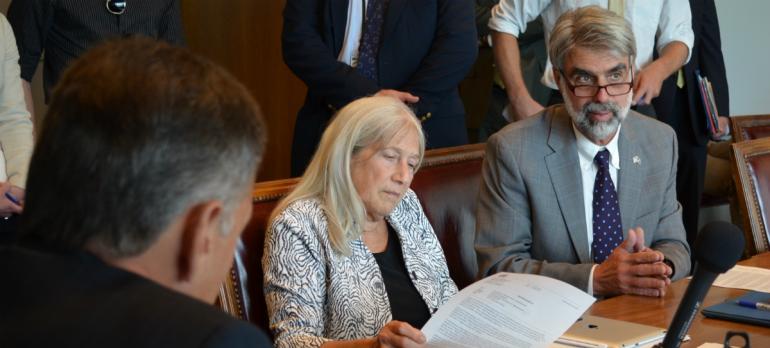
Jeb Spaulding as Administration Secretary in 2014. Vermont Business Magazine photos