

Contrary to popular perception, traditional home ownership truly is a goal of young professionals in the Burlington area, but not surprisingly, rent consumes a large percentage of their income,according to the results of a recent survey.During 2014, the Lake Champlain Regional Chamber of Commerce (LCRCC), through its Burlington Young Professionals (BYP) group, created the Young Professionals Advocacy Task Force with a specific focus on housing issues in and around Burlington. As one of its first steps, the Task Force compiled a survey to better understand the needs and concerns of Vermont’s young workforce.
“Understanding what young professionals need and want for housing will help us better advocate on their behalf” said Emily Piper, Executive Director of the LCRCC’s Burlington Young Professionals group. “It’s really important to the growth of our economy that employers have access to talent, and housing can be a barrier to a young professional remaining in Vermont,” she continued.
The Task Force disseminated the survey through multiple channels to reach a wide and diverse group and received more than 400 responses from residents who most often were between the ages of 26 and 35. “While many national articles share stories of a young workforce that wants only flexibility and high-rise living, our survey paints a different picture,” says Tom Torti, President of the Chamber. “Young professionals in the Burlington area do want accessibility to services, recreation, and work, but they also want the traditional American Dream,” Torti added.
RESULTS
 400 individuals responded to the survey, with the majority of those (approximately 64%) between the ages of 26 and 35. Age options included 20-25, 25-30, 30-35, and 35-40. While a sizeable portion of those responding own their homes, the majority (63%) are renters. Almost all of those individuals between 20 and 25 rent their residence with, homeownership increasing as the respondents age, and substantially so in the 30-35 age bracket. Even so, a good portion of those in the 30-40 age range continue to rent. Not surprisingly, in the span between ages 20 and 40, responses indicate that the young workforce will not all be looking for the same thing in a home. Many of the younger respondents appreciate the flexibility of a rental unit, while those who are older appear more interested in purchasing a home if they have not already done so. Of those in the 36-40 age range who rent their current residence and are dissatisfied with that living situation (68%), 93% indicated that they want to purchase a home but cannot afford it.
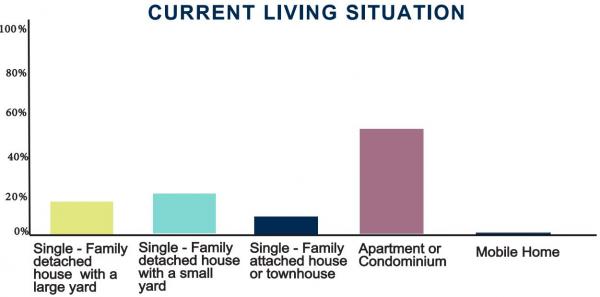
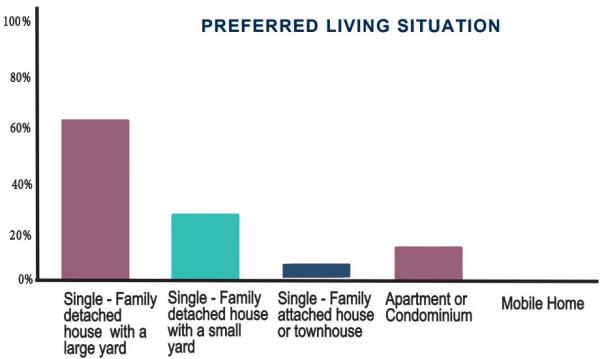
The majority (53%) of those responding to the survey currently live in an apartment or condominium, with the next largest group living in a single-family detached house with a small yard. The likely living situation is largely correlated with age, with those in the 36-40 range being much less likely to live in an apartment or condominium (34%) and those 20-25 almost always in a multi-unit building (74%). Absent an age breakdown, the majority of those responding to the survey currently live in an apartment or condominium (53%). However, when asked what type of residence in which they would most like to live right now, a strong majority (58%) chose “single-family detached house with a large yard.” Another 24% chose “single-family detached house with a small yard,” and only 12% chose an apartment or condominium. Those in the 20-25 age range were the most likely to want to live in an apartment or condominium, with 22% choosing that option.
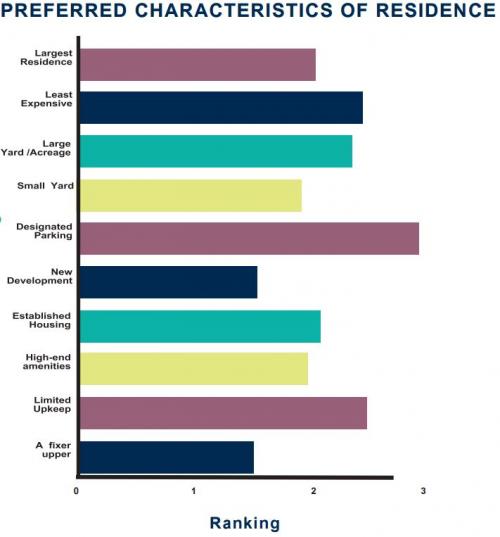
When asked to rank residence characteristics based on their importance, the top three most important characteristics were designated parking, limited up-keep, and the least expensive residence that the respondent could afford. The least important characteristic was a “fixer-upper.” The rankings were fairly consistent across the age ranges, but there was a discrepancy in the 31-35 age range, with that group ranking a large yard/acreage as more important than finding the least expensive residence they could afford.
Respondents came from a variety of current living circumstances. The majority (about 52%) live in a large town, but there was representation in suburban neighborhoods, small towns, and rural areas. When asked in what type of community they would most like to live, each type of neighborhood received some positive responses. The two types with the most positive responses were “large town – near a mix of apartments, offices, and shops” and “suburban neighborhood with a mix of houses, shops, and businesses,” the apparent connecting thread between those two being a neighborhood that has a mix of uses and, presumably, some accessibility to places other than residences, such as shopping, recreation, and work. Based on their responses, a suburban area with mixed uses is preferable even to an urban area such as a large town if the area within the large town is primarily residential and does not have a mix of uses.
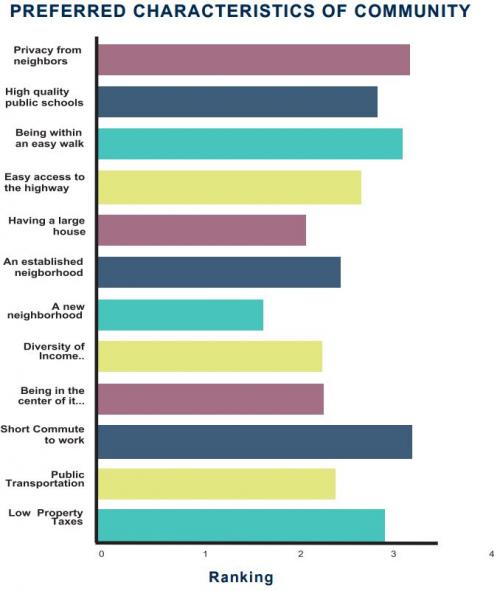
When asked to rank community characteristics based on their importance, those that emerged as the most important were privacy from neighbors, being within an easy walk of other things/places in the community, and a short commute to work. Coming in fourth and fifth were low property taxes and high quality public schools, respectively. The least important characteristic was a new neighborhood with recently built homes. It should be noted that many who responded wrote in comments about wanting to live alone or without multiple roommates in cramped quarters, so their desire for privacy from neighbors may be indicative of a desire to move out of shared housing rather than, or as well as, a concern about the geographic distance between dwelling units. The rankings remained fairly consistent across age ranges except for one discrepancy in the 31-35 age group, where high quality public schools beat out being within an easy walk of other things/places in the community for the top three desired characteristics.
Based on our survey results, a little more than half of those young professionals who responded (52%) are satisfied with their current living situation. Parsing out the numbers by age reveals an interesting discrepancy – satisfaction rates are higher than average for all age ranges except 26-30, where the responses were 56% not satisfied and 44% satisfied. The vast majority of those 26-30 who responded that they are not satisfied with their living arrangement are renters, and their most common reason for the dissatisfaction is that they want to purchase a home but cannot afford it, followed closely by the need for more space. In comments, they spoke often of student loan debt, of the cost of housing, and of the lack of a yard or sufficient space. Their responses match anecdotal information BYP & LCRCC recieved that the years from 26-30 are a transitional time where the young workforce is looking to purchase a home and settle down but may not yet have an income that meets their needs or desires, particularly in the Chittenden County area. The rise in satisfaction in the 31-35 range (up to 57%) may be because these older professionals have been better able to afford a different living situation, but it may also be that some of those who are dissatisfied have left the state.
Across age ranges, for those not satisfied with their living situation, the primary reasons for their dissatisfaction were the need for more space (58%), the desire to own but inability to afford it (56%), and the desire for a bigger yard (53%). More space is a priority for those in the 20-25 range; home ownership becomes top priority for those in the 26-30 range, drops a bit for those in the 31-35 range, and picks up again for those in the 36-40 range.
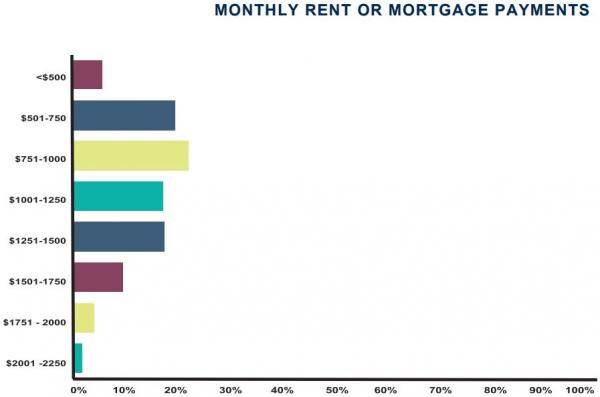
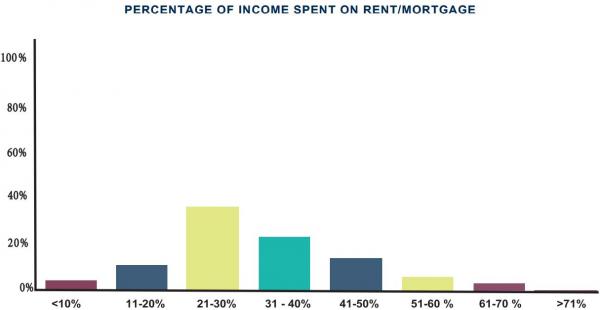
Sixty-three percent of those responding rent rather than own. The largest chunk of respondents pays between $500 and $1500 per month in rent or mortgage, with the most common rent/mortgage range being $750- 1000. A little less than half pay more than 30% of their take home income in rental or mortgage payments, and thirty-five percent pay between 21% and 30%. Homeowners are significantly less likely to pay more than 30% of their take-home pay on their mortgage than renters. Fifty-seven percent of renters pay more than 30% of their take-home pay on their rent, as compared with only 35% of homeowners. None of these percentages include utilites.
Of those who own, a small majority (52%) find their property taxes to be affordable, with the other 48% finding them unaffordable. Many who indicated that their property taxes are affordable left comments, such as “barely affordable,” “affordable, but challenging,” “increasing too quickly,” or “affordable but still significantly high.”
CONCLUSION
Though a small majority of young professionals are satisfied with their current living situations, a large minority are not. The desire to own a home is at the top of the list for many of those who are dissatisfied. While many national articles share stories of a young workforce that wants only flexibility and high-rise living, our survey paints a different picture. Young professionals in the Burlington area do want accessibility to services, recreation, and work, but they also want the traditional American Dream. Flexibility may be important right out of college as they begin to build a career, but once they reach their mid to late twenties, young professionals want a single family home with a yard.
Unfortunately, the survey also indicates that those individuals are currently paying a significantly high portion of their incomes in rent and are unable to afford purchasing a home. Comments indicate that the ability to save for a down payment is a major impediment.
Addressing these concerns is not an easy fix, but there are some policies that support homeownership and increase the availability of well-maintained workforce housing in areas that appeal to young professionals: down payment assistance programs, incentives for developing housing in downtowns and village centers, and streamlined permitting that reduces the cost of development. Young professionals are a vital resource to our community, and we cannot afford to ignore their concerns. If we assume that the beauty of Lake Champlain, the Vermont brand, or the quality of life will continue to attract the talented young workforce that we need, we will find ourselves in a more dire position than we are now.
Young professionals may appreciate all those assets, but they will not choose to come here or stay here if they believe they will not be able to build the life they want here. We owe it to our community to show them that they can.
To view a report on the housing survey results, visitwww.vermont.org/byphome page. A link to the survey is found at the midway point of the site on the left.
Source: LCRCC. 4.8.2015. The Lake Champlain Regional Chamber of Commerce is the largest business organization in the state. Its mission is to drive commerce and economic growth guided by the principles of community engagement, environmental responsibility, and issue-centric advocacy.