

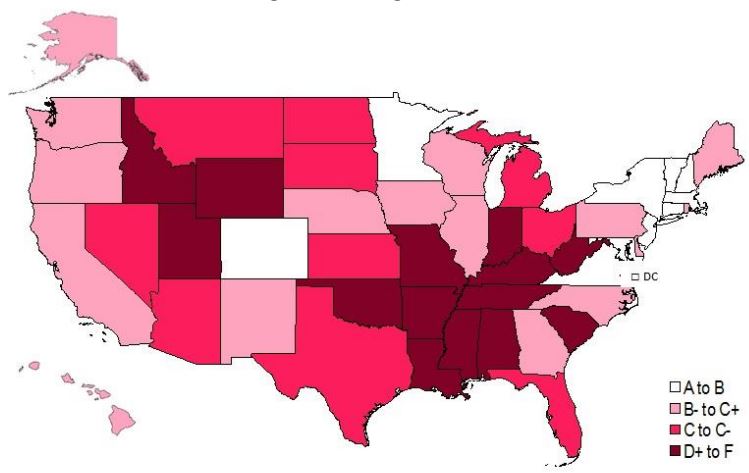
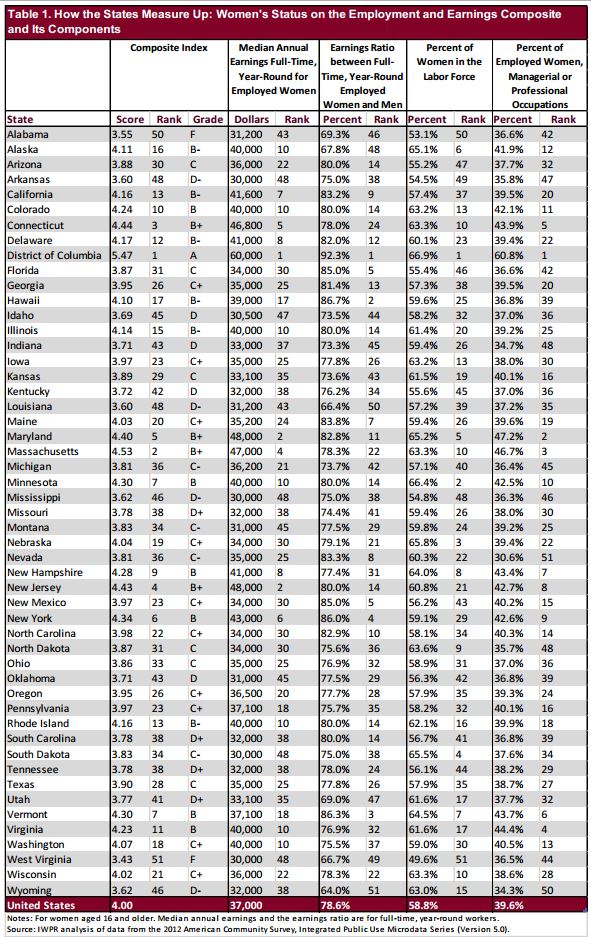
According to anew analysisby theInstitute for Women's Policy Research(IWPR), states across the nation vary widely in their progress towards achieving equality for women in the workplace, with Vermont 7th overall and New Hampshire 9th. TheDistrict of Columbiaranked highest in the nation for women's employment and earnings, whileWest Virginiaranked the lowest. The analysis includes state-by-state rankings and letter grades based on a composite score of economic indicators, including women's labor force participation, median annual earnings for women, the gender earnings ratio between women and men employed full-time and year-round, and the percentage of employed women in managerial or professional occupations. IWPR has been calculating and tracking state rankings in this area since 1996.
Since the composite was last calculated in 2006,AlaskaandCaliforniahave dropped out of the top eleven.New Mexicohas seen the greatest improvement in its ranking, moving up 21 places from 44thto 23rd, whileMissouri has seen the greatest decline, moving from 19thin 2006 to 38th.
RELATED STORY:
Roundtable launches inaugural executive leadership series with ‘What’s Holding Women Back in the Workplace?’
"Washington, DC, stands out as the best place for women in terms of employment and earnings potential and is, in fact, the only jurisdiction to receive a grade of A," said IWPR PresidentHeidi Hartmann. "The top states are characterized by modern, white collar economies that provide strong opportunities to women, andWashington, D.C., is even further buoyed by the presence of government jobs."
SEE TABLE BELOW
In addition toWashington, DC, thetop states for womenin employment and earnings are:Massachusetts, Connecticut,New Jersey,Maryland,New York,Minnesota,Vermont,New Hampshire,Colorado, andVirginia. Eight of these top eleven states that received a grade of B or higher are in the Northeast. In addition toWest Virginia, seven of the 14 lowest ranked states, which received a grade of D+ or lower, are located in the South:Alabama,Louisiana,Arkansas,Mississippi,Kentucky,Tennessee, andSouth Carolina.Wyoming,Idaho,Oklahoma,Indiana,Utah, andMissouriround out the bottom group.
"Top ranked states are doing a better job of making use of women's economic contributions—ensuring women have access to training and education, working to place women in top jobs," says Dr. Hartmann. "While these factors impact women individually, they also contribute to overall economic growth and strong economies in these states. Public policies also make a difference and voters and candidates should pay attention to these results."
This analysis is part of a larger body of IWPR's work onThe Status of Women in the States, which benchmarks the status of women on over 100 indicators in several topic areas, including employment and earnings, violence and safety, work and family, economic autonomy and poverty, reproductive rights, and health. Since 1996, IWPR has released reports oneach U.S. stateand theDistrict of Columbia, in addition toseveral city and area reports. IWPR will release anew comprehensive reportonThe Status of Women in the Statesin 2015.
The Institute for Women's Policy Research (IWPR)is a 501(c)(3) tax-exempt organization that conducts rigorous research and disseminates its findings to address the needs of women and their families, promote public dialogue, and strengthen communities and societies. Institute for Women's Policy Research
SOURCE WASHINGTON,Sept. 2, 2014/PRNewswire-USNewswire/ --Institute for Women's Policy Research