

Vermont Business Magazine The US is still slowly recovering from the staggering loss of jobs during the Great Recession, but some cities and states are rebounding faster than others. Vermont is once again in the bottom 10 for 2014 as it was in 2013. Vermont did not suffer as much during the recession as several other states, and therefore has less to rebound from, but the state is also showing stagnant results in labor force and total employment. Research Professor Lee McPheters of the WP Carey School of Business at Arizona State University provides rankings and analysis of the winners and losers for states and metro areas across the country, based on the latest figures from the US Bureau of Labor Statistics through the the third quarter of 2014.
Top 10 cities and surrounding metro areas (1 million or more workers), for non-agricultural job growth -- comparing January through September of this year to the same nine months last year:
- Orlando, Fla. – up 3.7 percent
- Houston – up 3.5 percent
- Dallas – up 3.4 percent
- Miami – up 3 percent
- Portland, Ore. – up 2.9 percent
- Riverside, Calif. – up 2.8 percent (tie)
Denver – up 2.8 percent
- San Francisco – up 2.6 percent (tie)
Seattle – up 2.6 percent
10. San Diego – up 2.4 percent
Top 10 states for non-agricultural job growth – comparing January through September of this year to the same nine months last year:
- North Dakota – up 4.6 percent
- Nevada – up 3.6 percent
- Texas – up 3.3 percent
- Utah – up 3.1 percent
- Florida – up 2.9 percent
- Oregon – up 2.8 percent
- Colorado – up 2.7 percent
- Delaware – up 2.5 percent
- California – up 2.2 percent (tie)
Washington – up 2.2 percent
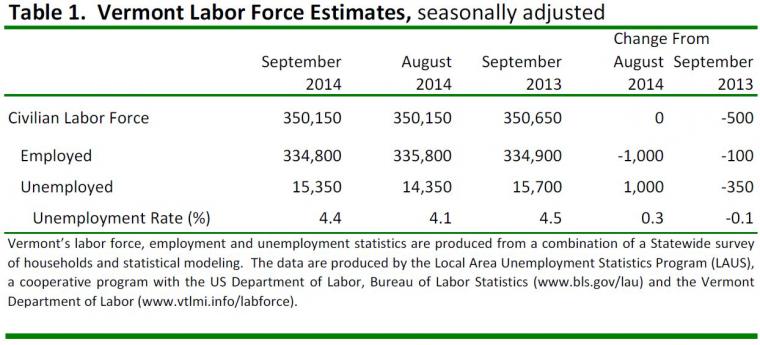
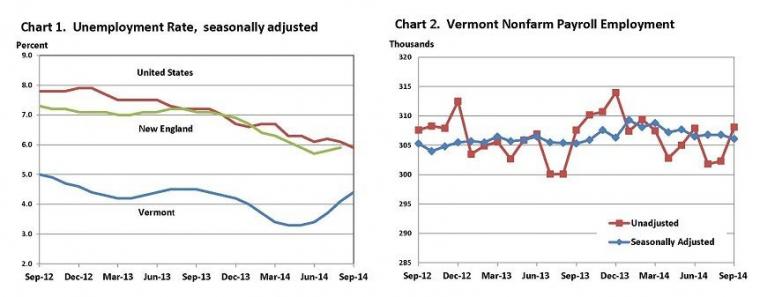 RELATED: Vermont unemployment rate up again, rises three-tenths to 4.4 percent
Analysis:
The United States has added about 2.4 million jobs so far this year. The monthly average from January through September was 1.8-percent job growth nationwide. That pace is only slightly better than last year’s, when we saw an overall annual increase of 1.7 percent, so the recovery remains relatively slow.
On the state list, North Dakota has held the No. 1 spot every year since 2009, largely thanks to its oil and gas production. Nevada, Texas and Utah also topped 3-percent job growth this time, with Nevada’s economy receiving a big boost from building activity and impressive construction gains of more than 10 percent.
“Seven of the top 10 job-growth states so far this year are in the West,” says McPheters, director of the JPMorgan Chase Economic Outlook Center at the W. P. Carey School of Business. “Oregon and Delaware are new on the list this time, replacing Idaho and Arizona.”
Arizona actually fell out of the top 10 for the first time in two years. Even though it ranked No. 3 in health-care job growth and No. 5 in financial-activities job growth, the state has now dropped to No. 14 overall. Manufacturing, government and construction contributed to the decline.
The bottom 10 states so far this year are Michigan, Pennsylvania, Connecticut, Maryland, Illinois, Vermont, Virginia, New Jersey, New Mexico and last-place Alaska. Five of these states were also on the bottom in 2013: Pennsylvania, Vermont, Virginia, New Mexico and Alaska.
McPheters notes very high interest in state economic performance right now because 30 governors are up for reelection, including those in top-10 states Nevada, Florida, Oregon, Colorado and California, as well as bottom-10 states Michigan, Pennsylvania, Connecticut, Illinois, Vermont, New Mexico and Alaska.
On the top 10 cities list, Orlando holds the No. 1 position with 3.7-percent job growth, double the national pace.
“Eight of the top large cities for job creation are in the West,” explains McPheters, “However, Florida also did well, with two cities on the list.”
Seven of the top 10 cities are clustered in Florida, Texas and California. They include Orlando, Miami, Houston, Dallas, San Francisco, San Diego and Riverside, Calif.
The greater Phoenix labor market dropped out of the top 10, as its rate of job growth slipped from 2.7 percent in 2013 to a more modest 2.2 percent during the first three quarters of this year. Phoenix is currently No. 12 among labor markets with 1 million or more workers.
Still, seven large labor markets have job creation below 1 percent: Chicago, Cleveland, Philadelphia, Kansas City, Pittsburgh, northern Virginia and lastly, Detroit.
The full rankings and other job-growth data from McPheters can be found at the W. P. Carey School of Business “Job Growth USA” website:
www.wpcarey.asu.edu/jobgrowth. Use the “year to date” function for the current 2014 numbers.
Sources: Vermont DOL. ASU, TEMPE, Ariz. (Oct. 28, 2014) — W. P. CAREY SCHOOL OF BUSINESS. The WP Carey School of Business at Arizona State University is one of the top-ranked and largest business schools in the United States. The school is internationally regarded for its research productivity and its distinguished faculty members, including a Nobel Prize winner. Students come from about 100 countries and include about 50 National Merit Scholars. For more information, please visit wpcarey.asu.edu and http://research.wpcarey.asu.edu.