

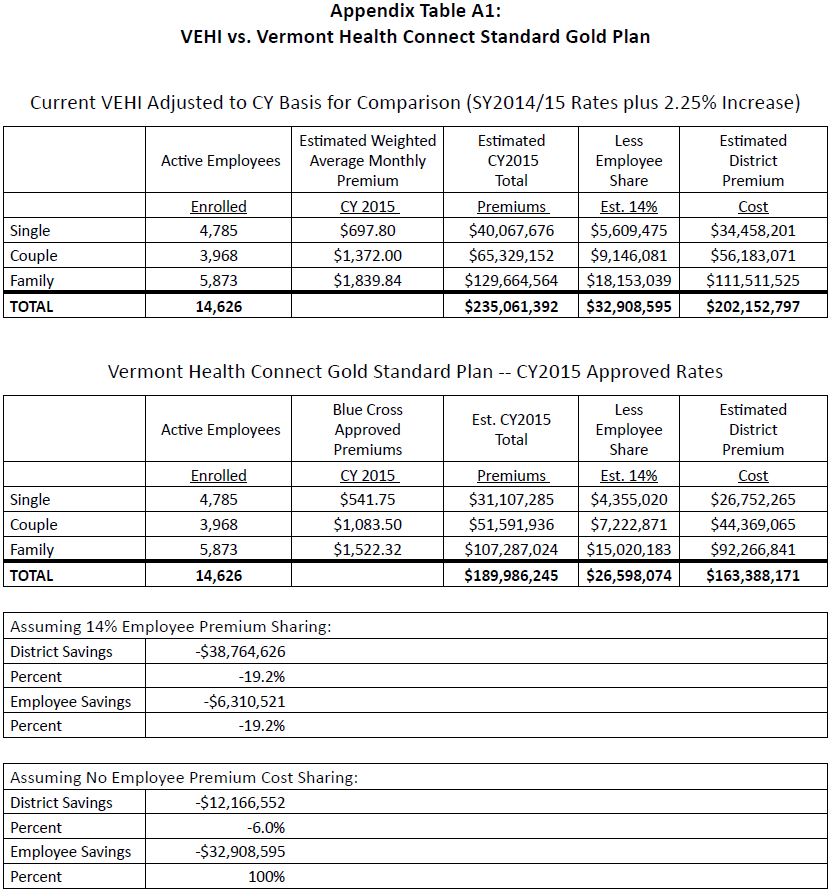
Because Vermont school districts on average provide health insurance at what would be considered a "Platinum Plus" plan now, if they transitioned to a Vermont Health Connect "Gold" level plan, it would result inpremium savings for school districts of almost $39 million if the current 14 percent employee premium contribution were continued.The Vermont School Boards Associationhas just releaseda reportdetailing the financial impact of health care reform on Vermont’s school districts. This issue is the perfect nexus between two of our state’s most pressing policy issues—the implementation of health care reform and rising property tax rates.
The VSBA commissioned the study in order to provide its members with the most accurate information about the current cost of health care and the potential savings that could be achieved if school district employees’ health care benefits were more closely aligned with the benefits available to all other Vermonters.
The report was authored by Scott Mackey. Mackey is an economist and the Managing Partner at KSE Partners LLP in Montpelier. Prior to joining KSE Partners, he was the Chief Economist at the National Conference of State Legislatures in Denver.
Summary of Key Findings:
Financial Impact of Health Care Reform on Vermont School Districts
Cost of Current School District Health Insurance Benefits
• School districts will spend an estimated $202 million in health insurance premiums for their
employees in calendar year 2015, about 86% of the total premiums paid. Total salaries are
expected to be about $920 million, meaning that health insurance costs will be 22% of payroll in
Vermont school districts.
• School district employees will pay the remaining 14% of health insurance premiums, or about
$33 million in calendar year 2015.
Comparison to Vermont Health Connect “Gold” Plan
• The current health insurance plans offered to school district employees through VEHI are more
generous than any that can be found on Vermont Health Connect – the equivalent of “Platinum
Plus.”
• Eighty-six percent of all Vermonters with coverage provided by the Vermont Health Connect
exchange are enrolled in Catastrophic, Bronze, Silver, or Gold plans. If school district employees
were transitioned to the Gold plan, they would have coverage equal to or better than 86% of all
Vermonters who receive coverage through the exchange.
• Transitioning school district employees would generate premium savings for school districts of
almost $39 million if the current 14% employee premium contribution were continued.
Comparison to Single, Publicly Funded Health Insurance Program Under 3 Scenarios
• Three scenarios were modeled to determine school district savings under a single, publicly funded
health insurance system: 1) 9% employer / 4% employee payroll tax; 2) 13% employer payroll
tax with no employee payroll tax; and 3) 9% employer payroll tax with balance raised through
general fund taxes.
• Under Scenarios 1 and 3, with a 9% employer payroll tax, school districts would save an
estimated $119 million in premiums. If this savings were returned to taxpayers, the statewide
property tax could be reduced by almost 12 cents.
• Under Scenario 2, with a higher 13% payroll tax, school districts would still save nearly $83
million in premiums. If this savings were returned to taxpayers, the statewide property tax could
be reduced by over 8 cents.
• Legislative mandates to require all or some of this savings to be returned to employees through
higher wages would reduce taxpayer savings.
Full Report can be found at: www.vtvsba.org/healthcarefullreport.pdf
Source: VSBAOctober 27, 2014