

by Hilary Niles vtdigger.org State agencies are being asked to stick to their strategic plans while drafting budget cuts up to 5 percent for fiscal year 2016, which starts next July 1. Instructions from Governor Peter Shumlin’s administration include notification that departments will be expected to absorb higher payroll costs stemming from the Pay Act. Two versions of their proposed budgets — one at level funding and one reflecting a potential 5 percent reduction — are due October 10 for most agencies.
Also next week, administration officials will meet with staff from the Legislature’s Joint Fiscal Office to find consensus on projected budget gaps the state will need to fill. Chief Fiscal Officer Steve Klein said Thursday he expects it will be in the range of $90 million to $120 million.
“It’s definitely not a happy number,” Klein said.
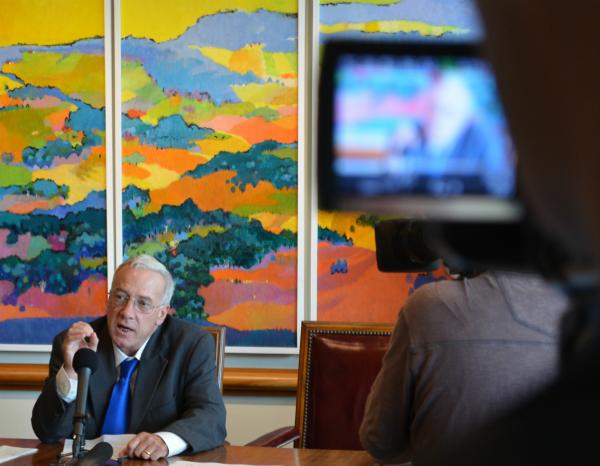 Commissioner of the Department of Finance & Management Jim Reardon makes a point at the Emergency Board meeting in July. Vermont Business Magazine photo.
Jim Reardon, commissioner of the Department of Finance and Management, said budget gap estimates at this time last year were closer to $70 million and proved to be pretty accurate. At that time, the administration asked departments to propose level-funding for the coming fiscal year.
On Friday, Reardon said he expects plugging the hole this year will leave some departments with level funding but some with less money to work with. Others may even get more, he said, as needs and priorities dictate.
The current fiscal year’s General Fund budget started at roughly $1.4 billion, but was cut by $31.3 million in August after the state’s economists downgraded Vermont’s revenue forecast.
RELATED:
Shumlin Administration unveils $31 million in spending adjustments
Shumlin proposes cutting current state spending nearly 2 percent
Tax revenue slump leads to lowered projections
The lowered revenue expectations are exacerbated by other spending pressures, according to both Reardon and Klein. These include:
-
$16 million in one-time funds used to cover about half the rescission
-
more than $10 million from higher costs of salary and fringe benefits from the Pay Act
-
about $7 million to cover reduced federal cost-sharing for Medicaid
-
$2.5 million in retired teacher health care costs (which previously were paid from the pension fund)
-
increased pension contributions based on actuarial recommendations
Reardon takes solace in the overall upward revenue projection, but said the bad news is that pressures on state spending continue to outpace what the government brings in to pay for services.
“We’re continuing to wean our way off the use of one-time money for ongoing expenses, which we’ve been using since the recession,” Reardon said. “But obviously, as we step down the use of one-time funds, that poses a challenge. It actually is part of the budget gap.”
Rebecca Holcombe, secretary of the Agency of Education, said Friday that her staff will consider what programs to potentially cut in order to meet the budget directive.