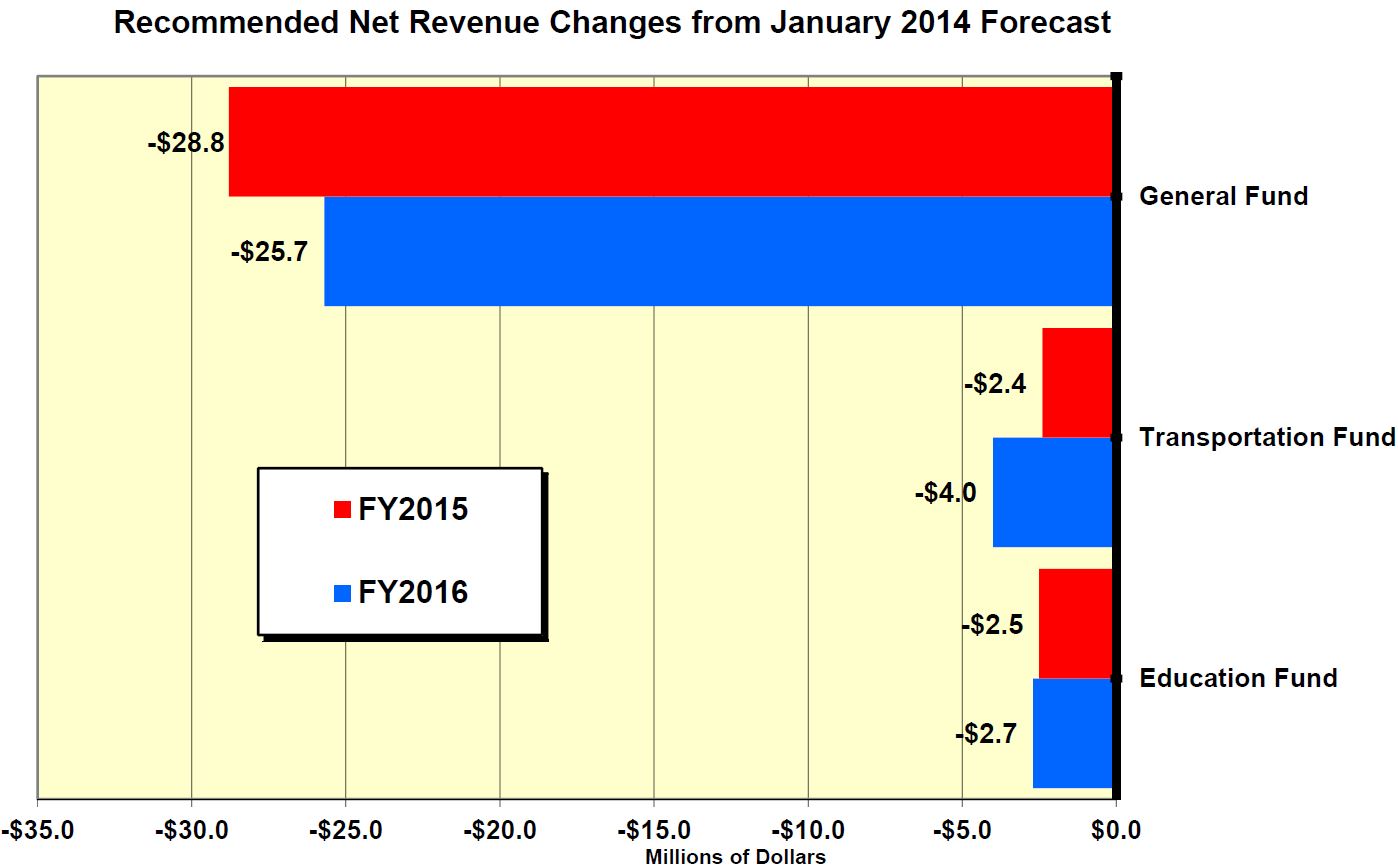
Vermont Business Magazine State economists presented a more somber report on projected tax revenues forecasts for the state of Vermont on Thursday and projected that revenues will be 1.8 percent lower going forward than anticipated last January for the fiscal 2015 (current) and 2016 years. Tom Kavet, for the Legislative, and Jeff Carr, for the Administration, restated for the Emergency Board what everyone already seemed to know: The recovery from the Great Recession has slowed, which has resulted, along with some technical changes, in a lowering of tax revenue expectations of $28.8 million for the current fiscal year, which started July 1, and $25.7 million for next year.
Governor Peter Shumlin, who chairs the E-Board, was quick to point out that these projections are not an actual reduction in revenue, but that the pace of growth has slowed. The E-Board is also comprised of the chairs of the four legislative money committees (Senators Jane Kitchel D-Caledonia, and Tim Ashe D/P-Chittenden, and Representatives Janet Ancel D-Calais, and Martha Heath D-Westford).
RELATED STORY: Shumlin proposes cutting current state spending nearly 2 percent as tax revenue slows
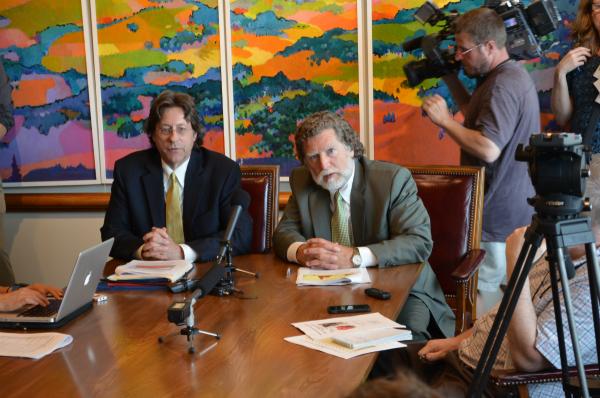 In their consensus revenue report, Kavet, right) and Carr stated:
"Despite aggregate revenue performance in fiscal year 2014 that was less
than 0.5% below January targets (and less than 0.5% above prior July 2013
forecasts), evidence the economy is on a slightly slower growth trajectory
and technical changes affecting individual revenue categories and allocations
to special funds will result in a downgrade to revenue projections for FY15
and FY16 of approximately 1.8%.
"The General Fund closed FY14 slightly below projections (-0.4%), but
experienced weakness in the second half of the fiscal year in personal
income receipts and sales and use revenues – the State’s two largest
revenue sources, both of which are intimately linked to general economic
conditions. Personal income withholding tax revenues actually declined in
the last quarter of the fiscal year, while lagging sales and use tax receipts
belied assumptions of accelerating economic growth. Weaker than expected
gasoline prices and continued consumption declines in gasoline gallonage
account for both the minor negative T-Fund variance in FY14 (-0.6%) and
slight adjustments to FY15 and beyond."
The economists said they had looked less at macro economic studies this time around because of the unusual data points. For instance, Carr said that both the number of payroll jobs and wages were both up, but personal income taxes were lagging. So they had to dig deeper to make their revenue estimates.
Kavet explained the tepid Transportation Fund revenues were in part explained by both a decrease in the price of gasoline over the last year and the decrease in the number of gallons sold, resulting from higher miles per gallon of vehicles and fewer miles being driven (the gasoline tax is based on both gallons and a sales tax on the bill, so both elements were down). This is not a new problem. Last year the Legislature adjusted the tax to put more reliance on the sales portion of the tax at a time that prices at the pump were high.
The cigarette tax, incidentally, was also lower, which is not fully explainable at this point. Kavet suggested that the reduction in the sales of real cigarettes might not be because people are smoking less, but because they are switching to "electronic" cigarettes.
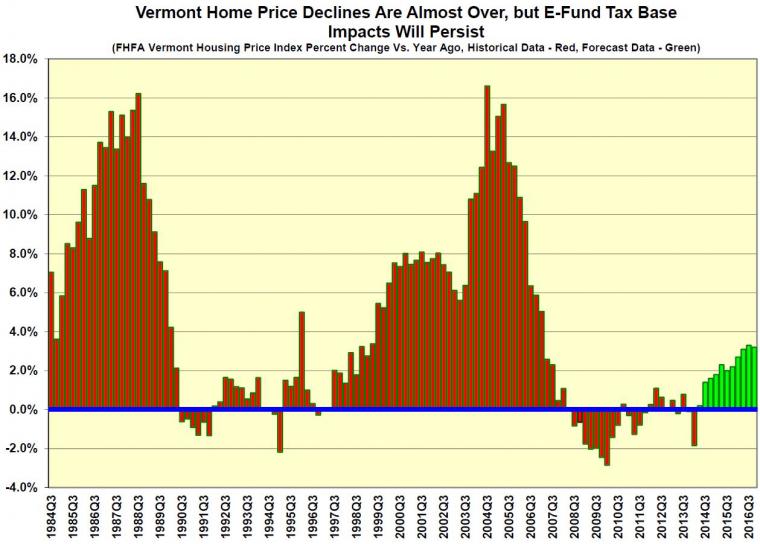
Housing is also a concern because prices actually fell a bit in the first quarter of the year (-1.8 percent), which is the least important because volumes are so low, Kavet said, but you would still want them going up. Carr added that if the state wants to see solid economic growth, residential home purchases, and with it new home construction, needs to increase, because those dollars filter throughout the economy into jobs and consumerism. One explanation for the lag, if it turns out truly to be one, is that younger people are putting off making life-long decisions, such as marriage, children and buying a home, until later in life.