

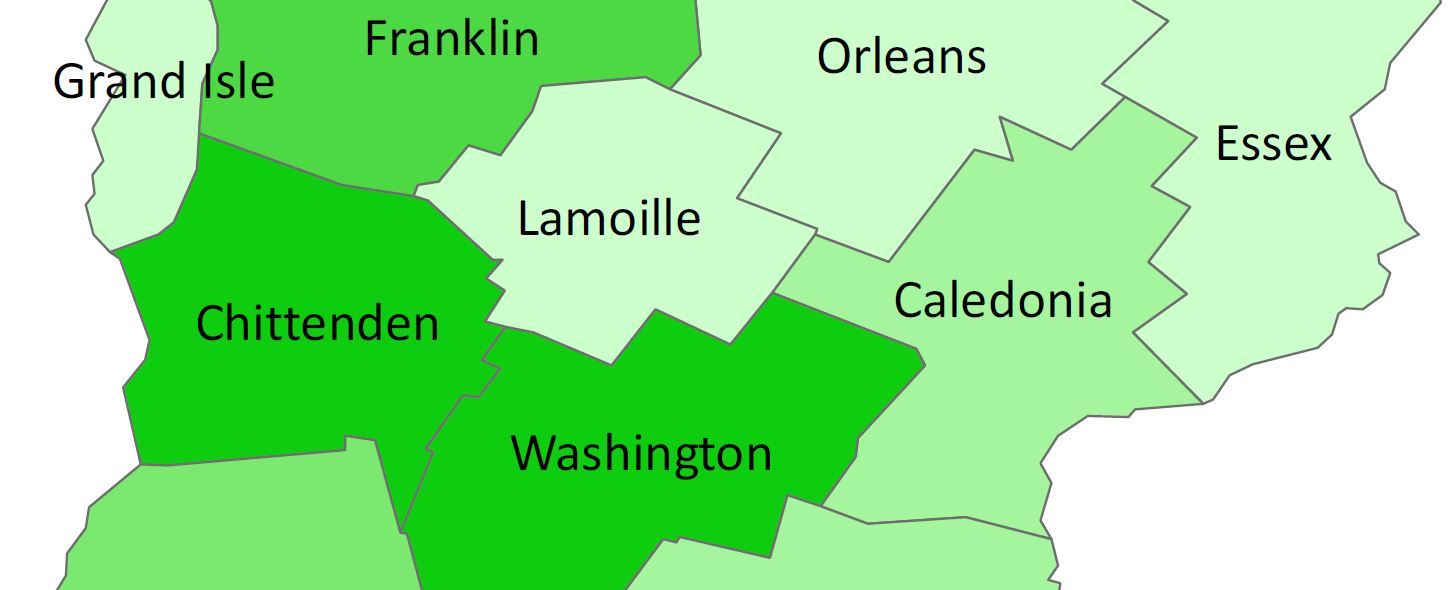
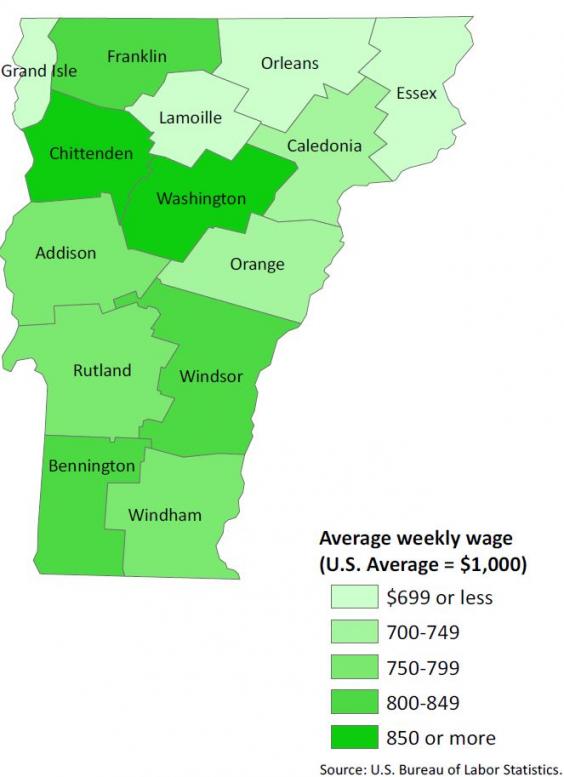
Vermont Business Magazine Employment in Vermont’s only large county, Chittenden, increased 0.4 percent from December 2012 to December 2013, according to the US Bureau of Labor Statistics. (Large counties are defined as those with employment of 75,000 or more as measured by 2012 annual average employment.) The three counties in Vermont with the highest wages were Chittenden ($994/week), Washington ($895/week), and Franklin ($815/week), with Grand Isle ($624/week), Essex ($660/week), and Orleans ($676/week) the three lowest, meaning the wealthiest and poorest counties in the state are all in the northern half. As a state, Vermont's overall increase in wages ranked it fourth in the nation for growth, but 36th overall in average weekly wage.
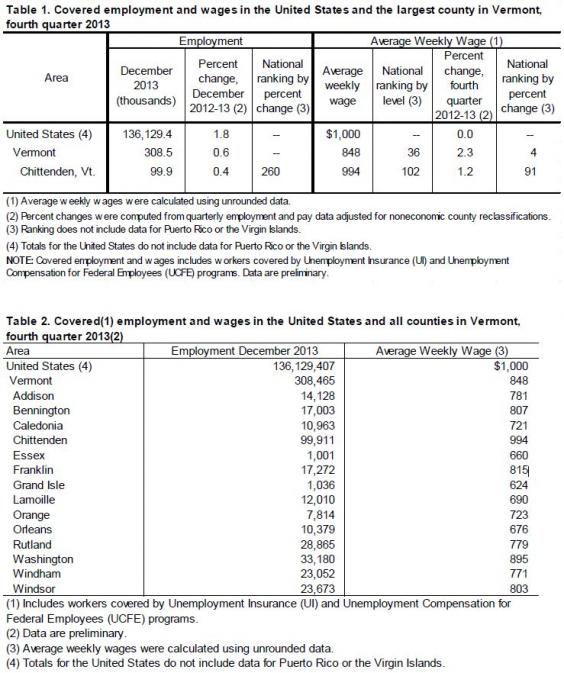
 SEE TABLES BELOW
Nationally, employment increased in 292 of the 334 largest counties from December 2012 to December 2013. The largest over-the-year percentage increase in employment was recorded in Weld, CO, up 6.0 percent. St Clair, IL, posted the largest over-the-year decrease in employment among the large counties in the US with a loss of 3.1 percent.
Employment in Chittenden County was 99,911 in December 2013, accounting for 32.4 percent of employment statewide. Nationwide, the 334 largest counties accounted for 71.7 percent of total U.S. employment. The average weekly wage in Chittenden County rose 1.2 percent from the fourth quarter of 2012 to the fourth quarter of 2013 to $994. (See table 1.) Nationally, the average weekly wage was unchanged over the year, remaining at $1,000 in the fourth quarter of 2013. Employment and wage levels (but not over-the-year changes) are also available for the 13 counties in Vermont with employment below 75,000. All 13 smaller counties in Vermont had average weekly wages below the national average. (See table 2.)
Large County Wage Changes
Chittenden County’s 1.2-percent wage increase from the fourth quarter of 2012 to the fourth quarter of 2013 placed 91st nationally. (See table 1.) Nationwide, 185 of the 334 largest counties had over-the-year gains in average weekly wages from the fourth quarter of 2012. Santa Cruz, Calif., had the largest wage gain in the nation, up 6.5 percent. Of the 334 largest counties, 140 experienced over-the year decreases in average weekly wages. Douglas, Colo., had the largest average weekly wage decrease with a loss of 29.7 percent. San Mateo, Calif., had the second largest decrease in average weekly wages, followed by Virginia Beach City, Va.; McHenry, Ill.; and Shawnee, Kan.
Large County Average Weekly Wages
The average weekly wage in Chittenden County placed 102nd among the 334 largest U.S. counties in the fourth quarter of 2013. The county’s $994 average weekly wage was close to the U.S. average of $1,000. Among the highest-paid large U.S. counties, San Mateo, Calif., held the top position with an average weekly wage of $2,724. New York, N.Y., was second with an average weekly wage of $2,041, followed by Santa Clara, Calif. ($1,972), and San Francisco, Calif. ($1,753). Horry, S.C. ($587) reported the lowest wage nationwide, followed by the counties of Cameron and Hidalgo, Texas ($598 and $620, respectively). Wages in the lowest-ranked county, Horry, were less than one-fourth of the average weekly wage reported for the highest-ranked county, San Mateo, Calif.
Average Weekly Wages in Vermont’s Smaller Counties
The 13 counties in Vermont with employment below 75,000 had average weekly wages lower than the national average of $1,000. Among these smaller counties, Washington had the highest wage ($895) followed by Franklin ($815). Grand Isle reported the lowest weekly wage, averaging $624 in the fourth quarter of 2013. (See table 2.) When all 14 counties in Vermont are considered, 4 reported average weekly wages under $699, 5 had wages from $700 to $799, and 5 had wages of $800 or more. The lowest-paid counties, those with wages below $699, were generally located in the northern part of the state. (See chart 1.)
Additional Statistics and other Information
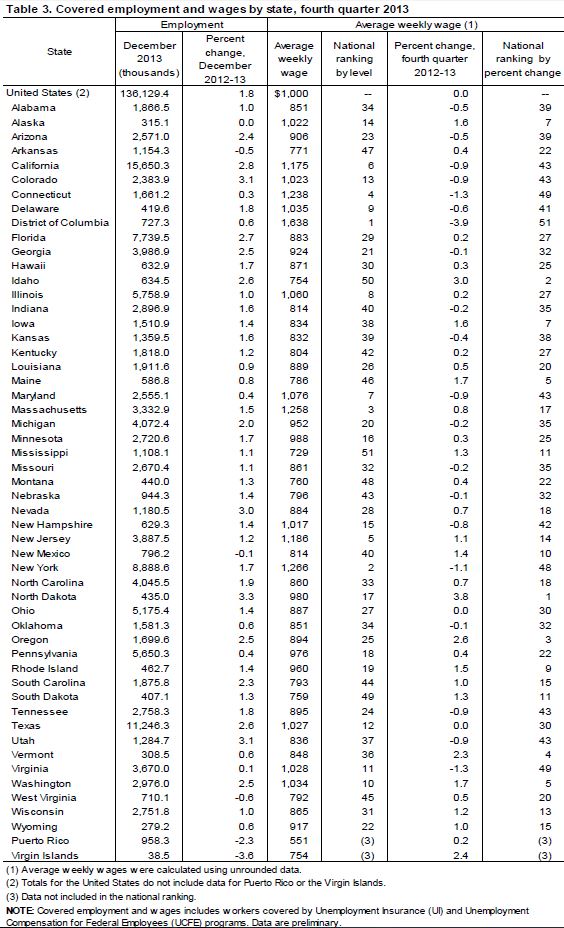
QCEW data for states have been included in this release in table 3. For additional information about quarterly employment and wages data, please read the Technical Note or visit the QCEW Web site at www.bls.gov/cew.
An annual bulletin, Employment and Wages Annual Averages Online, features comprehensive information by detailed industry on establishments, employment, and wages for the nation and all states. The 2012 edition of this publication, which was published in September 2013, contains selected data produced by Business Employment Dynamics (BED) on job gains and losses, as well as selected data from the first quarter 2013 version of the national news release. Tables and additional content from Employment and Wages Annual Averages 2012 are now available online at www.bls.gov/cew/cewbultn12.htm. The 2013 edition of Employment and Wages Annual Averages Online will be available in September 2014.
 Technical Note
Average weekly wage data by county are compiled under the Quarterly Census of Employment and Wages (QCEW) program, also known as the ES-202 program. The data are derived from summaries of employment and total pay of workers covered by state and federal unemployment insurance (UI) legislation and provided by State Workforce Agencies (SWAs). The 9.3 million employer reports cover 136.1 million full- and part-time workers. The average weekly wage values are calculated by dividing quarterly total wages by the average of the three monthly employment levels of those covered by UI programs. The result is then divided by 13, the number of weeks in a quarter. It is to be noted, therefore, that over-the-year wage changes for geographic areas may reflect shifts in the composition of employment by industry, occupation, and such other factors as hours of work. Thus, wages may vary among counties, metropolitan areas, or states for reasons other than changes in the average wage level.
Data for all states, Metropolitan Statistical Areas (MSAs), counties, and the nation are available on the BLS Web site at www.bls.gov/cew/; however, data in QCEW press releases have been revised and may not match the data contained on the Bureau’s Web site. QCEW data are not designed as a time series. QCEW data are simply the sums of individual establishment records reflecting the number of establishments that exist in a county or industry at a point in time. Establishments can move in or out of a county or industry for a number of reasons—some reflecting economic events, others reflecting administrative changes. The preliminary QCEW data presented in this release may differ from data released by the individual states as well as from the data presented on the BLS Web site. These potential differences result from the states’ continuing receipt, review and editing of UI data over time. On the other hand, differences between data in this release and the data found on the BLS Web site are the result of adjustments made to improve over-the-year comparisons. Specifically, these adjustments account for administrative (noneconomic) changes such as a correction to a previously reported location or industry classification. Adjusting for these administrative changes allows users to more accurately assess changes of an economic nature (such as a firm moving from one county to another or changing its primary economic activity) over a 12-month period. Currently, adjusted data are available only from BLS press releases.
Source: US Bureau of Labor Statistics, 7.17.2014