

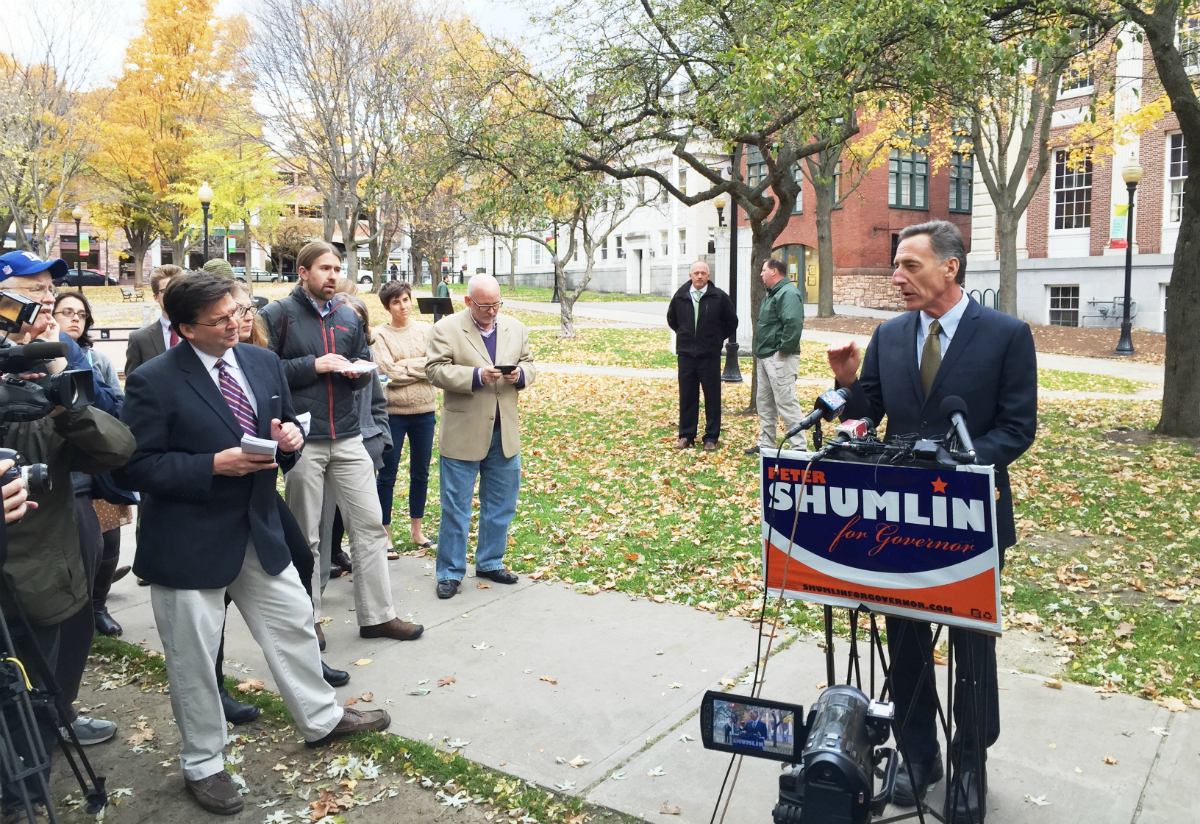
by Chris Graff Those who have written off Governor Peter Shumlin as too wounded to be effective are ignoring history and the power of a governor. As for the history lesson, consider Governor Deane C Davis: Polling showed in 1970 that the governor was one of the most unpopular politicians in the country. He was so weak that his own lieutenant governor challenged his re-election in the Republican primary. In-depth polling in 1970 showed that Vermonters thought that Davis was cold and impersonal, didn’t care about the average man and, most importantly, that he had lied to them.
At the heart of the dispute was the 1968 campaign when Davis quite openly said he would support a sales tax for the state, but would only propose one as a “last resort.” After he was elected and appreciated the full extent of the state’s budget crisis, he ended up proposing a sales tax in his inaugural address – and that’s what touched off the anger and distrust.
But Davis fought back in that 1970 campaign, won re-election and went on to be one of the state’s most revered governors.
Sure, Peter Shumlin has been hit hard. But he is the governor and still retains the power to shape the state’s agenda in the coming two years. When he stands before the Legislature in January and delivers his inaugural and budget addresses he can count on most all of his priorities passing into law. That’s just the way it is.
But another story comes to mind as well.
In the 1994 Legislature the top priority of Governor Howard Dean, a doctor, was health care reform. The lawmakers and the administration had been paving the way to passage for two years. Two options had been presented to design a new health delivery system that would contain costs yet ensure access to health care for all.
House Speaker Ralph Wright appointed a special health House committee to consider the measure in hopes of streamlining the process and promoting passage. The plan, though, was incredibly complex and the press had tremendous difficulties understanding the proposal, much less communicating to the public what was going on.
At one point Dean said the new system would cost $37 million but others estimated the true cost would be more than $100 million and even then there was talk that healthcare costs would remain high for most families.
By mid-March it was clear that the comprehensive bill would not pass the House. In his autobiography, All Politics is Personal, Speaker Wright recalls that he turned to Dean when it became evident the bill was mired in the House, hoping to develop a strategy for continuing the fight in the Senate.
“What are we going to do?” Wright asked.
“Nothing,” said Dean. “It’s dead.”
Wright was incredulous. “That’s it. It’s dead? Two years of grinding and fighting, and it’s dead? Everything went out of my mind, as the only visual I had was the governor in a hospital room, pulling another sheet over a patient’s face, and turning back to look at the charts on the patient in the next bed.”
Dean knew when to move on. The collapse of the major healthcare initiative did not deter him from continuing to work on the issue. Year after year he promoted and passed some incremental changes. By the end of his time as governor all those little changes added up to big successes.
Shumlin needs to do the same: It is time to move on. Single payer health care reform may make perfect sense as a policy initiative, but it does not make sense as a political initiative – at this time.
The landscape is too complicated. The financing is too overwhelming. The failures of Vermont Health Connect have raised legitimate questions about the ability of the state to implement such sweeping change. The dust-up over the remarks and attitude of MIT Professor Jonathan Gruber have further eroded the credibility of the endeavor.
Like Dean, Shumlin would be best served by taking a step back from pushing single payer sooner and develop a plan to build support over the longer term. And to educate Vermonters about all of the change that is happening here – right now – in Vermont in health care delivery, health care technology and health care reform.
Lost in all of the debate on how to finance a single payer health care system are the incredible successes of the Green Mountain Care Board to bend the cost curve. The board has made marked improvements in controlling hospital costs and refocusing the health care delivery system on wellness and outcomes. Vermonters need to understand what accountable care organizations are and how their creation is a huge step forward in a health care model for the future.
Shumlin is impatient. But in politics timing is everything.
And this is just not the time.
Chris Graff, a former Vermont bureau chief of The Associated Press and host of VPT's Vermont This Week, is now vice president for communications at National Life Group. He is author of, Dateline Vermont: Covering and uncovering the newsworthy stories that shaped a state - and influenced a nation.
PHOTO: Governor Shumlin holds a press conference two days after the election. He and the Legislature must address a large budget shortfall, as tax revenues so far this fiscal year are disappointing, and wide concerns about the property tax and the impact and revenue sources for the governor's single-payer health plan. VBM photo.
RELATES STORIES: