

Governor Peter Shumlin, Burlington Mayor Miro Weinberger, Burlington Electric Department Interim General Manager Neale Lunderville, and other stakeholders Wednesday celebrated the installation of electric vehicle charging stations in both the Marketplace and Lakeview Garages in Burlington. These state-of-the-art EV fueling pumps will improve customer convenience and make electric vehicles a more attractive option for Burlington residents.
“I am thrilled to see these charging stations in downtown Burlington,” Shumlin said. “Our grant program demonstrates Vermont’s commitment to supporting electric vehicles. To grow our statewide EV stock, it is important that Burlingtonians and visitors to our communities have charging locations available in town. Installing charging stations in convenient areas is a major step forward.”
“As our transportation sector continues the transformation from fossil fuels to electricity, Burlington is pleased to be at the forefront of installing these charging stations,” said Mayor Weinberger. “We are supporting a new clean industry and reducing greenhouse gas emissions. These EV charging stations will help keep our downtown vibrant, as residents and visitors can recharge while dining, shopping, and doing business in Burlington.”
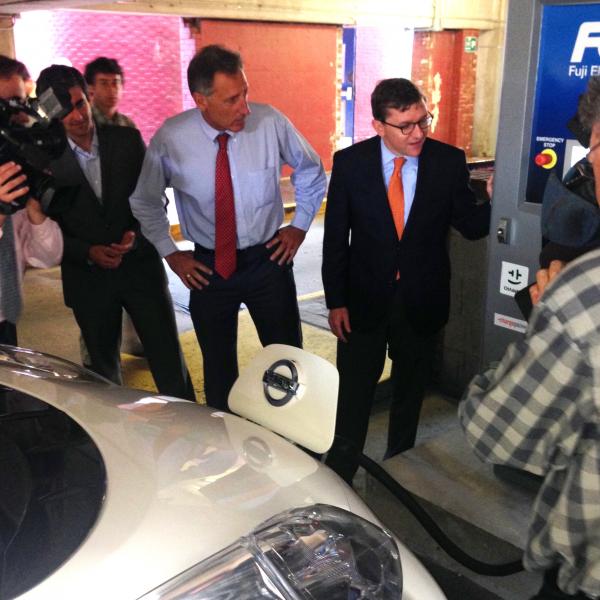 Weinberger, Shumlin and Lunderville check out the new Level 3 charging station in Burlington. See a description of the charging levels below. Courtesy photo.
The EV fueling pump in the Marketplace Garage is a Level 3 charging station, complete with the fastest charging time of any commercially-available station on the market today. In the Lakeview Garage, two Level 2 dual-port stations have been installed. These three charging stations were partially funded through the 2014 Downtown Electric Vehicle Charging Station grant program, co-sponsored by the Downtown Program of the Vermont Agency of Commerce & Community Development and the Air Quality and Climate Division of the Vermont Department of Environmental Conservation. Through this program, 13 charging stations were funded in six of Vermont’s Designated Downtowns.
Along with these two new downtown stations, Burlington has a number of other public charging stations, including a Level 3 charger located next to BED, and several Level 2 chargers – one dual-port at BED, and one at the intersection of Church and Main Streets in front of the Chittenden County Courthouse. Other stations in downtown Burlington, located at City Market and Main Street Landing, are privately-owned and available for public use.
“As the publicly-owned utility in Burlington, BED is excited to be on the cutting edge of energy innovation,” said BED Interim GM Lunderville. “These new charging stations will improve customer convenience and make electric vehicles an even more attractive option for Burlington residents. As more people turn to electricity for transportation, we plan to continue to promote this service.”
Karen Glitman, Director of Transportation Efficiency at Vermont Energy Investment Corporation and a frequent EV charging pump user in Burlington, also attended today’s event. “These new charging stations put Burlington on the map as an EV destination. The stations are good for the environment and the economy, as they encourage economic activity and leave behind cleaner air and less noise,” said Glitman.
The City selected the Marketplace Garage because of its location in the heart of the Church Street Marketplace retail district and its designation as Burlington’s busiest parking facility. The City selected the Lakeview Garage, located near two major hotels, for its proximity to both the City’s commercial core and the waterfront, helping bridge these two popular attractions. Aided by a contribution from Nissan Motor Corporation, the Marketplace Garage’s Level 3 “fast charger” will charge all-electric vehicles within 30 minutes, the duration of typical parking stays in this facility. Level 3 pumps generally recharge in less than one hour, and Level 2 pumps recharge in approximately two hours. The volume of charging is steadily increasing at these and all of the facilities connected to BED’s Chargepoint network.
The full list of awards for the State’s 2014 Downtown Electric Vehicle Charging Station grant program is as follows:
- Barre – $30,000 for Level 2 chargers in two locations
- Bennington – $22,000 for Level 2 chargers in two locations
- Burlington –$30,000 for two Level 2 chargers and one Level 3 charger
- Middlebury – $29,287 for Level 2 chargers in two locations
- Morristown – $10,098 for Level 2 chargers in two locations
- St. Albans – $6,625 for Level 2 chargers in two locations
Level 1 Charging
Level 1 equipment provides charging through a 120 volt (V), alternating-current (AC) plug and requires a dedicated circuit. Generally speaking, Level 1 charging refers to the use of a standard household outlet. Level 1 charging equipment is standard on vehicles and therefore is portable and does not require the installation of charging equipment. On one end of the provided cord is a standard, three-prong household plug. On the other end is a connector, which plugs into the vehicle. Depending on the battery technology used in the vehicle, Level 1 charging generally takes 8 to 12 hours to completely charge a fully depleted battery. The most common place for Level 1 charging is at the vehicle owner's home and is typically conducted overnight.
Level 2 Charging
Level 2 equipment offers charging through a 240V, AC plug and requires installation of home charging or public charging equipment. These units require a dedicated 40 amp circuit. Level 2 charging equipment is compatible with all electric vehicles and plug-in electric hybrid vehicles. Level 2 chargers have a cord that plugs directly into the vehicle in the same connector location used for Level 1 equipment. Depending on the battery technology used in the vehicle, Level 2 charging generally takes 4 to 6 hours to completely charge a fully depleted battery. Charging time can increase in cold temperatures.Level 2 chargers are commonly found in residential settings, public parking areas, places of employment and commercial settings.
Level 3 Charging (CHAdeMO)
Level 3 equipment with CHAdeMO technology, also commonly known as DC fast charging, charges through a 480V, direct-current (DC) plug. Most Level 3 chargers provide an 80% charge in 30 minutes. Cold weather can lengthen the time required to charge. This type of Level 3 equipment is not compatible with all vehicles, and the charge itself is not accepted by all vehicles. There is currently no industry standard for this level of charging; however, Level 3 chargers are being deployed across the United States in public or commercial settings. Currently, the Mitsubishi "i" and Nissan LEAF can accept a Level 3 charge. Other vehicles, such as the Chevy Volt, FordC-Max Energi and Prius plug-in cannot.
Sources: Governor's office. Mayor's office 8.7.2014. www.evtown.org