

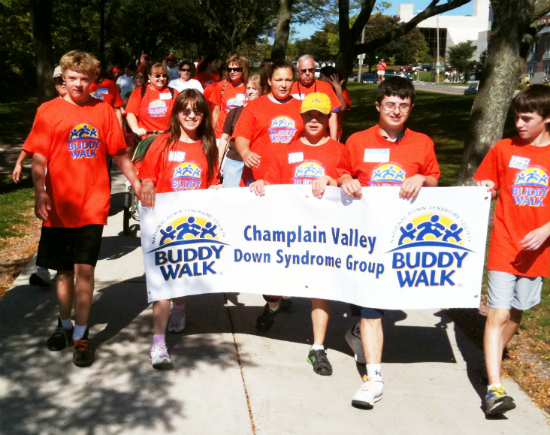
The 4th Annual Champlain Valley Buddy Walk will take place at Burlington's Battery Park on Sunday, October 13, starting at noon. More than 250 people are expected to attend the event, which is one of over 250 Walks across the country this fall to raise awareness and funds for programs that benefit people with Down syndrome and their families. This year’s Walk is made possible with the generous support of the People's United Bank Foundation and Dore & Whittier Architects.
The Champlain Valley Buddy Walk will begin with a Welcome and Opening Remarks at noon followed by the Walk at 1 pm. The route will go through the downtown business district and up Church Street before returning to the park by 2 pm. Those who have a child with Down syndrome or who have known a person with Down syndrome or want to simply support their friends and neighbors are welcome to join the Buddy Walk.
The registration fee is $10 per individual and family registration will not exceed $50. Buddy Walk tee-shirts are available to early registrants. Refreshments and food will be provided by Starbucks and Subway/Williston. To register, please visit, http://tinyurl.com/buddywalkCVDSG.
"What we hope participants will take away from this is that people with Down syndrome don't have special needs, they have the same needs as everyone else,’ says Champlain Valley Down Syndrome Group President Lisa DeNatale. ‘We all need a good education, to have access to good health care, to get a meaningful job, and to make life-long friends."
The Champlain Valley Down Syndrome Group was founded in March 2010. The group’s mission is to provide information, resources and support to individuals with Down syndrome and their families, and to promote awareness and inclusion in our communities of people with Down syndrome to help them achieve their full potential.
For more information, contact Tim McQuiston at (802) 355-4206. To learn more about the Buddy Walk, visit www.facebook.com/ChamplainValleyDownSyndromeGroup or go to the NDSS Web site at www.buddywalk.org.
Local participants will join nearly 300,000 Americans across the country that are expected to walk this fall in support of Down syndrome awareness. Bring your friends, bring your neighbors, bring your dog!
"It's very important to raise awareness and make a difference for people with Down syndrome by participating in a Buddy Walk. The focus is not on our disabilities, but on our abilities that count," said Actor and NDSS Goodwill Ambassador Chris Burke. "At the Buddy Walk, we all walk together."
The National Buddy Walk Program welcomes participants of all ages and abilities. The goals of the program are to promote acceptance and inclusion of people with Down syndrome and to positively influence local and national policy and practice. Last year alone, Buddy Walk events raised more than $11 million to benefit national advocacy initiatives, as well as local programs and services. All funds raised through the National Buddy Walk Program support both local and national programs. To learn more, visit www.buddywalk.org.
My Great Story, the National Down Syndrome Society's public awareness campaign, features a section exclusively devoted to the Buddy Walk. All are encouraged to submit their stories, or to vote and comment on those already in the collection. Visit http://r20.rs6.net/tn.jsp?e=0016XWBVRpqttGFH5iKiLo5-j6tiPPO43ktohidppg3n... to view the collection and share your own Buddy Walk story.
The 2013 Buddy Walk National Partners are BandAbout, Knology, Signing Time, Down Syndrome Footprint, Vacation Roost, Woodbine House, Goodthreads and Imagination Movers.
About NDSS
The National Down Syndrome Society is a nonprofit organization representing the more than 400,000 Americans with Down syndrome. The mission of NDSS is to be the national advocate for the value, acceptance and inclusion of people with Down syndrome. The National Down Syndrome Society envisions a world in which all people with Down syndrome have the opportunity enhance their quality of life, realize their life aspirations, and become valued members of welcoming community. NDSS has over 350 affiliates nationwide.
To learn more about NDSS, visit www.ndss.org.
www.facebook.com/ChamplainValleyDownSyndromeGroup
Buddy Walk® Fact Sheet
The Buddy Walk® was established in 1995 by the National Down Syndrome Society to celebrate Down Syndrome Awareness Month in October and to promote acceptance and inclusion of people with Down syndrome. Today, the Buddy Walk program is supported nationally by NDSS and organized at the local level by parent support groups, schools and other organizations and individuals.
Over the past 17 years, the Buddy Walk program has grown from 17 walks to more than 250 expected in 2011 across the country and around the world.
Last year alone, 285,000 people participated in a Buddy Walk. They raised more than $11 million to benefit local programs and services as well as the national advocacy initiatives that benefit all individuals with Down syndrome.
Since it began in 1995, the Buddy Walk has not only become the premier advocacy event for Down syndrome, but also the world's most widely recognized public awareness program for the Down syndrome community.
The Buddy Walk is nationally ranked in the 30 Top Run/Walk/Ride Endurance Events. This year, the Buddy Walk is ranked 25th for dollars raised and 9th for number of participants.
The Buddy Walk is usually a one-mile walk (some locations vary) in which anyone can participate without special training. It is an inspirational and educational event that celebrates the many abilities and accomplishments of people with Down syndrome. Whether you have Down syndrome, know someone who does, or just want to show your support, come and join a Buddy Walk in your community!
Buddy Walk events are open to participants of all ages and abilities. Each Walk location has places where you can sit down, relax, and watch the excitement if you choose not to walk. You can also become a member of the cheering section and cheer on the walkers.
Buddy Walk events are great places to network with families and learn more about support services available.
There are no mandatory fundraising requirements for participants of a Buddy Walk. While most Walks choose to include a fundraising component to raise money for local and national programs, there is no individual requirement beyond the registration fee (if applicable).
Down Syndrome Fact Sheet
Down syndrome occurs when an individual has three, rather than two, copies of the 21st chromosome. This additional genetic material alters the course of development and causes the characteristics associated with Down syndrome.
Down syndrome is the most commonly occurring chromosomal condition. One in every 691 babies is born with Down syndrome.
There are more than 400,000 people living with Down syndrome in the United States.
Down syndrome occurs in people of all races and economic levels.
The incidence of births of children with Down syndrome increases with the age of the mother. But due to higher fertility rates in younger women, 80% of children with Down syndrome are born to women under 35 years of age.
People with Down syndrome have an increased risk for certain medical conditions such as congenital heart defects, respiratory and hearing problems, Alzheimer's disease, childhood leukemia, and thyroid conditions. Many of these conditions are now treatable, so most people with Down syndrome lead healthy lives.
A few of the common physical traits of Down syndrome are low muscle tone, small stature, an upward slant to the eyes, and a single deep crease across the center of the palm. Every person with Down syndrome is a unique individual and may possess these characteristics to different degrees or not at all.
Life expectancy for people with Down syndrome has increased dramatically in recent decades - from 25 in 1983 to 60 today.
People with Down syndrome attend school, work and contribute to society in many wonderful ways.
All people with Down syndrome experience cognitive delays, but the effect is usually mild to moderate and is not indicative of the many strengths and talents that each individual possesses.
Quality educational programs, a stimulating home environment, good health care, and positive support from family, friends and the community enable people with Down syndrome to develop their full potential and lead fulfilling lives.
Researchers are making great strides in identifying the genes on chromosome 21 that cause the characteristics of Down syndrome. Many feel strongly that it will be possible to improve, correct or prevent many of the problems associated with Down syndrome in the future.