

by Alicia Freese vtdigger.org Two months before he’ll step down as Secretary of Education, Armando Vilaseca revived an age-old call for school district consolidation, and he told lawmakers that extending the school day is ‘one of the single most important things we can do for kids.’
In fall 2012, Governor Peter Shumlin chose Vilaseca, who was education commissioner, to serve a one-year term in the newly minted position of secretary. Shumlin announced in September that’ Rebecca Holcombe, an educator who runs the Dartmouth Teacher Education Program in Hanover, NH, ‘ would succeed Vilaseca, starting in January.
Vilaseca, first as commissioner and later as secretary, spent ample time in front of the House Education Committee.
Wednesday, Vilaseca returned to that committee for his final time in what’s sometimes referred to as the ‘hot seat.’ He offered lawmakers a ‘wish list’ of education reforms that eluded him during his tenure.
Vilaseca briefly recounted the’ agency’s accomplishments’ in the past year. He pointed to the ‘flexible pathways’ legislation and the creation of ‘personal learning plans,’ which, Vilaseca said, will give high school students a wider array of options and increase the relevance of education.
‘We can really say we’ve made an impact on the lives of kids,’ Vilaseca said, adding those changes are ‘sometimes hard to see on the policy level.’
But the secretary soon moved onto a stack of incompletes, declaring, ‘Enough of the kumbaya.’
Since 1997, Vilaseca told the committee, the state’s student population has declined by 25,000, while the number of staff has increased by more than 3,000. ‘That’s unsustainable no matter how we cut it.’
Pooling resources among merged districts offers the ‘biggest bang for our buck,’ Vilaseca said.
‘We don’t need 272 school districts,’ he said. ‘Do we need 63 superintendents in the state of Vermont? Can 24 be the number? Can 22 be the number? That’s where I think we should start.’
The Legislature passed Act 153 to facilitate district consolidation on a voluntary basis, but school districts have been reluctant to take that route. The law gave towns the option of forming ‘regional education districts.’
House Education Committee members Rep. Larry Cupoli (left), R-Rutland, and Rep. Bernie Juskiewicz, R-Cambridge, listen to outgoing Secretary of Education, Armando Vilaseca. Photo by Alicia Freese/VTDigger
Representative Peter Peltz, D-Woodbury, offered Vilaseca the chance to be more blunt.
‘I don’t want to be crass, but this could be your exit interview, where you let your hair down,’ Peltz said. ‘Are you advocating that we take a bull by the horn and do it legislatively?’
It won’t happen without a nudge from the state, Vilaseca said.
‘When I talk to school board members and superintendents, they say, ‘We’ll never do this ourselves.’ There has to be some sort of hammer,’ he said.
In an interview after the meeting, Vilaseca proposed one way a ‘hammer’ could be added to Act 153.
‘What was missing [from Act 153],’ Vilaseca said, ‘was an end. So after seven or eight years if the districts haven’t joined together, then the state will come in.’
Vilaseca devoted part of his hour to what’s arguably an even thornier issue ‘ childhood poverty and the challenge of making sure low-income students have equal educational opportunities.
‘We have not reached equity for opportunities for kids,’ he said.
‘Extended-day learning is probably one of the single most important things we can do for kids,’ Vilaseca told the committee.
He recommended revamping the so-called agrarian calendar, which runs from September to June, and increasing the length of the school day.’ Superintendents in the Champlain Valley recently tried’ to do the former, but the proposal was put on hold after many parents objected.
Despite the quashed attempt, Vilaseca said he thinks communities will warm to the idea.
‘You saw those poor superintendents in Chittenden County and northwest Vermont try to put out Calendar 2.0 and they got beat up over it,’ he said. ‘And that’s OK because it’s the first time.’
Vilaseca identified pre-kindergarten education and ‘full-service’ schools that integrate services like health care into the school setting as two priorities. The latter, he said, is ‘something the governor is really hot on.’
Vilaseca said he doesn’t know what he’ll do next ‘ he says he’s been too busy right now tying up loose ends at the Agency of Education.
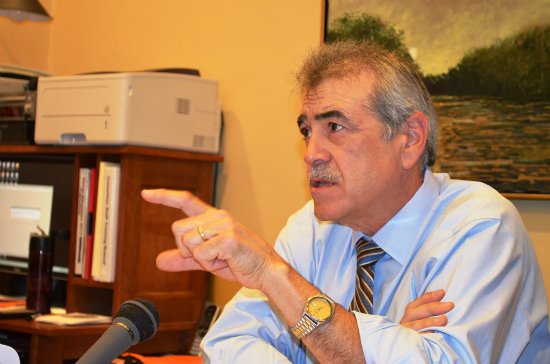
VERY’ TOP’ PHOTO: Education Secretary Armando Vilaseca addresses the House Education Committee on November 6, 2013. Photo by Alicia Freese/VTDigger