

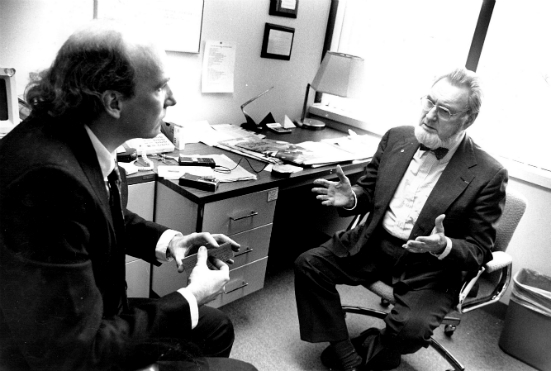
When former Surgeon General C. Everett Koop died last week at age 96 in Hanover, Vermont Business Magazine editor and VPR commentator Timothy McQuiston was reminded of an interview he had with Koop 19 years ago. Koop was living in Vermont at the time and had just started working at Dartmouth. The Vermont Public Radio commentary and Q&A from February 1994 are below.
McQuiston: Koop's Legacy
Thursday, 03/07/13 5:55pm
Listen (2:50)
MP3 | Download MP3
By Timothy McQuiston
(McQuiston) When I heard the news of his death, the first thing I thought of was how he talked about his own living will at some length - and stressed the importance of planning for one's end-of-life circumstances. His daughter, he said, would make the appropriate decisions when the time came. The time came last week and I wondered what, if any, decisions his daughter had made.
The second thing I thought of was why he was famous in the first place. Certainly being named Surgeon General of the United States doesn't make one famous. Can you name the current one - or any one, for that matter?
Koop had a Quaker Oats beard and his first name was Charles, though I doubt very much anyone ever called him Charlie, or The Chuckster - and he became famous because of AIDS.
Koop was surgeon general during the Reagan Administration in the ‘ 80s, when AIDS became a national calamity. At first it was a mysterious disease that plagued certain demographic groups. HIV was discovered to be its incurable cause. But because it most profoundly struck gay men, it also quickly became a socio-political debate.
The administration took a laissez faire attitude toward AIDS, thus giving some ugly Americans the cover to say things like, "They got what they deserved." Never mind who "they" were or that diligence was not paid to the blood supply, causing the disease to spread further.
This was truly a bad time.
He was picked by President Reagan because he was a conservative, notably on abortion. But as a medical professional he was conservative in the classic sense. He was a doctor first.
Koop recognized that AIDS was not a political or social issue; it was a severe health care problem of epidemic proportions that had to be dealt with immediately - and that blunt action was needed.
Perhaps Koop wasn't the first government official to use the word "condom" in public, but his public stance in television commercials and other media made the term "safe sex" part of our American lexicon.
He recognized the public health disaster that was AIDS. He stood up for his principles as a physician. He was vilified by some and scolded by others, but he forged ahead. He never retreated from his stance that the first thing that had to be done was to slow down the spread of a disease that not only was incurable, but for which at the time there was not even a treatment protocol.
Doctors need to be direct. Sometimes they tell you you're going to die; sometimes they save your life. That's their job. Koop saved untold numbers of lives, but he didn't think of it that way. When I interviewed him in a small room at Dartmouth-Hitchcock, he didn't talk much about AIDS or the politics of the 1980s. He was a conservative doctor. He wanted to talk about the role of the health care provider and the responsibility of the individual.
Q&A, C Everett Koop
This article was first published in the March 1994 issue of Vermont Business Magazine.
VBM file photo by Phara Fisco.
Q&A, C Everett Koop
He says, "Unless everybody is covered, nobody is really covered." And that pragmatic humanity comes through the celebrity, the weariness, the stature, the confidence, candidness and contentedness of C Everett Koop. It is not hyperbole to state that this pediatric surgeon is the most famous physician in world. He splits his time, when he is not in a million other places, between the White House and Dartmouth College, from which he graduated with a bachelor's degree in 1937. He received his MD from Cornell College in 1941 and ScD from the University of Pennsylvania in 1947. He served as surgeon-in-chief of Children's Hospital in Philadelphia from 1948 until 1981. He joined the US Public Health Service in February 1981 and the following November was sworn in as Surgeon General -- a position he held for eight years.
Dr Koop became a national figure when he brought a reluctant federal government into AIDS awareness, education and prevention. Only hints of his Brooklyn birth are evident in his voice, but the familiar bearded visage and bow tie remain. Straightforward and almost stern, his comments about life and human nature are often terminated with self-inflicted chuckles. He shifts from reclining in his swivel chair to dropping his elbows on his knees to move in on an important point.
He spoke with Vermont Business Magazine editor Timothy McQuiston in late February at the Dartmouth-Hitchcock Medical Center about health care reform activity in Vermont and in Washington; about universal coverage, managed care, choice of doctor, employer mandates, and single-payer plans; about health and commonsense in America; about the Koop Institute and the on-going education of health care providers; and about the virulent spread of AIDS. Dr Koop and his wife have three children and seven grandchildren. He sits on many health-related boards across the country, has received 29 honorary doctorates and scores of other acknowledgements, including the Medal of Legion of Honor of France. Now back at Dartmouth, he is the senior scholar of The C Everett Koop Institute and is the Elizabeth DeCamp McInerny Professor of Surgery. "I'd try to make people their brother's keeper, once again," he says.
VBM: How closely have you been following the events in Vermont?
KOOP: Not very. I talk to the governor periodically about things, but I really am so...up to here that I can't keep much track. And I've been doing a lot of things at the White House, and that doesn't allow me much time to spread myself any thinner than I am. I'm so thin now you can see right through me.
VBM: Do you have a lot of contact with the Clintons?
KOOP: Yes.
VBM: One of the persistent questions asked by the opponents of health care reform is whether there is a health care crisis. Is there a health care crisis?
KOOP: Oh, I think there's a health care crisis.
VBM: How is it manifested?
KOOP: Well, if you don't think there's a health care crisis, ask the 250,000 people last year who had to declare bankruptcy because they were in such debt from medical bills; or ask the 100,000 people every month who lose their insurance and can't get it replaced; or ask some of the people who are uninsured. The statistics that are used about the uninsured are very interesting. For the last couple of years, people have been saying 37 million, it's actually 38.2 million, who on any one day are uninsured. Well, then the pundits who don't want to believe there's a crisis say, "Well, you know, they're only uninsured for a couple of days." But, that's not true. Let me put it this way. Suppose you're uninsured for one day out of the year and that's the day you get quadriplegic. You're life and finances and that of your family are totally ruined. But, the statistics are very interesting. Back in 1980, about half of the people were uninsured for less than six months. In the mid-1980s, half the people who were uninsured were uninsured for about six months. That meant that the other half were uninsured for more than six months. But, by the time we got to 1992, it's pretty impressive. Twenty-eight percent are uninsured for a whole year, and 19 percent are uninsured for two years. And if you add up all the people that were uninsured at any time, it's 53 million people at risk. I think that's a crisis. Maybe if you're sitting, you know, with a self-insured company or you have Metropolitan Life and you're employer is a real beneficent guy, it's not a crisis for you. But, it's a crisis for an awful lot of people.
VBM: One of the things we've found in Vermont, and I'm sure you've found it across the country, is the working uninsured, and, frequently, if they have a personal crisis, they have to quit working to get coverage with Medicaid.
KOOP: That happens all the time. The critics of the crisis theory say, well, these are deadbeats who would rather not be insured and just take their chances. The great majority of people who are uninsured in this country are the working poor. And many of them hold down two jobs, neither one of which has a health insurance plan, but their total income is not enough for them to buy insurance on the open market. As I've traveled around the country and talked to people in this state, they would love to be able to insure their families, but the cost would have to be about a third of what it is now for them to do it.
VBM: One of the major sticking points, whether its President Clinton's or Governor Dean's plan, is the employer mandate. Is that an absolute requirement of serious health care reform?
KOOP: I think if you look at the national scene, you have to recognize that it's the linchpin of Mr Clinton's plan. His is the only plan that has an employer mandate. And that's how we're going to pay for it. So, if you say I'll take the Clinton plan except take out the employer mandate, who's going to pay for it? You're certainly not going to be able to tax the people in addition to this. He got away for quite awhile calling these premiums, instead of taxes on employers income, but I really think that if they pull that part of the Clinton plan out, then I don't see much really happening in health care reform, because if they do, you will not get universal access, and if you don't get universal access, you don't get portability, if you don't have portability, you'll still have previous diagnoses keeping you from health care, and I don't think we're going to be any better off. Now, if you get none of the things you want, but you do the other parts of reform, which put more and more money in the hands of fewer and fewer and bigger and bigger insurance companies, I don't see any incentives there to make those companies advocates for patients. That worries me.
VBM: What is the best way to pay for it, would it be a payroll deduction like social security, or how would it be paid for? Vermont is debating whether it's going to be a payroll tax, income tax, a broad-based tax other than income tax, or splinter taxes on cigarettes and liquor, etc, etc.
KOOP: Let me start at the end of your question first and say we're never going to get serious about health care reform until we get serious about alcohol, tobacco and violence, because this is what costs a great big hunk of what we spend. And I believe that if people understand, and they do, you and I know that they do, what the risks are of smoking, and that costs the health care industry $70 billion a year, I don't think you and I as non-smokers should pay for that. The only way you can make the smokers pay for it is at the point-of-service, and, therefore, it should be a tax. My fear all along is that whoever is responsible for health care reform, whether you call it the Congress or the president, are going to knuckle under to special interests. Mr Clinton campaigned on a $2 a pack tax on cigarettes. He's come up with 75 cents in order to keep the total tax under a dollar -- 99. And, yet, we know that not only would the $2 tax have taken care of the cost of smokers' health care, but, it's the best public health measure you could possibly conceive of to keep young people from smoking. It's kids who start, it's not adults.
VBM: Would that be enough to pay for the initial part of it?
KOOP: No.
VBM: And then there would be a loss in revenues as fewer people smoked.
KOOP: It would be awhile, but there'd be benefits. I mean, the benefits to the health care system, if young people didn't smoke, would be almost incalculable. And then alcohol is not even mentioned, and we pay very little tax on alcohol compared to other countries. And, also, there's been no tax since 1992, and that was a very modest tax. And, yet, I know for a fact that there were a group of senators who went to the president before he lost this thing and said,"If you have anything in there about an alcohol tax, we won't support the bill." And that's what I call knuckling under to special interests. It's tough, you know, but if you're going to be president and you're going to campaign on one thing, you pretty well better stick to it. You'd be a hero, you know? You might not be a hero with some senators or the alcohol industry, but you'd be a hero with the people, which is the people he has to be a hero with.
VBM: What do you think Congress will do? Will they do the right thing, in your view, or is the weight of politics too great?
KOOP: The weight of politics is great and it depends which of the lobbies succeeds in influencing the way Congress votes. The big players are really not organized medicine. It isn't the AMA or the American Society of Neurologists who's going to get to Congress. It's going to be people like the tobacco industry, the alcohol industry, it's going to be the insurance companies, and it's especially going to be those people who have made their profits by cherry-picking out of the community pool all of those people who have no previous illnesses, low risk, young not old. And that's not what insurance was made for. And the people of this country who are the uninsured, among that group are people who are uninsurable, that's different than being uninsured, and they're the people for whom insurance was first made -- so you with your muscular dystrophy will rely on the rest of us in your community to pay your bill when the time comes that you need it. And we expect you to do the same for us. And, yet, you're out, we're in. And that's just not the way to do it.
VBM: I would think that the insurance companies operating in Vermont would be scared to death, because one of the serious proposals there is the single-payer plan, I don't think there's any chance that would happen on the federal level...
KOOP: The American College of Surgeons came for it two weeks ago. THAT was a big surprise. They're taking no stand on this all the way along, and all of sudden they come out, without a word of warning. Single-payer has tremendous advantages, if you look at the short term. If you're looking at medicine and say the world is going to end in the year 2000, then let's do the best we can. Single-payer makes great sense in that because it continues fee-for-service, it changes very little of what you do, and it preserves choice on the part of patients. So, it satisfies doctors, it satisfies patients, and when you've got both of them working together, you've got a good plan. But, when you take a step like that, which is really a social revolution, you have to say to yourself, what is the next step likely to be? Well, we know what the step is likely to be, because we have all these countries in the world that have done it. They run it. They take it over. And you get the government practicing medicine, like you do in the United Kingdom, Germany, France, and so forth. It's very difficult. And I just think that the expediency of settling to keep your advantage right now is very short-sighted for the next generations that follow you in medicine. I put it in these terms: All of health care reform is just not health care reform, it is an extraordinary challenge for a democratic society. Each of us is being asked to do something for the good of all of us, and each of us has a feeling that what's good for all of us may not necessarily be good for each of us. So, it seems very simple to say that that's one of the most complicated statements you could possibly make, because it puts everybody's money where his mouth is. There was a Gallup poll done just about a year-and-a-half ago that said 70 percent of Americans were really concerned about the then 37 million who were uninsured. So much so, the second question was answered, yes, they would like to do something about it; third question, would you be willing to have your income tax increased as much as $200 a year; that 70 percent shrank to 20. So, you have in this whole business of health care reform, you have altruism, a great old American tradition. But, there's no more individualistic country than we are. Altruism versus individualism can either impede or accelerate health care reform. The last time we did anything major in health care reform was in the mid-60s in Lyndon Johnson's time -- Medicare/Medicaid -- the height of the Great Society. And I do think the American people acted at that time out of a genuine sense of altruism. But now, with the Me Generation, altruism has been sort of suppressed and you have a kind of a fear. And it's really a true fear because the people who are insured today have absolutely no assurance that they will wake up tomorrow morning having fallen through the cracks of the system, either because their insurance company failed or the courts have said, "Hey, your employer doesn't have to keep his word about his promise he made three years ago to you." And you're really at the mercy of a system that you really have no ability to control yourself.
VBM: What do you think will happen?
KOOP: I'm a prophet of sorts, but it's a very hard thing to prophesy. I think it all depends on the way the forces line up. That's what's unpredictable. Two weeks ago, labor hated this president because of NAFTA. Yesterday, there going to put $10 million into supporting his health care reform. They've gotten over being mad, in a sense, and they see some great advantage for their people and they're going to support it and spend $10 million to prove they mean what they say. Depending on how all these things work out, and how close the working out of them comes at the time when votes are taken in Congress, it's very hard to predict. It also depends on other things. Will this president step out when it gets down to voting time, as he did for the budget, as he did for NAFTA? Will he spend his time as a ward politician, going around garnering votes? I suspect he'll do that. But, you also have to ask yourself, has he used up all his chits, because he sure traded a lot of things in those last two fights in Congress?
VBM: It seems he's very resilient.
KOOP: Oh, no question.
VBM: Two years ago, a high-level Ford Motor executive came to Burlington to push a health care plan that includes employer mandates. It appeared that Clinton would've been able to count on big business, which has carried a lot of the burden for health care premiums and cost-shifting for a long time. But, big business has backed off from that position. Have the politics got to them, or would they still support that position?
KOOP: I think that was their position up until the pressures began to come in and then groups like the national Chamber of Commerce and the Business Roundtable took a stand against it. A lot of companies don't want to stand up and say, "I'm against that." Chrysler did, but that was unusual. Very few people did. You asked about the future. You know, there are 965 lobbies that are interested in this legislation. And that's why it's so hard to know what's going to happen. If you look in the manner in which people efficiently change public opinion, you look at the manner in which Bromberg, who's the chief lobbyist for the health insurance industry, the way he manages to sway votes; it's really quite remarkable. He's an extraordinarily aggressive guy. He goes out into communities all over the country. Has editorial conferences with editors, and he gives them, of course, his point of view. In a day or two, there appears in the local newspaper an editorial usually espousing his cause. All he has to do is collect those editorials and take them to the various people in Congress, whose constituency constitutes those papers, and say, "Here's what your people think; you can't vote any other way." You know, it's a very neat strategy. You go out and create the opinion, and then you take the opinion to the congressman and say, "Here's what your people think." And, it's working. It is going to be fascinating, as it comes down to the wire, how these varying lobbying interests are going to deal with each other. And they have to deal with each other, just as congressman do, you know, you vote for me on this and I'll vote for you on that. If they were to plow straight forward, they'd make enemies they wouldn't like to have next year.
VBM: Is a watered down plan, whether it's Senator Carroll's here in Vermont, or Representative Cooper's in Washington, worse than doing nothing?
KOOP: I wouldn't say it's worse than doing nothing.
VBM: I say that because it would probably prevent anything more getting done in the foreseeable future.
KOOP: Yup. I think one of the real problems with the plans like the Cooper plan is we know nothing about them. The bill that the Clintons put forth to Congress is 13 hundred 74 pages. The Cooper plan is 30. Now, I wouldn't want to buy that. It's a pig in a polk. What it says is the president will appoint political overseers and they will decide the benefits package. Well, I don't know. Do you want to do that? I don't think I want to do that. But then what does the benefits package contain? It could be so minimal that it's hardly worth having, or it could be so maximal that there's no way, down the road, that you could afford to pay for it. I think, in a sense, Cooper is basking in the sunshine right now, but I don't think he realizes how much he's being used by the conservative Democrats and Republicans, as the straw man up there. As long as they're for Cooper, they don't have to fight what they're against, you see. But, I think he could lose out in this whole thing. And I think it depends on one's philosophy. No other plan, except the president's, really is made to guarantee universal access. Others will build up to it incrementally and even leave a little bit at the end, where you're never sure how it's going to work out. And if you are of the philosophical bent that says, unless you have universal access, you haven't reformed health care. Then, I guess, you could say if you lose that you've lost the ball game.
VBM: Are you of that bent?
KOOP: I would put it this way, it would seem ridiculous to go through this tremendous upheaval we're going through if you don't achieve universal access. And, that, of course, would take with it portability and no pre-existing conditions. And I'd be willing to pay for that. I'd be willing to pay for that in terms that would protect the people who needed it. I've got the cushion that I can afford it. I know that's a different opinion, but I think that if I were selling this plan, I'd try to sell it on that basis. I would not try to sell it on the basis that there really are no taxes, "We're going to call these premiums." I would say, you know, unless everybody is covered, nobody is really covered. And you will continue to pay for them because we're going to shift the costs over to you, as we have for the last 15, 20 years. And if I were a salesman for the Clinton plan, which I have told him I would not be, that's where I'd be going. I'd try to make people their brother's keeper, once again.
VBM: Without reciting the copious Health Security Act, if you could write the plan...
KOOP: If we were starting from scratch? And you asked me how would I bring about health care reform? I would aim for the same things Mr Clinton's aims for, in reference to universal access, portability and no pre-existing condition. But simultaneously, I would approach the problem the way you would approach the problem if you sat down with your family one night and said, "We're spending too much money. And we're not getting what we think we're getting for it." And I'd start to cut the things that have to be cut. The first thing that seems absolutely ridiculous to me and self-evident is 26 percent pushing paper. You know, that doesn't make sense. I know what an office is like to run; I've run them all my life. I know it doesn't take a quarter of your income to make the paper roll. And, so, if you were to be very generous, you could say, cut that in half, and Congress could handle that tomorrow. And if you did half, it's $100 billion. And it's a huge amount of money. Second thing, malpractice insurance. The way the Clintons have dealt with it, is nothing. They've guaranteed that the contingency fees of lawyers will not go higher than they presently are. The average lawyer charges 30 percent (of the gross settlement or award in a malpractice case). There are some shysters that charge 50. But, that's no relief for anybody. They haven't taken away the pain and suffering awards, which is what attracts lawyers to malpractice, because those are the big bucks. Those are the 8 and $10 million suits. You know, it's nice to get 30 percent of 8 million bucks.
VBM: And the insurance companies would rather settle than take the big risk of a jury award.
KOOP: That's right. But, the most important thing, and it has a connection with the place where we are now (the Koop Institute), that I am one of those who has reluctantly come to the conclusion that 25 to 30 percent of what of we do diagnostically and therapeutically, for individual patients, is not medically indicated. There may be reasons you do it. Support your hospital. Support your pocketbook. You're not very smart. This is what you do in your community, but it is not medically necessary. And the reason we are in that situation is because we really do not know what works and doesn't work in the theory and practice of medicine. So, if you're interested in long-term results, that you will not see immediately, you start a system of outcomes research, so that you really learn what works and what doesn't work. Now, in the first three years you wouldn't even notice that it had happened. But, in five years, you'd see some changes. And in 10 years you'd see some remarkable changes. If you could cut that out of the beast of health care, it's $200 billion. So, in just the few minutes we've been talking, I found you 100 billion in paper work, 200 billion in outcomes research and 70 billion in malpractice. That'd buy everything you want. Not saying that's a substitute, but I would certainly not, in my own life, rearrange the health care system without cutting out what I know is wrong. And, therefore, I don't think the American people should be asked to add a bureaucracy without taking some of it away. I don't think we should be asked to do anything more until we know where we can do less.
VBM: Should people be worried about people getting so involved?
KOOP: I'll say. As a person who worked in government in a very high position in health for eight years. The more you can keep government out of health care, the better of you'll be.
VBM: Why is that?
KOOP: Well, there are a lot of things government does well, but one of them is not run the practice of medicine. Government has to do certain things. They're the only agency big enough to be able to afford things like NIH, the Centers for Disease Control. They're good at public health measures. They're not good at telling you what doctor you can see, what your choices are, what tests you can have, and that sort of stuff. And if you look at it the way the average physician looks at it, he says, "I'm being forced to practice medicine in a way that is economically sound, rather than as an advocate for my patient." And the way the patient looks at it, is that the thing I enjoy most in the world about medicine is my choice of a physician, and now that's being taken away from me. And both of those affect quality. Do they save money? Yeah. But, there must be some better way to save money, than to lose the quality.
VBM: How do you have a plan that the government institutes, without it being a government plan, or if it is a government plan, how do you convince people it's not going to be a bureaucratic disaster?
KOOP: Let me give you an example. The plan calls for alliances to be formed in the states. These alliances are mandated by government. They are essentially controlled by, not the government, but by the federal board, and probably by the state board, two whole bureaucracies being placed between the top and the bottom, and there are a lot of insurance company executives who feel about insurance the way you and I do: That it has not been done right and that they'd like another chance to do it properly. And these people tell me, and I've heard them say this in front of Mr Magaziner, and so forth, we can set up a system where by these alliances are voluntary, and the government can keep out of them. And if you let them be voluntary, they actually will be able to adjust to the market pressures better, than if you were out there pushing them into what you think the market pressures are.
VBM: Should the insurance companies be scared of what's happening?
KOOP: The little ones have to be scared; a lot of them are going to have to be dissolved. I think the big ones are sitting pretty proud and smug at the moment. They're going to absorb the little companies. And the big ones are out buying up whole networks up here in New Hampshire and Vermont. Insurance companies are coming and buying up practices and they're getting a whole network of physicians that work with XYZ hospital all in one box, so that when we go to the national health reform, whatever it happens to be, they'll say, "Well, our network covers the whole southern half of Vermont and part of New Hampshire and a little bit of northern Massachusetts. And we have this great big bargaining thing and we've got these guys sewed up." I think a lot of these people are going to regret they moved so quickly because they're frightened.
VBM: Let me quickly outline what's happening in Vermont. The Legislature is in a big time crunch because they have to do health care reform this spring, or they'll have to start over next year with a new Legislature. The senators only serve two years, as does the governor, so everyone's going to go. And they're kind of stuck. The liberal House is starting to move away from a single-payer, but it's still out there, the governor is looking at a multi-player with a managed care focus, and the Republican Senate is suggesting a simple massage of the current system, probably with coverage for those who are not now covered. One of the big questions in Vermont is, should we do this at all now? Should we wait for the federal government?
KOOP: Well, a lot of people are hoping you WILL, so they can see how it works out. And that's one of the great advantages of the present system. The threat, or the promise, of health care reform by this president has really enabled him to accomplish more in one year than all of his living predecessors accomplished together. But one of the nice things is that you have experiments going on in California, in Maryland, in Utah, in Minnesota, and up here in Vermont. And if you could have a sort of cooling off period at the federal level now, and say, "Let's wait a year and see what happens in Vermont." But, the problem with saying, "Hey, this is a pilot study," is they're going to put in the final study before the pilot is finished. And that doesn't make much sense.
VBM: What advice would you give Vermont?
KOOP: What advice would I give Vermont? Well, in general, I'm afraid of single-payer systems because of what it does to the practice of medicine. And Vermont is small enough to be manageable and big enough to be significant. And, so, therefore, it's a nice place and it has kind of a diverse population -- a lot of Vermonters are displaced other people who come in, and, I think, you have an intelligent electorate there, and if I were trying to lead Vermont, I'd go on, let's cut what we know is fat on this beast; let's go with the sine quo non of health care reform, which is universal coverage, portability, and no pre-existing condition, and I even think you could do it incrementally in a state like that. But, I sure wouldn't lock myself into reform that is so wide-sweeping that it affects every phase of everybody's life, and that's what the Clinton plan, for example, would do if enacted all in one piece by the federal government.
VBM: People are afraid of managed care because they're afraid they're going to have to give up their doctor.
KOOP: Well, they are. It's possible, on the federal plan, that you might be able to follow your doctor into a managed care system, but you may have a surgeon as well as that doctor; your wife might have a gynecologist; you have kids who need a pediatrician; one of them has allergies, he's got an allergist; one's got a dermatology problem; you've got an adolescent child who's maybe got some mental health problems. You're maybe seeing 10 doctors. You can't possibly follow them all. And, so, the burden is for you to step out of managed care and seek fee-for-service. You won't be referred there, but, then, you're going to have to pay cash out of your own pocket. There's a cap to it, and maybe your family can afford the 2,400 bucks, but there are a lot of families who can't do that. And, I think, that's going to make it very difficult for people to be satisfied with what they have. The other thing about managed care that bothers me is that, human beings being what they are, even though the law says you can't discriminate, I think an HMO could make life so miserable for a high-risk patient that they'd have to step out of that plan and go someplace else just for comfort. And everybody knows the gatekeeper function and it is to scrimp. I'll give you an anecdote. I have a friend who is a very, very bright young lady -- graduated her residency in family medicine -- and I asked her where she was going and she says, "Oh, I'm going to such and such an HMO," and I raised my eyebrows and sort of indicated I thought that was a great place to go, and a year later I met her and she said, "You sort of indicated that you thought that was a poor choice. Well, I want to tell you," she said, "that I have not had one single instance in one year where I couldn't practice medicine the way I wanted to. I am still my patients' advocate and I've had a wonderful time." The next week, the board of the HMO called her in for her review, just a little off the annual anniversary, and they said, "First of all, you're seeing far too many patients -- seven times a year -- when our standard is four. And the ones you are seeing only four, you're spending too much time with. Knock it off." She changed her mind overnight. The sanction will be, of course, that she's not in for the bonuses that they give or they could ask her to leave the HMO. And she has no control over that. You can't say, "You hired me, I've got a contract for X years. So, managed care sounds very good. And I've practiced managed care all my life, but I've practiced it with integrity for the benefit of my family. And for some patients it was expensive and for some patients it was cheap. That's because I was a frugal kind of a doctor and I knew what I was doing. But, when you talk about HMOs doing what they were meant to do, which was to be health maintenance organizations, they're not doing that. As Americans we're still practicing the, "I'm well, I'm healthy, whoa, I just broke something, if I got back to where I was and I'll be fine." The HMO is supposed to bring you back and lift you up to a higher plain and then maintain you there. Now, if the HMO looks at me at my age and says, "Koop, we're going to prevent your stroke, we're going to prevent your heart attack, we're going to prevent your peripheral vascular occlusion in your leg." That is wonderful medicine, and for them, it's good business. But, if you're going to postpone my grandson's hernia because it's not symptomatic today, and then when it becomes symptomatic next year and it requires emergency surgery and he happens to have a cold and he gets pneumonia with his anesthesia, that is lousy medicine and it's not very good business, because it costs more in the long run. It takes a person of real judgment and compassion to be able to fight the system that keeps saying, "Don't spend this much, don't do this test, don't do that test."
VBM: Governor Dean is advocating managed care. Having said all you have just said, one would infer that you would oppose that.
KOOP: It's not that black and white. I would begin to separate HMOs. If you get a very large HMO that is based on non-profit, I think you get a much better shake as a patient, than if you go to a small physician company -- a for-profit kind of an HMO -- where at the end of the year, all the players divide up what's left over. Well, you know, that has got to affect your stuff as a physician. I always felt a fiduciary responsibility to the hospital where I worked. I had 27 partners when I was a surgeon in Philadelphia. I felt a fiduciary responsibility there. But, the patient always came first. Let me tell you of a philosophy that I think you as a patient would believe in. When I sit down at your bedside, when you have severe pneumonia, you don't want me to where any hat except that of the patient advocate. I could where an economics hat, and I could say this guy has really severe pneumonia and the anti-biotic that I think will do the best for him costs $6.40 a capsule, but, I can get this generic penicillin for 23 cents. Now, that is not fair to you. Now, I realize that the doctor has the responsibility for economics, but I think instead of exercising that at your bedside, he should go to Montpelier once a month and sit down with the cost commission and say, "What can we do to cut down the costs?" It's one thing for society to say, "Doctor Smith, when you treat severe pneumonia, you've got to try this inexpensive drug first, and if it's not working within three days, then shift to the more expensive medicine, because we simply cannot afford it any longer." That is not a moral judgment, where the doctor is thinking of his own profit. You'd also have to wonder if treatment would be different if you were younger or prettier or something else, would the doctor think you were more worthwhile? That's why a system like Oregon, as bad as I think it is, doesn't put the doctor in the position of making economic decisions. There's a certain line that says, "Below this you can't pay for it because we haven't got the money." So, the doctor says, "Gee, I think your hemorrhoids are terrible. I know they won't kill you, but they're making your life hell, but they won't pay me to take care of them." That's much different than saying, "Those aren't bad hemorrhoids. You can stick with it for awhile." But that's what managed care forces a doctor to do. He's constantly balancing the economic against the advocacy position he has for his patient. And there's no doctor whoever went into medicine for the economics of his patient. He may have gone into it for the economics of himself. But even if he's a crass, money-grubber, as far as his patients are concerned, he wants the best for his patient.
VBM: One of the scary issues for Vermont health care providers, particularly the hospitals and diagnosticians, is global budgets. People will spend anything and go anywhere to find the best health care. If budgets limit services, the Vermont providers are worried about losing a competitive edge and finding their patients running, in particular, to the place we are sitting right now. Health care is a big industry in Vermont; can you speak to those concerns?
KOOP: I've never had to work under a global budget in health. I don't know how you can.
VBM: I don't know how you can, either.
KOOP: I'll tell you who works under global budgets very well and that's the Germans. But the Germans have a system where there is the bakers guild and the cosmetic guild and the whatever guild. When you're born to a beautician, you join the beautician's guild insurance company until you come your maturity and you decide you're going to become a printer. Then you join the printers guild and get their insurance plan. You stay there the rest of your life, even if you decide you're going to be a carpenter, you still pay your insurance into the printers guild insurance plan. Well, Germans are very regimented. They walk lock-step and do things like that. The way the German government does it is they bring in all the people that run those insurance plans for every one of the guilds and half-way into the budget year they say, "We are coming out a little bit lower than we thought we would, and, therefore, we can allow a 1.2 percent increase in the medical budget. You decide how it's going to be spent." Well, that's simple, because they're Germans. The chief reason we can't do that is because, yes, we haven't got the vertical system, but, also, we're not Germans. The reason we couldn't have the Canadian system is not for any fancy reasons, but because we're not Canadians. We would not put up with what the Canadians stand for. Just wouldn't do it. Would you stand in line some place for six months waiting for your coronary bypass, and die in the meantime? You sure wouldn't. You wouldn't, and your family wouldn't let you do it.
VBM: Another concern in Vermont is the function of the gatekeeper. Vermont is rural and there are not many family practitioners in the hinterland who can act as gatekeepers in a managed care system. Does that fact simply close the gate on the notion of gatekeepers.
KOOP: No. I think what's going to happen is there's going to be an influx of primary care physicians into places like New Hampshire, Vermont and Maine, and other rural parts of the country. Now, we have the very crazy system of 71 percent of our doctors being specialists and only 29 being generalists. The mandate is 55 and 45. If you started turning out half of all graduates of residency programs tomorrow in primary care, it would take you 22 years before half the docs in the country were in primary care. So, as we start turning out more over the next quarter-century, they're going to find their ways to places like Vermont and New Hampshire -- nice places to live. But, remember, the one thing that's going to be different with everybody, if the Clinton plan were to go through, is that there never will be an encounter between a doctor and a patient where there is not an exchange of a fee. That changes the entire countenance of medicine. An awful lot of doctors in Vermont today don't get paid at all, or they barter down to something, or they get paid by Medicaid, which is inadequate, or Medicare, which is inadequate, and this is going to change all that. Now, it's very interesting to figure out how you're going to save money if you change all that.
VBM: There is a question about managed care ultimately leading to better health. Is that the case? Is there evidence to support that?
KOOP: I don't think there's any evidence to show that people who are in managed care have better health than those who have fee-for-service. What the proponents of managed care say is there are tremendous economic savings. Now, there are savings, but they're not tremendous. They purport to say the increase in cost per year is not greater than it is in the inflationary index of the country. That's really not true. If you compare the increase, and these figures are not accurate, but just let me give you an idea, fee-for-service went up 14 percent and the HMO people like to lead you to believe that their's went up 4 percent. Actually, they went up 11 percent. So, there's only a 3 percentage point difference in inflationary costs of medicine. That's not really enough, unless you're really getting awfully good quality.
VBM: Hawaii has a successful employer mandate for health care, but its plan is pooh-poohed as not applicable to the rest of the country.
KOOP: It's not just the employer mandate in Hawaii, it's the people in Hawaii. There's very little poverty in Hawaii. And, they have a huge Oriental population that takes good care of its health. They're sort of like the Japanese. The Japanese love to go to the doctor and get pills, but it's not because they're sick. They have been raised to practice good preventive medicine, on the basis of diet and exercise and avoiding alcohol and avoiding tobacco, and so forth. So, from a public health point-of-view, they are a healthy population that doesn't get sick and doesn't require the costs that we do.
VBM: It seems to me the sticking points in Vermont are, obviously, choosing your own doctor, which I guess you'd find anywhere...
KOOP: Number one concern for patients.
VBM: ...and the employer mandate, because there are so many small businesses in Vermont, and, in fact, almost every business in Vermont would qualify as a small business based on federal standards.
KOOP: Right, right.
VBM: And, of course, a lot of them are now carrying no insurance or a very high deductible policy, and they simply can't afford it. What would you tell those small business people in Vermont?
KOOP: Well, I'd tell them that it's going to cost them something. But that the federal government, according to the Clinton plan, is going to do the best that it can to subsidize the cost of care. And, I think, you have to recognize that there are two things happening now that are different, but are confused by people. The winds of reform are not the winds of change. The winds of reform are just starting to blow. The winds of change have been blowing for a long time, and they've been hurting some people for a long time. As far as the winds of reform are concerned, some people are just beginning to see that they might hurt down the road. People tend to look at what they have now and say, "If the Clinton plan goes in, this is what I'll lose." But, what they really should say is, "This is what I have now, and if something like the Clinton plan doesn't come along, this is what I'll have in five years." The winds of change have been blowing inexorably in the direction of higher-deductibles, higher copayments, and the loss of entitlements. So, you might be insured by the XYZ company, and it might be a great plan, but last year they took this out and the next year they took out orthodontics for your children, and people may say, "Well, that's OK, they took away orthodontics," but if you've got two teenage kids, that's $7,000. And, so, we've been on a slippery slope in health care. We're getting less for more, and in the process, many times, getting poorer quality, without really knowing about it. And, now, when people come along and say, "Let's reform things," people say, "Hey, we can't put up with that," not recognizing that the slope of change, for many people, has been a steeper decline than the slope of reform would be for them.
VBM: What would you tell teacher unions, in particular, and other industrial unions, who have had 100 percent coverage for a long time and are fighting tooth and nail to keep from paying a 25 or 30 or 50 percent copayment? The teachers, in particular, are one of the few thriving unions left.
KOOP: Why are they different? I'd talk to them the way I'd talk to anybody. This is not just a health care reform, we have problems in this country that are not only due to diseases of the body, but also diseases of society. Number one of which is poverty. Number two, maybe, is greed. Now, when you say that to a union, they say, "Yeah." They're thinking about doctors, hospitals. Know what the greediest part of the whole health care equation is? The patient. "I want everything I want every time I want it and don't tell me it isn't mine, because I paid for it." So, I'd have to say, you've got to shape up. Life is not going to be like it was before. And you may get a little less and you may pay a little bit more. But, it's not a bad deal for the rest of the country.
VBM: Is it too extreme to talk about triaging health care? People will say, well, such a huge percentage of spending on health care goes to the elderly and terminally ill. Should that even be part of this reform debate?
KOOP: I don't think the word triage should be used, but there are a lot of things that you can do to cut down on the way we spend money. I'm very pro-elderly, I'm very pro-life, I'm very opposed to anything in the way of a social change that would re-order the situation, but I'm all in favor of education. Let's say you're in a state as small as Vermont, with a great many retired people, then you've got a marvelous opportunity to approach the problem from where I would. One is, you've got to start off by saying dying is part of life. Everybody has to do it. And then call attention to the fact that we are a death-denying society. Eighty percent of the people in America who write a will say, "If I should ever die." IF I should die? Total denial of the fact that this is a fact of life. And then, I would teach those people two things. If at the age of 45 you are smart enough to look forward to your golden years, you can affect the quality of your life by changing your life-style now. You don't have to crawl up to 65, go over the top, and go down. You can stay up on a disease-free plateau, and eventually fall off the edge, which is a much better way to do it. The second thing I would do is to make it very clear to older people that the thing they fear most -- that someone is going to prolong their act of dying -- is not necessary. Now, there's a tremendous difference between standing back from your grandmother's terminal illness and letting nature take its course, and giving her a shove over the brink. They are not to be confused in any way. I imagine your grandmother doesn't want to be on a respirator. I imagine she doesn't want to spend her last two weeks in serious pain, living only on IVs, getting enough morphine so that she isn't even sure who her visitors are, and if she knows that that choice can be obviated, not by committing suicide, not by euthanasia, but by saying, when the time comes, "I have told my family that this is the way I want to be treated." Now, if I'm cognitive at the time, ask me, and I'll tell you. But, if I'm not, my daughter will handle the problem because she knows exactly what I want, and I talk to her about it all the time. You could save a tremendous amount of money and make a lot of people happier.
VBM: Do you think that would ever happen?
KOOP: Yeah, I sure do, yeah. There was a seminar here on advanced directives. One of the best things I've ever seen. It followed two families through this institution, one had an advanced directive and one didn't. And in both instances, the family, being very attuned to what I'm saying they should be attuned to, thought, "We shouldn't prolong it." So they kept asking the doctors, "Cut that out, don't do that, I don't think she'd like that." And, the outcome of it all is that both patients left the hospital, they walked out well. If the doctors had listened to the children, the patients would've been dead. So, that is a story that denies what I've been telling you, but I tell it to you because each individual case is different, but we should face these things, and talk about them. There's a wonderful retirement center out here, it's a life-care place, Kendall, just north of Hanover on the way to Lyme. That's the place you ought to go. A couple of hundred people who are most of them are over 75. Most of them healthy. Most of them well-to-do. And just talk about these things, but nobody ever wants to talk about them. We don't talk about this. We don't talk about it until grandma has lost consciousness and we're spending $4,000 a day. And then, you get people with mixed motives. Then you have the grandson standing by the side of the dying grandmother seeing $4,000 of his inheritance go down the drain every day. Is that right? "That's what's going to send me to college." There are lots of ways out of it. You do know the statistics: In the last six months of life, one-half of that persons lifetime medical expenditure is expended. The dangers of this are terrible. Suppose that somebody decides, after you get smashed by a truck on the way home from work some day, that this is the last six months of your life. But, in reality, you have 28 more years to go. You've got to be careful with that, too. And there are an awful lot more people in our society who are so intent on what we're talking about, that they're willing to take any kind of bias into saying, "Yeah, this is the end, let's push him over."
VBM: Is this something of what you're doing here at the Koop Institute?
KOOP: The Koop Institute is here to help reform health care through the reformation of medical education. Medical education, to me, starts in high school and goes until the end of one's life. Now, I work with high schools, I work with colleges, I work with medical schools, I work with house staff, but this is the neglected part. From the time you graduate from your residency, until the time you retire or die, this is the time when the average physician in Vermont feels isolated from the mainstream of medicine, intellectually, but also geographically. Now, as soon as I came here, and I looked over the situation in these three states (Vermont, New Hampshire, Maine), I said, that is where I should be concentrating my effort. Because, we can make curriculum changes in medical school, we can put a collegial around these kids in college, we can do special things for the high school kids and make them interested in science and make their teachers better teachers, but for the people already out, they're going to go downhill like this, unless we do something to bolster it. Also, they get burnt out. Also, they quit. Let's make primary care in rural New England more exciting, more fulfilling and more rewarding. That was the challenge. Now, fortunately, to meet the challenge comes Al Gore, and he says, "Let's have an explosion of communication, build a superhighway." What I'm involved in now is creating a tri-state infrastructure that will support the education of those doctors. But, the grid that will do that also serves the education of the populations they serve; it also serves business. Because, you use the same highway to drive cars there all the time.
VBM: I wanted to mention the information highway and how you use that as far as health care is concerned.
KOOP: There are untold opportunities. We have the technology available right now to take this medical center out to Bridgewater, Vermont, to a doctor's office, or to a clinic any place you want to go. We also can bring that doctor in here to the medical center without moving bodies at all. And you can do it by computer, by modem, you can do it by plain video, you can do it by television, you can do it by radio, you can do it by interactive video. Eventually, you'll be able to do it by virtual reality. In the beginning, it'll be expensive; toward the end it will be cheap. In the beginning, interactive video will be something reserved for doctors. So, I'll be in this medical center and you'll be out in Bridgewater, and we'll set up a time that you can examine her, get my expertise because you haven't seen what her problem is before. But, eventually, she can wake up in the morning and find her child has a temperature of 105, she's scared to death, but instead of bundling him up and running down to the clinic or the doctor's office or coming across here, she dials me and I say to the kid, open your mouth and say, ahhh. He's got a strep throat and you can prescribe the medication right to the local pharmacist, and billing can be done automatically. The savings are tremendous.
VBM: Let me ask you an AIDS question. It's being implied here in the US that it has sort of peaked.
KOOP: No, it's not being implied. The way it's being transmitted, the kinds of people that are getting it, are different. Now the people who are getting it are not just homosexuals; they're not just IV drug abusers. A large number of people infected last year are women, in ordinary, heterosexual relationships. And the press makes the mistake of not listening carefully to what the Centers for Disease Control says. When the Centers for Disease Control says things are not as bad in 1994 as we thought they would be when we made the predictions in 1986, well, that's good news, but it doesn't mean it's peaked out. It just means it's not going as fast as we thought it would.
VBM: In Asia, apparently AIDS is exploding.
KOOP: Oh, yes.
VBM: What must we do as individuals, as governments, as physicians, whether it's here or whether it's in India?
KOOP: In this country, you just have to continue the educational process, but you have to also do it to target audiences, and that's where the problems have come here. If you want to address a specific type of message to an illiterate, homosexual, drug abuser on the streets of New York, there's going to be somebody like Jesse Helms saying, "You can't do that." But, if you don't target specific populations that aren't able to hear you because of their illiteracy, or whatever, then you've got real troubles. The problems in Asia are the same way, except that it isn't just sexually transmitted. In places like Africa, it's the way they give their drugs. An African doesn't think he's had medicine unless it comes through a needle. But they use the same needle for 20 people, until it gets too dull to stick the next guy. And the handlers, the 12- and 14-year-old kids who work in the clinics, they think nothing at all of reaching into a dishpan full of all these things and coming out with three needles sticking out of him. It's just unbelievable.
PHOTO: Vermont Business Magazine Editor Timothy McQuiston with Dr C Everett Koop, February 1994, Dartmouth-Hitchcock Medical Center.
Copyright 1994, Vermont Business Magazine. All Rights Reserved.