

by Timothy McQuiston, Vermont Business Magazine The Brookings Institute today released its long-awaited report on Amtrak ridership. It comes as no surprise that Amtrak had a negative operating balance of over $550 million or that it lost over $600 million on its long-distance and rural routes, like the Vermonter and Ethan Allen Express, or that only four of its 44 routes had a positive balance and that even one of those, the Adirondack from just across the lake in New York, got a state subsidy of half its cost of operation.
What is a surprise is the Brookings Institution Metropolitan Policy Program REPORT is bullish over the opportunities for growth in ridership across nearly all its routes, including Vermont. Brookings anticipates an increase in revenues in an organization that is ‘ too often considered a big, bloated bureaucracy that depends heavily on federal subsidies and is no longer relevant to the technologically-oriented metropolitan economies of today.’
Amtrak is now carrying more than 31 million riders annually, an all time high in 2012, and is increasing at a rate faster than other domestic transportation modes, outstripping population by three-fold, and exceeding real gross domestic product. Ten metropolitan areas are responsible for almost two-thirds of Amtrak’ s ridership. These places are mostly concentrated on the coasts, with the exception of Chicago. All 10 metros’ ridership growth exceeded their population growth.
In 2012, twenty-six corridors under 400 miles carried 83 percent of all system riders. The positive operating balance of the two most popular Northeast Corridor routes between Boston and Washington, DC, the Acela (+$178.8 million) and Regional (+$28 million), were enough to offset the net operating costs of the other 24 short-distance routes.
Only a handful of routes actually lost riders between 1997 and 2011 (including the Vermonter). However, even here fortunes could be changing fast. On March 11, train speeds will be allowed, by the Vermont Agency of Transportation, to increase to up to 79 MPH from the Massachusetts border to White River Junction, and up to 59 MPH up to St Albans. Not only have the tracks been upgraded, but 46 road crossings have been improved.
Amtrak now offers an in-state Vermont, one-way fare of only $12. Which means if you have to travel more than about 60 miles, it will be cheaper to take the train. For instance, it's 150 miles from Brattleboro to Essex Junction.
All of this is perhaps reason to be bullish about passenger rail service. Amtrak’ s resurgence is one of the unintended positive outcomes from the Great Recession, as ARRA funding targeted capital-intensive infrastructure projects.
Much of the $8 billion in ARRA projects were directed to upgrading and modernizing the existing passenger rail network, such as improving signals and surfaces in Vermont, which was a minor expense within the whole system.
Brookings suggests that routes such as the Vermonter (which runs up the I-91 and I-89 corridors from Washington DC to St Albans) and the Ethan Allen Express (from Albany to Rutland) are not money makers by any means, but also do not cost much.
While the long-haul, expensive and big money losers, like the 2,200-mile Southwest Chief, which lost $66.5 million in 2011, present a different set of challenges for Amtrak, the shorter and lower-cost routes present growth opportunities in both ridership and finances.
While Brookings does not delve into the Vermont routes much, it cites some which show great opportunity. For instance, the Downeaster, which runs from Boston up the coast of Maine, is a money loser now, but has grown its ridership to 541,757 riders. It is 10 times the ridership of the Ethan Allen (54,376, -$1.9 million, including a state subsidy of $1.5 million) and seven times the ridership of the Vermonter (82,086, -$1.9 million, $3.2 subsidy). The Downeaster received a state subsidy of $5.3 million, revenues of $15.5 million and lost $1 million.
Brookings says the Downeaster is estimated to directly or indirectly employ more than 200 people, while having a $12 million annual economic impact from visitors to Maine. This is a transportation corridor ripe for the picking, as riders would no longer need to fight high gas prices, tolls in Maine and New Hampshire or the choke points along the I-95 corridor, especially at Hampton, NH.
Among the details in the report, Brookings states that nearly all, 90 percent, of Amtrak’ s ridership since 1997 has been on short-distance routes, driving a 55 percent jump in passengers and generating a positive operating balance of $47 million in 2011, according to a new report released today by the Brookings Institution Metropolitan Policy Program. Conversely, long-distance routes, carrying less than 20 percent of system riders, contributed an outsized negative share, $614 million, to Amtrak’ s balance sheet.
Amtrak is now carrying more than 31 million riders annually, an all time high in 2012, and is increasing at a rate faster than other domestic transportation modes, outstripping population by three-fold, and exceeding real gross domestic product. Ten metropolitan areas are responsible for almost two-thirds of Amtrak’ s ridership. These places are mostly concentrated on the coasts, with the exception of Chicago. All 10 metros’ ridership growth exceeded their population growth.
‘ A New Alignment: Strengthening America’ s Commitment to Passenger Rail’ is the first-ever analysis of passenger rail data to focus on metropolitan areas rather than on individual stations or cities. The report provides Amtrak ridership levels for each of the largest 100 metro areas, as well as route operating costs, from 1997 to 2012.
‘ Amtrak is too often considered a big, bloated bureaucracy that depends heavily on federal subsidies and is no longer relevant to the technologically-oriented metropolitan economies of today,’ stated Robert Puentes, Brookings senior fellow and co-author of the report. ‘ But the fact is that Amtrak is reinventing itself through its short haul routes and with the support of states, which are helping upgrade tracks, operate routes, and redevelop stations.’
In 2012, twenty-six corridors under 400 miles carried 83 percent of all system riders. The positive operating balance of the two most popular Northeast Corridor routes between Boston and Washington, D.C, the Acela and Regional, were enough to offset the net operating costs of the other 24 short-distance routes.
Those metro areas that have seen the biggest jump in Amtrak ridership in the last fifteen years are Phoenix, AZ; Dallas-Fort Worth, TX; and Austin, TX. Of those metro areas with the heaviest ridership, Boston experienced a 211 percent increase; Sacramento saw a 197 percent jump; and San Francisco marked a 197 percent boost.
Metro areas that lost ridership include Worcester, MA (-43 percent); Denver, CO (-20.8 percent); and Cincinnati, OH (-15.7 percent). Toledo, OH, the busiest station in Ohio, also lost ridership (-1.6 percent). More metropolitan and route details can be found on the interactive tool.
Between 2007 and 2011, fifteen states paid at least a portion of the operating expenses, totaling nearly $850 million, for 21 different routes. (The report ranks these states by operation support for Amtrak routes.) Starting later this year, all states will be required to increase support for routes under 750 miles, so that each route will have an even operating balance.
‘ While the financial sustainability of short-distance routes is now more secure as states become stronger partners in their operation and maintenance, the future of long-distance routes remains uncertain. These routes continue to hamstring the entire network with high costs and relatively low ridership. A new relationship between Amtrak and the states home to these longer routes is now critical if they are to survive,’ added Puentes.
The report proposes a series of recommendation to address these issues. Amtrak, the federal government, and states should:
· Broker a new agreement between Amtrak and the states to share operating costs and other responsibilities for longer corridors;
· Refine existing programs to promote intermodalism, empower broader funding flexibility towards rail activities, and create a dedicated funding source for future rail investments;
· Complete a national rail plan, do more to promote multistate rail compacts, and foster a stronger relationship between public agencies and private capital and management firms.
Adie Tomer, Brookings associate fellow and co-author of the report, said in a statement: ‘ Amtrak’ s ridership has grown faster than other major travel modes and we can see that passenger rail in the United States is on track for success. Now is the time for policymakers and state leaders to better understand the location dynamics of Amtrak so that they can make pragmatic decisions going forward.’
Route
Weighted Distance (miles)
Average Weekday Departures
Ridership
2011 Operating Finances ($million)
1997
2012
Change*
State Support
Other Revenue
Costs**
Balance**
Ethan Allen
241
1
29,000
54,376
87.5%
$1.5
$2.6
$6.6
($2.5)
Adirondack
381
1
99,000
131,869
33.2%
$7.6
$7.0
$13.3
$1.3
Vermonter
611
1
85,000
82,086
-3.4%
$3.2
$4.2
$9.3
($1.9)
Downeaster
111
6
0
541,757
---
$5.3
$7.2
$13.5
($1.0)
Acela
308
25
0
3,395,354
---
N/A
$510.3
$331.6
$178.8
Northeast Regional
330
22
7,041,000
8,014,175
13.8%
$0.2
$505.1
$477.3
$28.0
Southwest Chief
2,265
1
257,000
355,316
38.3%
N/A
$48.0
$114.5
($66.5)
By the numbers
Route detail
Filter routes and metro areas
Route name
Dist. (mi.)
Ridership (1997)
Ridership (2012)
Change
(%)
Cost
(mil.$)
Balance
(mil.$)
New Haven-Springfield
62
0
384,834
NA
24.4
-12.9
Hiawatha Service
86
361,000
838,355
+132.2%
25.9
-2.2
Downeaster
111
0
541,757
NA
13.5
-1.0
Capitol Corridor Service
113
490,000
1,746,397
+256.4%
69.6
-14.1
Empire Service (NYP-ALB)
141
1,057,000
1,062,715
+0.5%
71.9
-31.0
Washington-Lynchburg
173
0
184,907
NA
6.9
3.3
Piedmont
173
43,000
162,657
+278.3%
7.1
-1.9
Pere Marquette
176
65,172
109,321
+67.7%
6.8
-0.8
Pacific Surfliner
183
1,635,000
2,640,342
+61.5%
115.4
-30.1
Washington-Newport News
187
0
623,864
NA
31.3
-0.5
Keystone Service
195
442,000
1,420,392
+221.4%
47.0
-8.2
Hoosier State
196
0
36,669
NA
4.9
-4.0
Heartland Flyer
206
0
87,873
NA
8.7
-2.7
Ethan Allen
241
29,000
54,376
+87.5%
6.6
-2.5
Chicago-Quincy (IL Zephyr/Carl Sandburg )
258
82,000
232,592
+183.6%
16.8
-2.4
Cascades
262
335,000
845,099
+152.3%
66.1
-15.6
Kansas City-St. Louis
283
156,000
195,885
+25.6%
14.1
-0.3
Chicago-St. Louis
284
256,000
597,519
+133.4%
32.4
-4.1
San Joaquin Service
303
688,000
1,144,616
+66.4%
77.9
-6.8
Wolverine Service
304
418,491
484,138
+15.7%
37.2
-17.0
Acela Express
308
0
3,395,354
NA
331.6
178.8
Chicago-Carbondale (Illini/Saluki )
309
89,000
325,255
+265.5%
20.6
-4.4
Blue Water
319
123,504
189,193
+53.2%
14.0
-2.3
Northeast Regional
330
7,041,000
8,014,175
+13.8%
477.3
28.0
Albany-Niagara Falls-Toronto
347
0
407,729
NA
30.9
-5.9
Adirondack
381
99,000
131,869
+33.2%
13.3
1.3
Pennsylvanian
444
160,000
212,006
+32.5%
16.8
-7.4
Vermonter
611
85,000
82,086
-3.4%
9.3
-1.9
Carolinian
704
231,000
306,419
+32.6%
21.9
-1.1
Capitol Limited
780
179,000
226,884
+26.8%
47.0
-24.5
Palmetto
829
188,000
198,260
+5.5%
34.0
-16.5
Auto Train
855
241,000
264,096
+9.6%
101.5
-31.5
City of New Orleans
934
174,000
253,170
+45.5%
41.6
-22.8
Lake Shore Limited
989
355,000
403,700
+13.7%
70.4
-37.5
Cardinal
1,147
80,000
116,373
+45.5%
26.4
-18.6
Texas Eagle
1,305
95,000
337,973
+255.8%
56.7
-30.1
Crescent
1,377
247,000
304,266
+23.2%
77.1
-44.8
Coast Starlight
1,377
497,000
454,443
-8.6%
98.1
-53.8
Silver Meteor
1,389
255,000
375,164
+47.1%
85.6
-44.0
Silver Star
1,521
270,000
425,794
+57.7%
86.9
-50.7
Sunset Limited
1,995
124,000
101,217
-18.4%
51.7
-39.1
Empire Builder
2,230
347,000
543,072
+56.5%
112.3
-54.6
Southwest Chief
2,265
257,000
355,316
+38.3%
114.5
-66.5
California Zephyr
2,438
292,000
376,459
+28.9%
112.5
-62.6
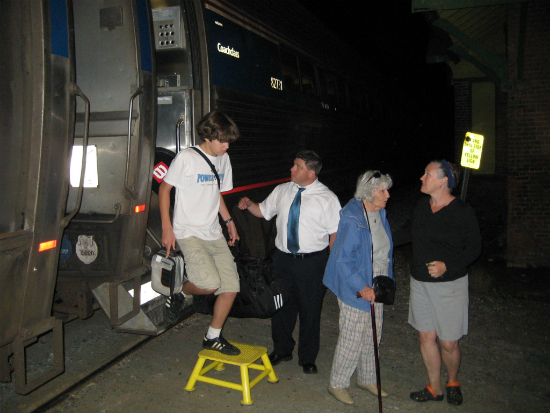
Source: Brookings. 3.1.2013 PHOTOS: Fair Haven, Vermont, station on the Ethan Allen line. Vermont Business Magazine file photos.
-->