

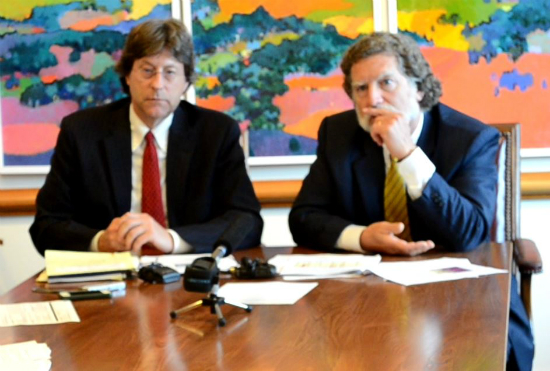
Vermont economists Jeff Carr, for the administration, and Tom Kavet, for the Legislature, wore matching suits and had matching revenue forecasts at Tuesday afternoon's regular July Emergency Board meeting. The only thing different was the color of their ties and the more subdued economic outlook than the one Governor Shumlin has suggested. The governor sees the 7.7 percent growth in last year's General Fund revenues (fiscal year 2013 over 2012 and 2 percent above projections), the $26.1 million surplus and the state's 4.4 percent unemployment rate (the fourth lowest in the nation and lowest east of the Mississippi) as reasons for the state to feel relatively good about the direction of the economy.
Carr and Kavet agreed all that was good, but still see slow growth for the foreseeable future. They also said that some of the revenues from last year was due to "profit taking" by taxpayers last winter, who feared that the capital gains tax would raise. It didn't. But that windfall in FY13 is expected to lower the take in FY2014, which began July 1.
Governor Shumlin chairs the E-Board. To his right is Representative Martha Heath, (D-Westford), Senator Tim Ashe (D/P-Chittenden), and Treasurer Beth Pearce.
The governor, whose upbeat view of things is one of his hallmarks, said, "Vermont's on the right track."
FY13 ended on June 30 with General Fund revenues of $1.2886 billion, up 7.7 percent. The economists forecast that FY 2014 will increase 2.8 percent to $1.3242 billion and will gain another 5.5 percent in FY 2015 to $1.397.1.
Noting that the corporate income tax is playing a larger and larger role in the state's revenues, but that it includes many fewer participants than the personal income tax, urged the governor and legislators (the E-Board consists of the governor and the heads of the four legislative money committees) to keep ahead of the reserve funds, something that the governor has urged legislators to do.
"If you have more volatility," Kavet said, "you'd want to have more in the reserve fund."
Administration Secretary Jeb Spaulding then pointed out that $6.25 million of that $26.1 million surplus is, indeed, earmarked for a Rainy Day fund, which is a special reserve fund. The reserve funds act to smooth out cash flow and support gaps in revenue. Vermont adherence to a healthy reserve fund has also kept its bond rating high.
Kavet, in his written economic review, said: "Reflecting a continued lack of policy consensus in Washington, monetary policy (the Federal Reserve Bank) is at full throttle while fiscal policy (sequestration) is firmly applying the brakes -- leaving the US economy struggling to attain takeoff speed. With offsetting economic effects, these contradictory policies have left job growth in low gear and frustrated achievement of potential economic growth and full employment. In accord with this trudging recovery, FY14 State revenue growth (excluding T-Fund tax increases enacted in the recent legislative session) is expected to be subdued before accelerating in FY15.
"State revenues across all three major funds closed FY13 about 1.5 percent above expectations, due primarily to exceptionally strong April income tax receipts. Relative to prior January 2013 projections, recent tax law changes will add about $20 million per year to future Transportation Fund revenues, while only minor adjustment were made to both the General and Education Funds."
The T-Funds (Transportation Funds) reference is to the Legislature in this past session, in a somewhat emergency move of their own, reconfigured the gasoline tax to adjust to the "new normal" of driving habits. People are driving less and are driving more fuel-efficient vehicles. The old method of collecting gasoline taxes was to simply tax individual gallons sold, but with fewer gallons sold the tax revenues were not keeping up with the demands of repairing roads and bridges. So along with a per gallon charge, there is also a sales tax on the total fill up. It took effect in the spring.
This, the economists said, has increased revenues to the T-Fund and made it a bit more complex in forecasting transportation revenues. Some of those revenues also filter into the Education Fund.
While Jeff Carr commented that more robust economic growth always seems to be forecast for sometime in the future, one important trend suggesting such is consumer confidence.
Carr wrote: "Much of the optimism centers on improving consumer sentiment (and what that means for consumption, which is roughly two-thirds of the US economy) and the fact that the threats to the US upturn, at least those caused by an uncertain fiscal policy direction which were so prevalent a year ago, appear to have begun fading into the background)."